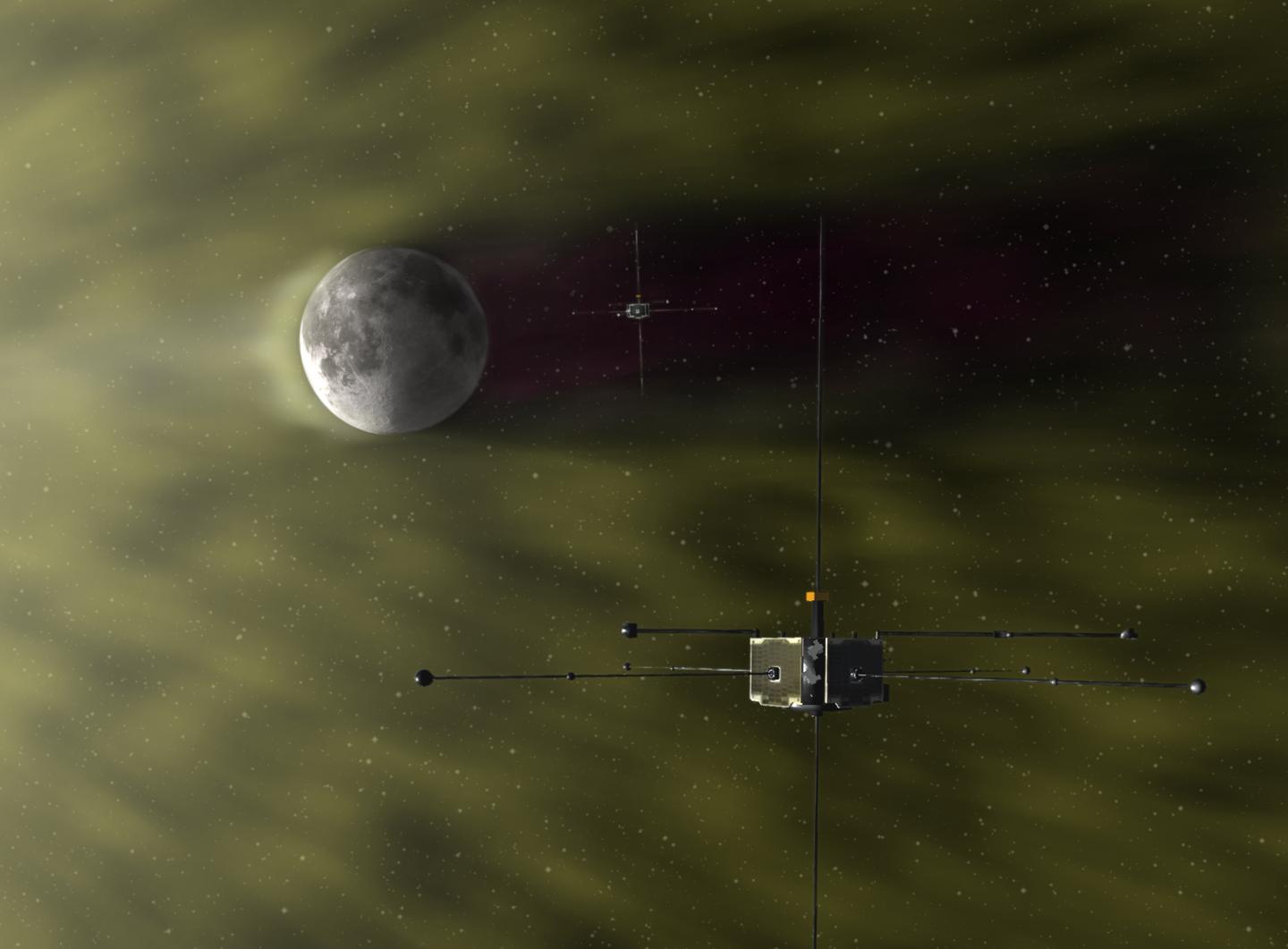
Credit: E. Masongsong, UCLA EPSS
By 2024, NASA will land astronauts, including the first woman and next man, on the Moon as part of the Artemis lunar exploration program. This won’t be the first time NASA takes the name Artemis to the Moon though. Two robotic spacecraft orbiting the Moon today were initially known as ARTEMIS — short for Acceleration, Reconnection, Turbulence and Electrodynamics of the Moon’s Interaction with the Sun. Since 2011, these spacecraft have been sending scientists valuable information about the lunar environment, and laying groundwork critical to returning humans to the Moon.
The mission, now renamed THEMIS-ARTEMIS, uses spacecraft that were originally apart of the mission known as Time History of Events and Macroscale Interactions during Substorms, or THEMIS, for short, which launched five spacecraft in 2007 to discover the physical processes that occurred during the events that cause the auroras.
“THEMIS-ARTEMIS has been a pathfinder for technologies that will be important for NASA’s new Artemis program,” said Jasper Halekas, THEMIS-ARTEMIS scientist and researcher at the University of Iowa in Iowa City. “Some of the work we’ve done in terms of navigation and operations will be used by future missions.”
One Mission into Two
The five THEMIS spacecraft were sent into carefully designed orbits that brought them in alignment every four days. After two productive years of discoveries about radiation and particles in the near-Earth environment, the spacecrafts’ orbits had significantly precessed, or drifted. Orbit precession is a natural and expected phenomenon for spacecraft that typically doesn’t affect scientific studies. But in the case of THEMIS, it meant the spacecraft would no longer align every four days.
Knowing the orbits would eventually precess, the THEMIS scientists, in a joint effort coordinated through NASA and the Space Sciences Lab at the University of California, Berkeley, decided in advance to do something new with two of the spacecraft. Instead of spending the remaining fuel to reset the orbits, they’d send them off in a radically new direction — to the Moon.
“NASA’s Jet Propulsion Laboratory and Goddard Space Flight Center did some wonderful orbit navigation design for us and came up with these very clever orbits that allowed us to get to the Moon,” Halekas said. “And we’re still there.”
Thus, the THEMIS-ARTEMIS mission was born. The mission’s acronym was created to reflect its science and position at the Moon, since in Greek mythology, Artemis was goddess of the Moon. Artemis was also the twin of Apollo. NASA Administrator Jim Bridenstine recently named the new lunar program Artemis for these reasons, plus the fact that the agency will send the first woman to the Moon as part of the program.
“THEMIS-ARTEMIS is NASA’s only long-term monitor of conditions in and around the lunar environment,” said David Sibeck, THEMIS project scientist at NASA’s Goddard Space Flight Center in Greenbelt, Maryland.
Spacecraft Reborn
With the same instruments it used to look for events around Earth, the new mission uses the two spacecraft to learn about how the Moon interacts with the space around it.
“Before THEMIS-ARTEMIS was at the Moon, most people had the idea that the Moon was just a big rock in the sky and it didn’t interact a lot with its environment,” Halekas said. “The understanding that we’ve built up over the last eight years is that the Moon is really connected to the space environment around it. The space environment affects the Moon and vice versa.”
Over the years scientists have made discoveries about the solar wind and its impact on the Moon’s surface, interplanetary electromagnetic fields, the structure of the lunar interior, and the particles in the tenuous lunar atmosphere and ionosphere.
Working Together
In addition to furthering our understanding of the Moon, the measurements THEMIS-ARTEMIS has made will be useful for upcoming missions, including the Artemis program.
“When we’re designing robotic systems and systems for humans on the Moon, we have to understand the conditions they’ll be exposed to,” Halekas said. “The measurements from THEMIS-ARTEMIS have helped us find what those conditions are and how they change with time.”
THEMIS-ARTEMIS could provide real-time measurements of highly energetic particles that can be hazardous to spacecraft and astronauts. It will also provide valuable information for instruments placed on the lunar surface. Just like a weather satellite can provide information about incoming storms, THEMIS-ARTEMIS can give information about the space environment to help contextualize discoveries made on the surface.
“THEMIS-ARTEMIS would be a natural partner for any heliophysics mission that is sent to the Moon either on a spacecraft or on the lunar surface,” Sibeck said. “Both spacecraft are working just fine, taking their full sets of measurements, and could last for a very, very long time in that environment.”
As part of the Commercial Lunar Payload Services initiative under the Artemis program, NASA will send a suite of new instruments and technology demonstrations to study the Moon ahead of a human return. The first two lunar deliveries on commercial landers are targeted to launch in July 2021. While many of these investigations focus on lunar science, some hark back to THEMIS’s roots in the science of heliophysics, the study of the Sun’s interaction with the solar system. The Lunar Surface Electromagnetics Experiment, or LUSEE instrument, will look at electromagnetic phenomena on the lunar surface. The Lunar Environment heliospheric X-ray Imager, or LEXI instrument, will plant a telescope on the Moon to study the Earth’s magnetosphere and its interaction with the solar wind.
In the coming years, THEMIS-ARTEMIS, like the agency’s Lunar Reconnaissance Orbiter, will continue to provide valuable information to NASA as preparations continue to send astronauts forward to the Moon, and ultimately on to Mars.
###
By Mara Johnson-Groh
NASA’s Goddard Space Flight Center, Greenbelt, Md.
Media Contact
Mara Johnson-Groh
[email protected]
Original Source
https:/