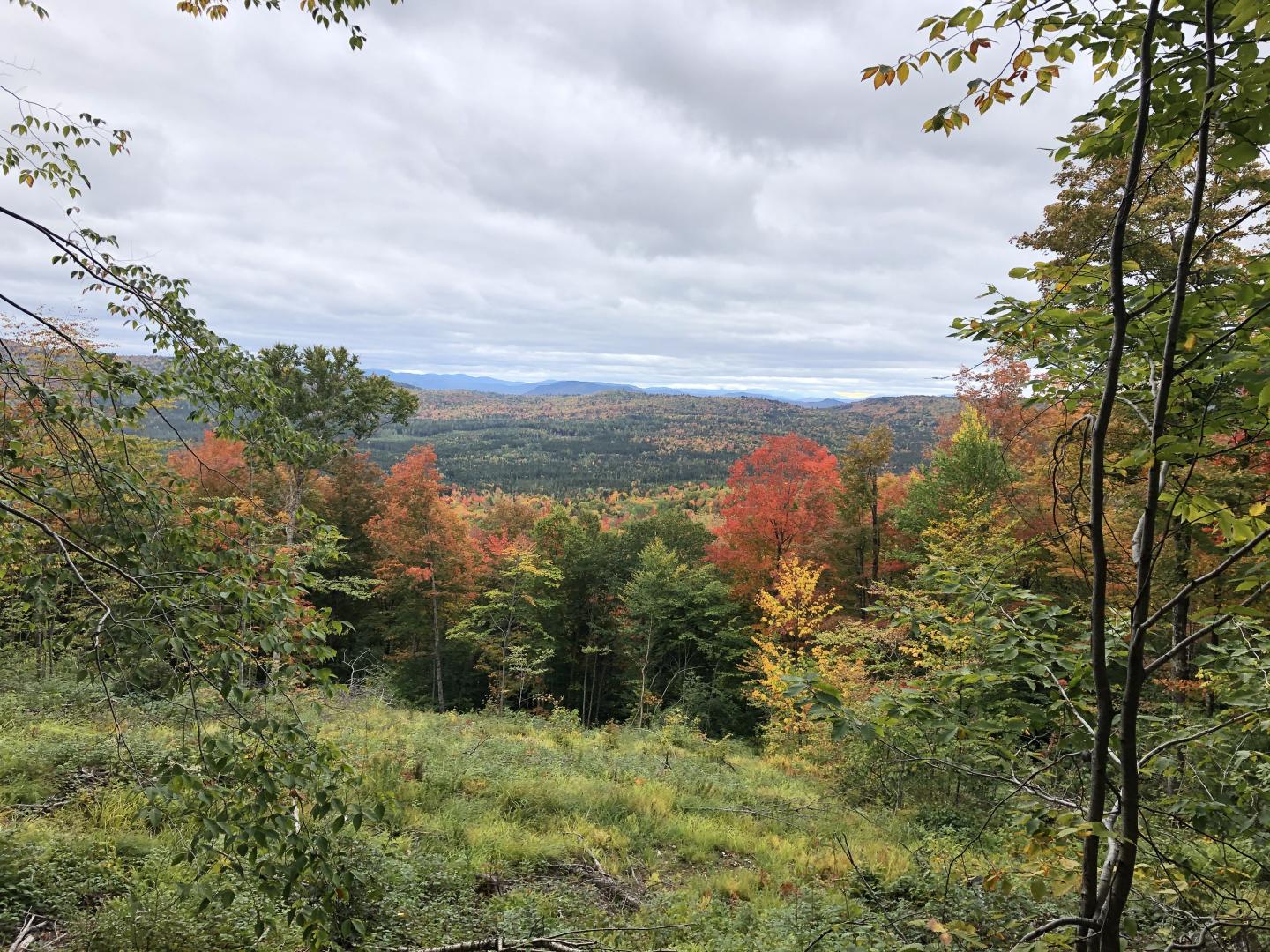
Credit: Photo by Genevieve Goebel
A Dartmouth-led study examining carbon stocks in an actively managed mixed wood forest in New Hampshire finds that places with more trees have more carbon stored in both the trees and the soil. The findings, published in Forest Ecology and Management, demonstrate the connection between above ground and below ground carbon, which has implications for forest management strategies.
Understanding how much carbon is housed in our forests, including in the soil, is important because forests capture and store carbon, which can help mitigate climate change by reducing the amount of carbon in the atmosphere. Historically, soil carbon has been less studied because it is easier to count and measure trees than it is to measure how much carbon is in the soil.
The study is one of the first to examine total carbon in an actively managed northeastern U.S. forest used for timber production. The research was conducted at two sites in northern New Hampshire within Dartmouth’s Second College Grant, Alder Brook and Merrill Brook. Both forest sites were harvested in the 1950s and 1960s and again in either the late 1990s or 2000s when an improvement cut was made. Alder Brook had one additional harvest in the 1970s. The researchers sought to identify how much carbon there is, where it is stored and how it varies from place to place. The team measured soil and trees from 96 study plots spread across each of the 80-hectare (or 200-acre) study areas. They estimated the total carbon stocks in the soil layers sampled, and analyzed how landscape elevation, soil moisture and pH, and vegetation impacted soil carbon data.
The results revealed that the managed forests at Alder Brook and Merrill Brook are rich in carbon stores (approximately 118,500 kilograms per hectare), even though they have been logged several times over the last century. To put these carbon stocks in another context, the authors estimate that a 40-acre forest (1/16 of a square mile) in northern New Hampshire contains about the same amount of carbon as 53,000 automobile tanks of gasoline (which contains about 634 grams per liter of carbon). Of the total carbon in the forests at the two sites, about 60 percent was stored in the trees and 40 percent in the soil. The researchers found that soil carbon was higher in subplots where there were more and bigger trees, especially if there were fir and spruce trees present in addition to hardwoods.
Alder Brook, which had one more forest harvest than the other site, had about 15 percent less soil carbon deeper in the soil (mineral soil) than Merrill Brook. This was consistent with other Dartmouth research showing that logging activities can decrease soil carbon in the forests. Yet, while Alder Brook had less mineral soil carbon, this forest had more carbon in its trees and shallower soil. As a result, there was no less carbon overall at Alder Brook, the site that had been logged an additional time.
“Understanding the overall story of carbon in the forest, including how much carbon is stored in deep soil and the mechanisms that allow it to stay there, is something that we as the science community are just beginning to understand,” explains lead author Fiona V. Jevon, a graduate student in Dartmouth’s Ecology, Evolution, Ecosystems, and Society program. “Our results indicate that the amount of carbon stored in the deep soil layer (mineral soil carbon) is relatively large. That carbon tends to be much slower to change and may be less vulnerable to loss,” she added.
“Our forests are our friends in terms of limiting atmospheric carbon dioxide,” says co-author Matthew Ayres, a professor of biological sciences and chair of the graduate program in ecology, evolution, ecosystems and society at Dartmouth. “This study shows that our northeastern forests can provide sustainable products such as lumber, pulp and fuel while still serving as reservoirs for lots of carbon, but the details depend on how forests are managed, and we need to keep getting better at that.”
The study’s results provide a baseline for soil carbon data at Alder Brook and Merrill Brook, which are part of a broader research effort throughout forests in the U.S. and Canada called Adaptive Silviculture for Climate Change that is examining the short- and long-term effects of co-developed forest adaptation strategies on sustaining forests into the future.
###
Available for comment are Fiona Jevon at [email protected] and Matthew Ayres at [email protected]. Anthony W. D’Amato at the University of Vermont, Christopher W. Woodall at the USDA Forest Service in Durham, N.H., and Jaclyn Hatala Matthews at Wellesley College, also served as co-authors of the study.
NOTE: The carbon equivalency presented in the fourth paragraph is based on the EPA’s calculator on Greenhouse Gas Emissions from a Typical Passenger Vehicle. The example provided is based on the assumption that there are 5.3 pounds of carbon per gallon of gasoline and 15 gallons per tank.
Media Contact
Amy D. Olson
[email protected]