• HOME
  • NEWS
  • EXPLORE
    • CAREER
      • Companies
      • Jobs
    • EVENTS
    • iGEM
      • News
      • Team
    • PHOTOS
    • VIDEO
    • WIKI
  • BLOG
  • COMMUNITY
    • FACEBOOK
    • INSTAGRAM
    • TWITTER
Saturday, March 28, 2026
BIOENGINEER.ORG
No Result
View All Result
  • Login
  • HOME
  • NEWS
  • EXPLORE
    • CAREER
      • Companies
      • Jobs
        • Lecturer
        • PhD Studentship
        • Postdoc
        • Research Assistant
    • EVENTS
    • iGEM
      • News
      • Team
    • PHOTOS
    • VIDEO
    • WIKI
  • BLOG
  • COMMUNITY
    • FACEBOOK
    • INSTAGRAM
    • TWITTER
  • HOME
  • NEWS
  • EXPLORE
    • CAREER
      • Companies
      • Jobs
        • Lecturer
        • PhD Studentship
        • Postdoc
        • Research Assistant
    • EVENTS
    • iGEM
      • News
      • Team
    • PHOTOS
    • VIDEO
    • WIKI
  • BLOG
  • COMMUNITY
    • FACEBOOK
    • INSTAGRAM
    • TWITTER
No Result
View All Result
Bioengineer.org
No Result
View All Result
Home NEWS Science News Chemistry

Why some greens turn brown in historical paintings 

Bioengineer by Bioengineer
October 2, 2019
in Chemistry
Reading Time: 2 mins read
0
IMAGE
Share on FacebookShare on TwitterShare on LinkedinShare on RedditShare on Telegram

IMAGE

Credit: Adapted from Inorganic Chemistry 2019, DOI: 10.1021/acs.inorgchem.9b02007

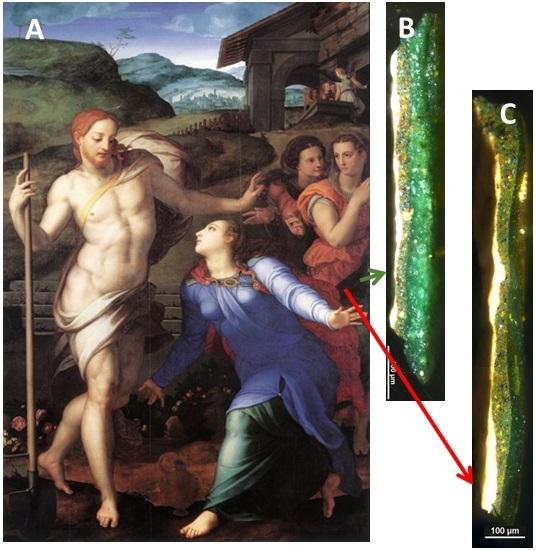
Enticed by the brilliant green hues of copper acetate and copper resinate, some painters in the Renaissance period incorporated these pigments into their masterpieces. However, by the 18th century, most artists had abandoned the colors because of their tendency to darken with time. Now, researchers reporting in ACS’ journal Inorganic Chemistry have uncovered the chemistry behind the copper pigments’ color change.

Copper acetate (also known as verdigris) and copper resinate were used in European easel paintings between the 15th and 17th centuries. Artists typically mixed these pigments with linseed oil to make paint. Until now, scientists didn’t know why the green paints often turned brown with time, although they had some clues. Light exposure was thought to play a role because areas of paintings protected by frames remained green. Also, oxygen appeared to contribute to the darkening process, with the brown color spreading from cracks in the paint that exposed the underlying copper pigments to air. So Didier Gourier and colleagues wanted to analyze the chemical changes that occur in the paints upon light exposure.

The team determined that the molecular structures of copper acetate and copper resinate were quite similar: Both had two copper atoms bridged by four carboxylate groups, but there was more space between resinate than acetate molecules. The researchers mixed the pigments with linseed oil and spread them in a thin layer. They then exposed the paint films to 16 hours of 320-mW LED light, which corresponded to hundreds of years of museum light. This illumination caused bridging molecules between the pair of copper atoms to be lost, which were then replaced by an oxygen molecule, creating bimetallic copper molecules responsible for the brown color. This process occurred more readily for copper resinate than for copper acetate. Boiling the linseed oil before mixing, which some artists did to improve the drying process, slowed the darkening reaction.

###

The authors acknowledge funding from the French Foundation for Cultural Heritage Sciences and LabEx Patrima.

The abstract that accompanies this study is available here.

The American Chemical Society, the world’s largest scientific society, is a not-for-profit organization chartered by the U.S. Congress. ACS is a global leader in providing access to chemistry-related information and research through its multiple databases, peer-reviewed journals and scientific conferences. ACS does not conduct research, but publishes and publicizes peer-reviewed scientific studies. Its main offices are in Washington, D.C., and Columbus, Ohio.

To automatically receive news releases from the American Chemical Society, contact [email protected].

Follow us on Twitter | Facebook

Media Contact
Katie Cottingham
[email protected]

Related Journal Article

http://dx.doi.org/10.1021/acs.inorgchem.9b02007

Tags: AnthropologyArts/CultureChemistry/Physics/Materials SciencesHistory
Share12Tweet8Share2ShareShareShare2

Related Posts

Isolated H2-Reduced Clusters Boost CO2-to-Methanol Catalysis

Isolated H2-Reduced Clusters Boost CO2-to-Methanol Catalysis

March 25, 2026
blank

Physicists Identify Electronic Drivers Behind Flat Band Quantum Materials

March 21, 2026

Würzburg Chemistry Professor Claudia Höbartner Receives Prestigious Honor

March 20, 2026

Scientists Reveal How Magnets Control Metamaterial Behavior

March 20, 2026
Please login to join discussion

POPULAR NEWS

  • blank

    Revolutionary AI Model Enhances Precision in Detecting Food Contamination

    96 shares
    Share 38 Tweet 24
  • Imagine a Social Media Feed That Challenges Your Views Instead of Reinforcing Them

    1004 shares
    Share 397 Tweet 248
  • Uncovering Functions of Cavernous Malformation Proteins in Organoids

    54 shares
    Share 22 Tweet 14
  • Promising Outcomes from First Clinical Trials of Gene Regulation in Epilepsy

    51 shares
    Share 20 Tweet 13

About

We bring you the latest biotechnology news from best research centers and universities around the world. Check our website.

Follow us

Recent News

In-Sensor Cryptography Links Physical Process to Digital Identity

Can Psychosocial Factors Influence Cancer Risk?

Depression Factors in Elderly: Pre vs. Post-COVID Analysis

Subscribe to Blog via Email

Enter your email address to subscribe to this blog and receive notifications of new posts by email.

Join 78 other subscribers
  • Contact Us

Bioengineer.org © Copyright 2023 All Rights Reserved.

Welcome Back!

Login to your account below

Forgotten Password?

Retrieve your password

Please enter your username or email address to reset your password.

Log In
No Result
View All Result
  • Homepages
    • Home Page 1
    • Home Page 2
  • News
  • National
  • Business
  • Health
  • Lifestyle
  • Science

Bioengineer.org © Copyright 2023 All Rights Reserved.