An ultra-fast optical way to extract critical information from quantum materials
Credit: Illustration: MBI
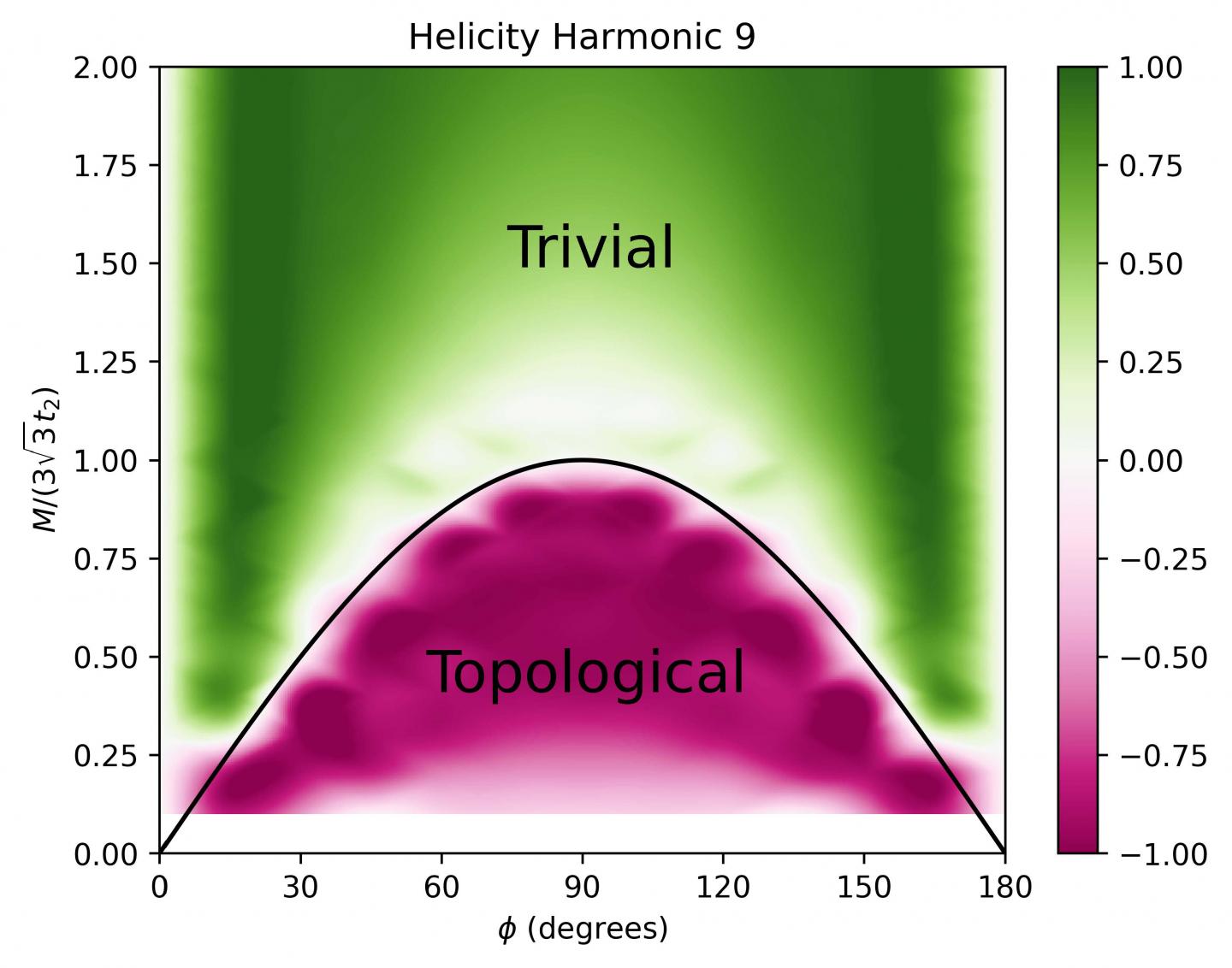
Topological insulators are quantum materials, which, due to their exotic electronic structure, on surfaces and edges conduct electric current like metal, while acting as an insulator in bulk. Scientists from the Max-Born Institute for Nonlinear Optics and Short Pulse Spectroscopy (MBI) have demonstrated for the first time how to tell apart topological materials from their regular – trivial – counterparts within a millionth of a billionth of a second by probing it with ultra-fast laser light. Their method could open the way for such materials to be used as logic elements in light-controlled electronics able to process information tens of thousands times faster as currently possible. Their study appeared in Nature Photonics.
The most common illustration of the topology concept involves an elastic pretzel, which can be stretched, bent, or twisted in any way; no matter the deformation, it is impossible to make a bagel out of a pretzel or add holes to it, without tearing it apart. The number of holes in a pretzel is thus invariant and provides topological information about the pretzel shape.
In a solid material, quantum-mechanical laws restrict which energies electrons can have, leading to the formation of bands with either allowed or forbidden energies. Using the concept of topology, physicists can describe complex shapes of allowed energy bands and assign them a specific topological number. A special topology of the band structure in a material system manifests itself in exotic properties that can be observed – such as the surface conductivity in topological insulators.
“The most remarkable aspect of topology is its robustness: properties induced by topology are protected by it,” explains one of the two main authors of the article Dr. Alvaro Jimenez-Galan from MBI. In the same way that we cannot change the number of holes in a pretzel without breaking it, impurities and other perturbations that usually disrupt the ability of the material to conduct electricity do not affect high electron mobility on the surface of topological insulators. The immunity to impurities is the reason why topological materials strongly appeal to electronic industries.
Making electrons “speak” about topology
Although the topology of the system is deeply linked to the behavior of electrons in it, the imprint of topological properties on electron dynamics at the time scale of a millionth of a billionth of a second has not been discovered up to now. By using numerical simulations and theoretical analysis, the group from MBI has proved that information about system topology is indeed encoded in this extremely fast electron dynamics and can be retrieved by looking at light emitted by electrons as they are excited with laser light. “If we imagine the electrons in a solid moving within energy bands as runners on the racing track, then our method allows to learn about the topology of this racing track, by simply measuring the acceleration of the runners,” clarifies Prof. Dr. Olga Smirnova, head of an MBI Theory group. The ultra-short laser pulses excite electrons of the system, making them hop from one energy band to a higher one, accelerating them on the new track. The accelerated electrons then emit light and quickly fall back to the lower position. This process lasts merely an infinitesimal part of a second but is enough for an electron to “feel” the fine difference between the energy structures of trivial and topological insulators and “encode” this information into the emitted light.
On the way toward ultrafast lightwave electronics
The current work demonstrates how to distinguish between trivial and topological insulators at an ultra-fast rate, in other words, to “read out” the topological information of the system using laser spectroscopy. For the next step, the MBI researchers plan to use this knowledge to convert a trivial insulator into a topological and vice versa with laser light – that is to “write” the topological information into a material at a similar rate. The theoretical proof of this effect could bring forward the implementation of topological materials in optically-controlled electronics, where only the speed of electronic response to light defines the limit for the speed of information processing.
###
Media Contact
Alvaro Jimenez-Galan
[email protected]
Original Source
https:/
Related Journal Article
http://dx.