• HOME
  • NEWS
  • EXPLORE
    • CAREER
      • Companies
      • Jobs
    • EVENTS
    • iGEM
      • News
      • Team
    • PHOTOS
    • VIDEO
    • WIKI
  • BLOG
  • COMMUNITY
    • FACEBOOK
    • INSTAGRAM
    • TWITTER
Saturday, February 7, 2026
BIOENGINEER.ORG
No Result
View All Result
  • Login
  • HOME
  • NEWS
  • EXPLORE
    • CAREER
      • Companies
      • Jobs
        • Lecturer
        • PhD Studentship
        • Postdoc
        • Research Assistant
    • EVENTS
    • iGEM
      • News
      • Team
    • PHOTOS
    • VIDEO
    • WIKI
  • BLOG
  • COMMUNITY
    • FACEBOOK
    • INSTAGRAM
    • TWITTER
  • HOME
  • NEWS
  • EXPLORE
    • CAREER
      • Companies
      • Jobs
        • Lecturer
        • PhD Studentship
        • Postdoc
        • Research Assistant
    • EVENTS
    • iGEM
      • News
      • Team
    • PHOTOS
    • VIDEO
    • WIKI
  • BLOG
  • COMMUNITY
    • FACEBOOK
    • INSTAGRAM
    • TWITTER
No Result
View All Result
Bioengineer.org
No Result
View All Result
Home NEWS Science News Chemistry

Combining cheap and safe black and white materials creates colorful pigments

Bioengineer by Bioengineer
September 26, 2019
in Chemistry
Reading Time: 2 mins read
0
IMAGE
Share on FacebookShare on TwitterShare on LinkedinShare on RedditShare on Telegram

IMAGE

Credit: Yukikazu Takeoka

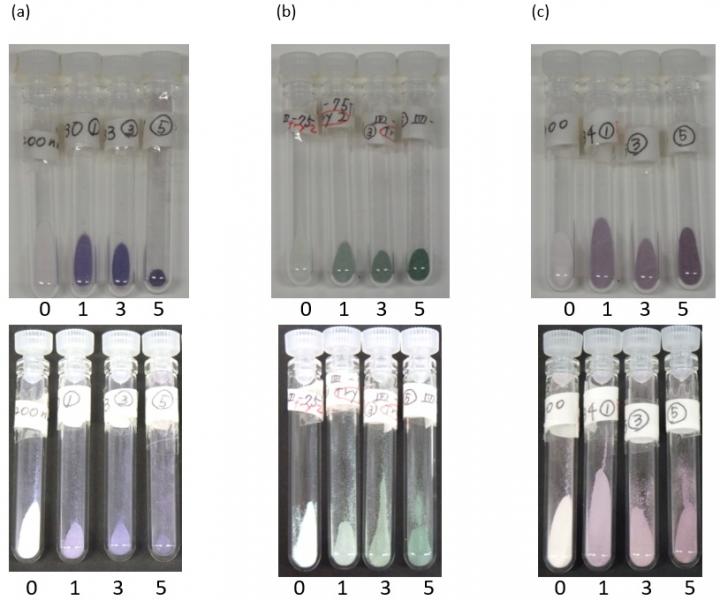
In response to worldwide concern over the adverse effects of chemical substances on human health and the environment, most developed countries have legally restricted the use of dyes containing heavy metals or carcinogenic organic compounds; thus, replacing such color materials with safer substances is an urgent issue. Motivated by this, a Nagoya University research group has found that pigments of various colors can be obtained by combining fine silica particles (white powder) and a complex of iron and tannic acid (black compound), both of which are inexpensive and harmless substances used for foods and cosmetics. The pigments are expected to be an alternative to conventional harmful color materials. This study was reported in ACS Sustainable Chemistry & Engineering on August 8, 2019.

Some conventionally used pigments and dyes contain heavy metals and are carcinogenic, bringing about the need to replace them with cheaper and safer colorants. In this research, the group prepared safe and inexpensive pigments using fine particles based on silica, which is abundant on earth, and tannin iron (Fe-TA), derived from tannic acid (TA) and iron (Fe) obtained from plants. By changing the size of the fine particles composed of silica and iron tannate, the resulting color can be changed. In addition, the angular dependence of the resulting color can be reduced by changing the aggregate state of the particles. Moreover, the presence of TA increases the mechanical stability of the pigment and improves its adhesion to the glass substrate, making it suitable for coating applications.

The lead author says, “In our daily lives, pigments and dyes that absorb part of the visible spectrum and scatter or transmit other colors of light are widely used. However, the natural world contains not only pigments and dyes of this kind, but also structurally colored materials, which display vivid colors because of the interaction of their fine structure with light. Considering that, there is no doubt that the safe and inexpensive structurally colored pigments introduced in this study will be useful for everyday life.”

Structurally colored materials can display various colors based on the principle of the three primary colors of light. In addition, materials whose colors do not depend on the viewing angle can be prepared. In the future, the group expects that research on structurally colored materials will result in the development of safe and inexpensive colorants.

###

The article, “Colorful Photonic Pigments Prepared by Using Safe Black and White Materials,” was published in ACS Sustainable Chemistry & Engineering at DOI:10.1021/acssuschemeng.9b03165

Authors: Miki Sakai, Takahiro Seki, and Yukikazu Takeoka at the Graduate School of Engineering, Nagoya University, Japan

Media Contact
Yukikazu Takeoka
[email protected]

Related Journal Article

http://dx.doi.org/10.1021/acssuschemeng.9b03165

Tags: Chemistry/Physics/Materials SciencesMaterials
Share12Tweet8Share2ShareShareShare2

Related Posts

blank

Breakthrough in Environmental Cleanup: Scientists Develop Solar-Activated Biochar for Faster Remediation

February 7, 2026
blank

Cutting Costs: Making Hydrogen Fuel Cells More Affordable

February 6, 2026

Scientists Develop Hand-Held “Levitating” Time Crystals

February 6, 2026

Observing a Key Green-Energy Catalyst Dissolve Atom by Atom

February 6, 2026
Please login to join discussion

POPULAR NEWS

  • Robotic Ureteral Reconstruction: A Novel Approach

    Robotic Ureteral Reconstruction: A Novel Approach

    82 shares
    Share 33 Tweet 21
  • Digital Privacy: Health Data Control in Incarceration

    63 shares
    Share 25 Tweet 16
  • Study Reveals Lipid Accumulation in ME/CFS Cells

    57 shares
    Share 23 Tweet 14
  • Breakthrough in RNA Research Accelerates Medical Innovations Timeline

    53 shares
    Share 21 Tweet 13

About

We bring you the latest biotechnology news from best research centers and universities around the world. Check our website.

Follow us

Recent News

Barriers and Boosters of Seniors’ Physical Activity in Karachi

Evaluating Pediatric Emergency Care Quality in Ethiopia

TPMT Expression Predictions Linked to Azathioprine Side Effects

Subscribe to Blog via Email

Enter your email address to subscribe to this blog and receive notifications of new posts by email.

Join 73 other subscribers
  • Contact Us

Bioengineer.org © Copyright 2023 All Rights Reserved.

Welcome Back!

Login to your account below

Forgotten Password?

Retrieve your password

Please enter your username or email address to reset your password.

Log In
No Result
View All Result
  • Homepages
    • Home Page 1
    • Home Page 2
  • News
  • National
  • Business
  • Health
  • Lifestyle
  • Science

Bioengineer.org © Copyright 2023 All Rights Reserved.