Marshes grow shorter, denser stems under high carbon dioxide, which can help them resist sea level rise
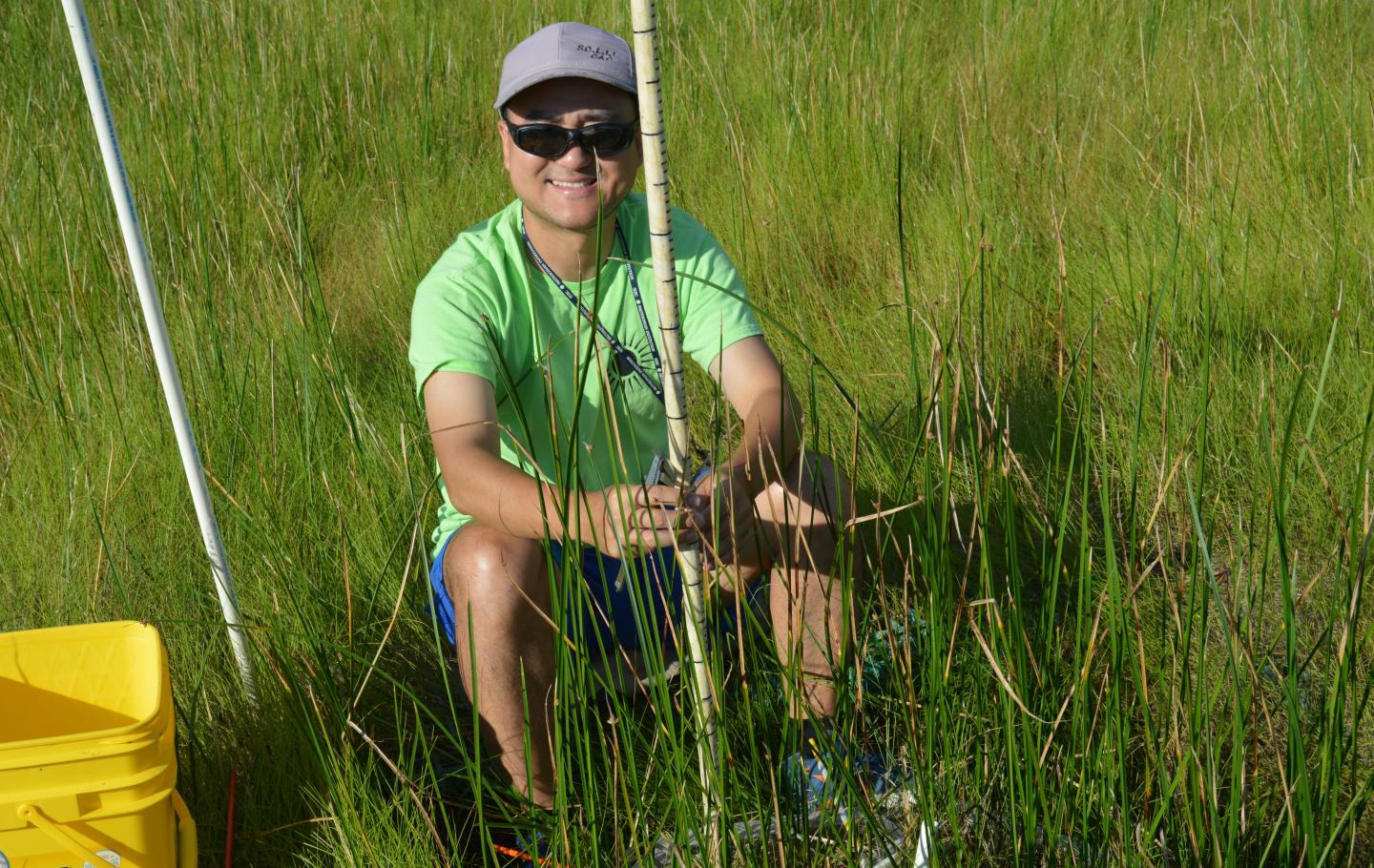
Credit: Maria Sharova/Smithsonian Environmental Research Center
For most plants, carbon dioxide acts like a steroid: The more they can take in, the bigger they get. But in a new study published Sept. 25, scientists with the Smithsonian discovered something strange happening in marshes. Under higher levels of carbon dioxide, instead of producing bigger stems, marsh plants produced more stems that were noticeably smaller.
“I don’t think anybody expected this,” said Meng Lu, lead author of the new study in Nature Climate Change. For years, scientists had known that carbon dioxide was bulking up the total biomass of marsh plants, so it seemed natural to think individual plants were getting bigger too.
“Everyone thought, okay, [plants] increased, biomass increased, so the height, width, all should increase. But that’s not the case in a marsh,” he said.
Lu, a research professor at China’s Yunnan University, made the discovery while a postdoc at the Smithsonian Environmental Research Center (SERC) in Maryland. He worked on a tidal marsh called the “Global Change Research Wetland,” home to one of the longest-running field experiments on climate change in the world. Inside experimental chambers, Smithsonian scientists have been raising carbon dioxide for more than 30 years. They are tracking how marsh plants grow in a world with carbon dioxide levels nearly twice as high as today–levels we could see by the end of the century.
Every year, scientists have harvested the plants in the chambers and measured their total biomass, stems, roots and other key traits. That gave Lu three decades of data to explore. After crunching the numbers, he realized that in the high-carbon dioxide chambers, the biomass of all the marsh sedges went up 20%. Richer carbon dioxide was spurring the marsh sedges to grow more stems in thicker clusters. But surprisingly, the individual stems had shrunk 16%.
The stems are shrinking because of another ingredient plants need to grow: nitrogen.
“If we get more carbon, we need more nitrogen to feed the plants,” Lu said. According to Lu, carbon dioxide and nitrogen are like food for plants. If carbon dioxide provides their sugar, nitrogen provides their protein. Without nitrogen, the extra injections of carbon dioxide will not spur the plants to grow bigger stems. Instead, the plants will spread their roots farther belowground, attempting to draw more nitrogen from the soil. And because most marsh plants are “clonal” (they can reproduce by making copies of themselves), they naturally send up more stems aboveground as their roots spread. This means more plants rather than bigger ones.
That is exactly what scientists saw happening in chambers where they increased only carbon dioxide. However, in chambers where they raised both carbon dioxide and nitrogen, the “shrinking stems” effect vanished. Plants were able to grow more stems and make those stems larger, thanks to the extra nitrogen.
“We knew that giving plants more nitrogen favors shoot growth over root growth, and vice-versa for carbon dioxide, but we never considered what this means for the numbers and sizes of plants,” said Pat Megonigal, a co-author and SERC senior scientist who oversees the Global Change Research Wetland. “We think that shrinking stems may be occurring in many other ecosystems with clonal plants.”
This may be good news for the marsh and for people living nearby. Having a thicker wall of stems–even shorter ones–buffs up the marsh’s defensive power. A dense marsh is good at absorbing energy from hurricanes and storms. Denser roots, another side effect of the high carbon dioxide, could be another plus. Roots enable a marsh to build soil. When a marsh builds soil, its entire elevation goes up, giving it a chance of outpacing sea level rise.
“Accelerating sea level rise is a threat to marshes worldwide,” Megonigal said. “The possibility that marshes will be able to trap more sediment at the same time is reason for a bit of optimism.”
###
Researchers from the Virginia Institute of Marine Science and Villanova University also contributed to this research. After publication, the paper will be available at https:/
Media Contact
Kristen Minogue
[email protected]
Related Journal Article
http://dx.