• HOME
  • NEWS
  • EXPLORE
    • CAREER
      • Companies
      • Jobs
    • EVENTS
    • iGEM
      • News
      • Team
    • PHOTOS
    • VIDEO
    • WIKI
  • BLOG
  • COMMUNITY
    • FACEBOOK
    • INSTAGRAM
    • TWITTER
Thursday, May 14, 2026
BIOENGINEER.ORG
No Result
View All Result
  • Login
  • HOME
  • NEWS
  • EXPLORE
    • CAREER
      • Companies
      • Jobs
        • Lecturer
        • PhD Studentship
        • Postdoc
        • Research Assistant
    • EVENTS
    • iGEM
      • News
      • Team
    • PHOTOS
    • VIDEO
    • WIKI
  • BLOG
  • COMMUNITY
    • FACEBOOK
    • INSTAGRAM
    • TWITTER
  • HOME
  • NEWS
  • EXPLORE
    • CAREER
      • Companies
      • Jobs
        • Lecturer
        • PhD Studentship
        • Postdoc
        • Research Assistant
    • EVENTS
    • iGEM
      • News
      • Team
    • PHOTOS
    • VIDEO
    • WIKI
  • BLOG
  • COMMUNITY
    • FACEBOOK
    • INSTAGRAM
    • TWITTER
No Result
View All Result
Bioengineer.org
No Result
View All Result
Home NEWS Science News Health

Predicting epileptic seizures might be more difficult than previously thought

Bioengineer by Bioengineer
September 24, 2019
in Health
Reading Time: 3 mins read
0
IMAGE
Share on FacebookShare on TwitterShare on LinkedinShare on RedditShare on Telegram

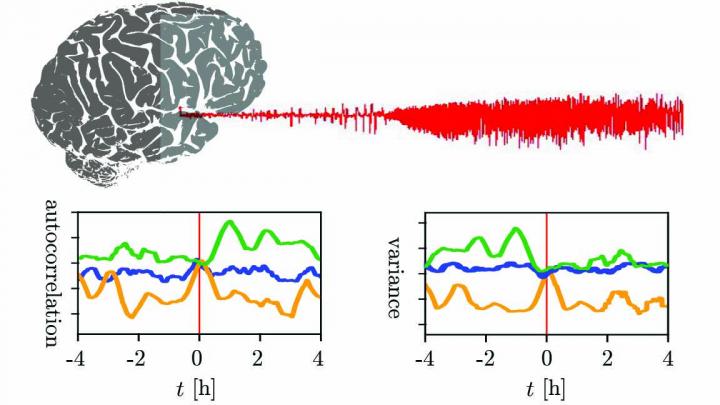
Scientists prove there is no evidence for a previously suspected warning sign for seizures
IMAGE

Credit: Klaus Lehnertz

WASHINGTON, D.C., September 24, 2019 — By studying the brain dynamics of 28 subjects with epilepsy, scientists demonstrated there is no evidence for a previously suspected warning sign for seizures known as “critical slowing down.”

In 2013, some of the first seizure-prediction devices were developed and successfully tested. Although extensive research efforts have successfully identified predictors of imminent seizures, the concept of critical slowing down as an index for seizure susceptibility has been controversial and remained unproven.

Critical slowing down refers to characteristic changes in the behavior of a complex system that approaches a theoretical tipping point. When this point is exceeded, it can lead to impactful and devastating changes. An epileptic human brain is considered an excellent example of a system such as this, due to the extreme and distressing nature of a seizure.

In a paper published in Chaos, from AIP Publishing, researchers investigated recordings of brain dynamics that captured 105 epileptic seizures using time-resolved estimates of early warning indicators of the seizures.

“In our investigations, we used the most prominent indicators and showed that critical slowing down prior to human epileptic seizures is not verifiable,” neurophysicist Thorsten Rings said. “This demonstrates that the concept underlying critical slowing down is too simple of a model for the human brain.”

Instead of critically slowing down, the researchers discovered the seizures acted oppositely and critically sped up, indicating the brain dynamics were less sensitive to changes and experienced a faster return to an unperturbed state.

“Similar indicators of critical slowing down can even be observed in relation to daily rhythms, such as sleeping and waking, but we lack clear-cut evidence for critical slowing down preceding such changes,” researcher Theresa Wilkat said. “Therefore, it is hard to clearly distinguish between a critical transition into a seizure and a critical transition into other states.”

An in-depth model of the transition into a seizure is still missing, but considering their research, Klaus Lehnertz and his team said the concept of critical slowing down is insufficient as a predictive method. They believe future studies should develop improved models and analysis techniques.

“A promising future approach might be to investigate how seizures emerge from large-scale brain networks by taking into account their time-varying structure and function,” Lehnertz said.

###

The article, “No evidence for critical slowing down prior to human epileptic seizures,” is authored by Theresa Wilkat, Thorsten Rings and Klaus Lehnertz. The article will appear in Chaos on Sept. 24, 2019 (DOI: 10.1063/1.5122759). After that date, it can be accessed at http://aip.scitation.org/doi/full/10.1063/1.5122759.

ABOUT THE JOURNAL

Chaos is devoted to increasing the understanding of nonlinear phenomena in all areas of science and engineering and describing their manifestations in a manner comprehensible to researchers from a broad spectrum of disciplines. See https://aip.scitation.org/journal/cha.

Media Contact
Larry Frum
[email protected]

Related Journal Article

http://dx.doi.org/10.1063/1.5122759

Tags: BiologyBiomechanics/BiophysicsChemistry/Physics/Materials SciencesDiagnosticsMedicine/Healthneurobiology
Share12Tweet8Share2ShareShareShare2

Related Posts

UofL Pediatrics Researcher Discovers Novel Signaling Mechanism Linked to Anxiety and Overgrooming

May 14, 2026
New Study Finds No Evidence Linking First Trimester Pain Reliever Use to Birth Defects — Medicine

New Study Finds No Evidence Linking First Trimester Pain Reliever Use to Birth Defects

May 14, 2026

Absolute Quantification of IgG Glycans Unlocks New Avenue for Predicting Biological Age

May 14, 2026

Engineered Bacteria in Implantable Living Materials Enable Autonomous Therapeutic Delivery

May 14, 2026
Please login to join discussion

POPULAR NEWS

  • Research Indicates Potential Connection Between Prenatal Medication Exposure and Elevated Autism Risk

    842 shares
    Share 337 Tweet 211
  • New Study Reveals Plants Can Detect the Sound of Rain

    729 shares
    Share 291 Tweet 182
  • Salmonella Haem Blocks Macrophages, Boosts Infection

    62 shares
    Share 25 Tweet 16
  • Breastmilk Balances E. coli and Beneficial Bacteria in Infant Gut Microbiomes

    57 shares
    Share 23 Tweet 14

About

We bring you the latest biotechnology news from best research centers and universities around the world. Check our website.

Follow us

Recent News

UofL Pediatrics Researcher Discovers Novel Signaling Mechanism Linked to Anxiety and Overgrooming

New Study Finds No Evidence Linking First Trimester Pain Reliever Use to Birth Defects

Absolute Quantification of IgG Glycans Unlocks New Avenue for Predicting Biological Age

Subscribe to Blog via Email

Enter your email address to subscribe to this blog and receive notifications of new posts by email.

Join 82 other subscribers
  • Contact Us

Bioengineer.org © Copyright 2023 All Rights Reserved.

Welcome Back!

Login to your account below

Forgotten Password?

Retrieve your password

Please enter your username or email address to reset your password.

Log In
No Result
View All Result
  • Homepages
    • Home Page 1
    • Home Page 2
  • News
  • National
  • Business
  • Health
  • Lifestyle
  • Science

Bioengineer.org © Copyright 2023 All Rights Reserved.