• HOME
  • NEWS
  • EXPLORE
    • CAREER
      • Companies
      • Jobs
    • EVENTS
    • iGEM
      • News
      • Team
    • PHOTOS
    • VIDEO
    • WIKI
  • BLOG
  • COMMUNITY
    • FACEBOOK
    • INSTAGRAM
    • TWITTER
Saturday, February 7, 2026
BIOENGINEER.ORG
No Result
View All Result
  • Login
  • HOME
  • NEWS
  • EXPLORE
    • CAREER
      • Companies
      • Jobs
        • Lecturer
        • PhD Studentship
        • Postdoc
        • Research Assistant
    • EVENTS
    • iGEM
      • News
      • Team
    • PHOTOS
    • VIDEO
    • WIKI
  • BLOG
  • COMMUNITY
    • FACEBOOK
    • INSTAGRAM
    • TWITTER
  • HOME
  • NEWS
  • EXPLORE
    • CAREER
      • Companies
      • Jobs
        • Lecturer
        • PhD Studentship
        • Postdoc
        • Research Assistant
    • EVENTS
    • iGEM
      • News
      • Team
    • PHOTOS
    • VIDEO
    • WIKI
  • BLOG
  • COMMUNITY
    • FACEBOOK
    • INSTAGRAM
    • TWITTER
No Result
View All Result
Bioengineer.org
No Result
View All Result
Home NEWS Science News Chemistry

Over 14% efficiency for ternary organic solar cell with 300 nm thick active layer

Bioengineer by Bioengineer
September 18, 2019
in Chemistry
Reading Time: 2 mins read
0
IMAGE
Share on FacebookShare on TwitterShare on LinkedinShare on RedditShare on Telegram

IMAGE

Credit: ©Science China Press

Organic solar cells (OSCs) have drawn great attention due to their advantages of making large area and flexible solar panels through the low-cost solution coating methods. Recently, the single-junction OSCs with over 16% power conversion efficiency (PCE) have been reported. However, photovoltaic performance of these cells is very sensitive to the variation in the active layer thickness, which has been recognized as a big challenge for practical application of OSCs.

The photovoltaic performance of OSCs is determined by open-circuit voltage (VOC), short-circuit current density (JSC) and fill factor (FF). For the current high efficiency non-fullerene-based system, the efficiency of OSCs usually shows a sharp drop in FF upon increasing the thickness of the active layer. Such FF drops are generally caused by poor and imbalanced charge transport, which results in enhanced bimolecular charge recombination and the formation of space charge in thicker films.

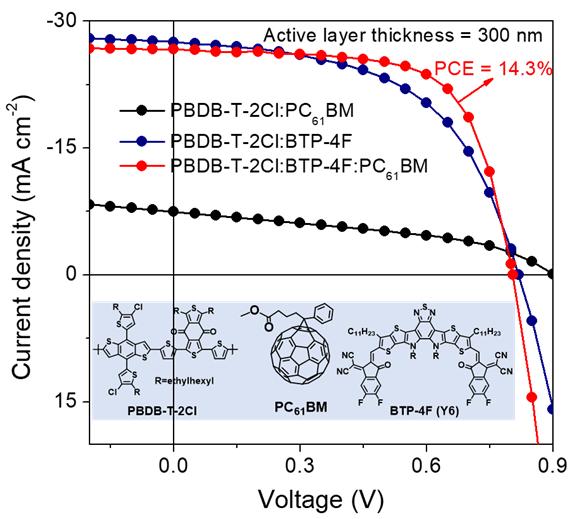
Very recently, Professor Jianhui Hou’s group in Institute of Chemistry Chinese Academy of Sciences demonstrated a thick-film (300 nm) ternary OSC with a power conversion efficiency of 14.3%. This excellent photovoltaic performance is achieved by introducing phenyl-C61-butyric-acid-methyl ester (PC61BM) into a PBDB-T-2Cl: BTP-4F host blend. They found that the addition of PC61BM is helpful for improving the hole and electron mobilities, and thus facilitates charge transport in the thick active layers, leading to the improved efficiencies of OSCs. Their results illustrate that introducing fullerene derivative as a third component is a facile and effective strategy to realize efficient thick-film OSCs.

###

This work was supported by the National Natural Science Foundation of China (21835006, 21704004, 91633301, 51673201), the Chinese Academy of Sciences (KJZD-EW-J01), the Innovation Project supported by Beijing National Laboratory for Molecular Sciences (BNLMS-CXXM-201903)

See the article: Ma L, Xu Y, Zu Y, Liao Q, Xu B, An C, Zhang S, Hou J. A ternary organic solar cell with 300 nm thick active layer shows over 14% efficiency. Sci. China Chem., 2019, 62, DOI: 10.1007/s11426-019-9556-7.

https://link.springer.com/article/10.1007/s11426-019-9556-7

Media Contact
Shaoqing Zhang
[email protected]

Related Journal Article

http://dx.doi.org/10.1007/s11426-019-9556-7

Tags: Chemistry/Physics/Materials Sciences
Share13Tweet8Share2ShareShareShare2

Related Posts

blank

Breakthrough in Environmental Cleanup: Scientists Develop Solar-Activated Biochar for Faster Remediation

February 7, 2026
blank

Cutting Costs: Making Hydrogen Fuel Cells More Affordable

February 6, 2026

Scientists Develop Hand-Held “Levitating” Time Crystals

February 6, 2026

Observing a Key Green-Energy Catalyst Dissolve Atom by Atom

February 6, 2026
Please login to join discussion

POPULAR NEWS

  • Robotic Ureteral Reconstruction: A Novel Approach

    Robotic Ureteral Reconstruction: A Novel Approach

    82 shares
    Share 33 Tweet 21
  • Digital Privacy: Health Data Control in Incarceration

    63 shares
    Share 25 Tweet 16
  • Study Reveals Lipid Accumulation in ME/CFS Cells

    57 shares
    Share 23 Tweet 14
  • Breakthrough in RNA Research Accelerates Medical Innovations Timeline

    53 shares
    Share 21 Tweet 13

About

We bring you the latest biotechnology news from best research centers and universities around the world. Check our website.

Follow us

Recent News

Phage-Antibiotic Combo Beats Resistant Peritoneal Infection

Boosting Remote Healthcare: Stepped-Wedge Trial Insights

Barriers and Boosters of Seniors’ Physical Activity in Karachi

Subscribe to Blog via Email

Enter your email address to subscribe to this blog and receive notifications of new posts by email.

Join 73 other subscribers
  • Contact Us

Bioengineer.org © Copyright 2023 All Rights Reserved.

Welcome Back!

Login to your account below

Forgotten Password?

Retrieve your password

Please enter your username or email address to reset your password.

Log In
No Result
View All Result
  • Homepages
    • Home Page 1
    • Home Page 2
  • News
  • National
  • Business
  • Health
  • Lifestyle
  • Science

Bioengineer.org © Copyright 2023 All Rights Reserved.