• HOME
  • NEWS
  • EXPLORE
    • CAREER
      • Companies
      • Jobs
    • EVENTS
    • iGEM
      • News
      • Team
    • PHOTOS
    • VIDEO
    • WIKI
  • BLOG
  • COMMUNITY
    • FACEBOOK
    • INSTAGRAM
    • TWITTER
Sunday, December 21, 2025
BIOENGINEER.ORG
No Result
View All Result
  • Login
  • HOME
  • NEWS
  • EXPLORE
    • CAREER
      • Companies
      • Jobs
        • Lecturer
        • PhD Studentship
        • Postdoc
        • Research Assistant
    • EVENTS
    • iGEM
      • News
      • Team
    • PHOTOS
    • VIDEO
    • WIKI
  • BLOG
  • COMMUNITY
    • FACEBOOK
    • INSTAGRAM
    • TWITTER
  • HOME
  • NEWS
  • EXPLORE
    • CAREER
      • Companies
      • Jobs
        • Lecturer
        • PhD Studentship
        • Postdoc
        • Research Assistant
    • EVENTS
    • iGEM
      • News
      • Team
    • PHOTOS
    • VIDEO
    • WIKI
  • BLOG
  • COMMUNITY
    • FACEBOOK
    • INSTAGRAM
    • TWITTER
No Result
View All Result
Bioengineer.org
No Result
View All Result
Home NEWS Science News Biology

North Atlantic haddock use magnetic compass to guide them

Bioengineer by Bioengineer
September 17, 2019
in Biology
Reading Time: 2 mins read
0
IMAGE
Share on FacebookShare on TwitterShare on LinkedinShare on RedditShare on Telegram

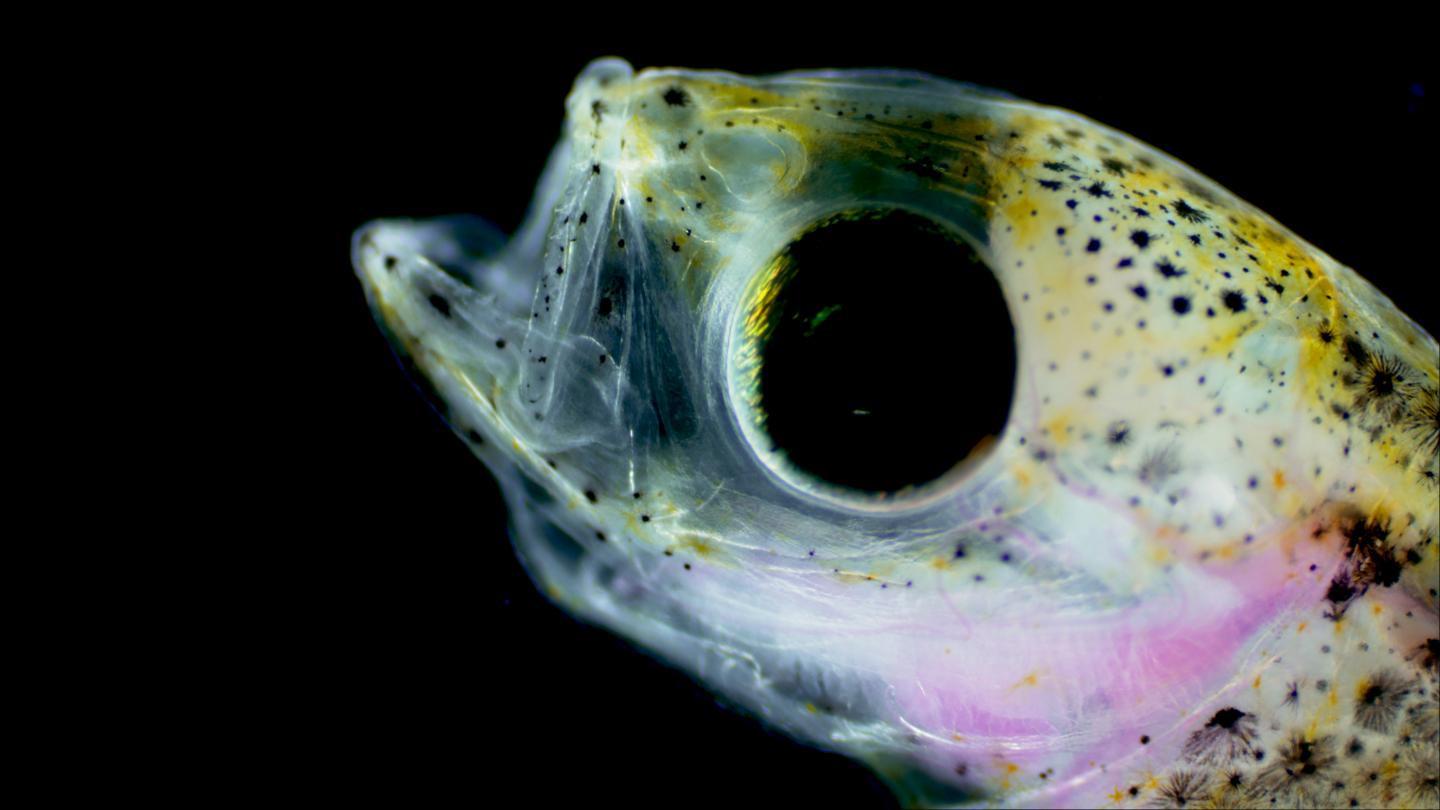
Study showed haddock larvae orient to the northwest at sea
IMAGE

Credit: Alessandro Cresci

MIAMI–A new study found that the larvae of haddock, a commercially important type of cod, have a magnetic compass to find their way at sea. The findings showed that haddock larvae orient toward the northwest using Earth’s magnetic field.

A team of scientists led by the University of Miami (UM) Rosenstiel School of Marine and Atmospheric Science and the Institute of Marine Research in Norway used a unique combination of experiments conducted in a magnetoreception test facility, or MagLab, and in a Norwegian fjord, a natural environment of Atlantic haddock larvae, to track their movements.

In the experiment, haddock larvae were first observed in a transparent behavioral chamber, known as a Drifting in situ Chamber and developed by UM Professor Claire Paris, to orient while drifting with the current under the environmental conditions that they would encounter at sea. The larvae were also tested in the MagLab, where the magnetic field to which they were exposed was then rotated such that the North-South and East-West were shifted by 90 degrees for each of the larvae.

They found that the larvae oriented to the magnetic northwest in the in situ chamber, and, although deprived of all other environmental cues, oriented towards the exact same magnetic direction in the MagLab.

“These results tell us that Atlantic haddock possess incredible orientation abilities from the earliest phase of their life, and that they have a sensitive magnetic compass,” said Alessandro Cresci, a Ph.D. student at the UM Rosenstiel School and first author of the paper. “The dispersal of haddock larvae could be much less passive than we have assumed in the past.”

“These microscopic haddock larvae were born in the hatchery and had never experienced life at sea, which suggests that magnetic orientation is in their DNA,” said Claire Paris, professor of ocean sciences at the UM Rosenstiel and senior author of the study. “The next step to understand the consequences of their magnetic guidance will be to measure their swimming speed.”

This discovery is an important step in better understanding the early-life stages of this commercially valuable fish, said the authors.

###

The study, titled “Atlantic haddock (Melanogrammus aeglefinus) larvae have a magnetic compass that guides their orientation,” was published this month in the Cell Press journal iScience. The study’s authors include Alessandro Cresci, Claire Paris, Matthew Foretich and C.J.E. O’Brien from the UM Rosenstiel School; and Caroline Durif, Steven Shema, Frode Vikebø, Anne-Berit Skiftesvik, and Howard Browman from the Institute of Marine Research’s Austevoll Research Station.

The study was supported by a grant from the Norwegian Institute of Marine Research and a National Science Foundation grant awarded to Paris.

Media Contact
Diana Udel
[email protected]

Original Source

https://news.miami.edu/rsmas/stories/2019/09/north-atlantic-haddock-use-magnetic-compass-to-guide-them.html

Related Journal Article

http://dx.doi.org/10.1016/j.isci.2019.09.001

Tags: BiologyFisheries/AquacultureMarine/Freshwater Biology
Share12Tweet8Share2ShareShareShare2

Related Posts

blank

Black Soldier Fly Larvae Boost African Catfish Growth

December 21, 2025
Gene Variations Enhance Beef Cattle Efficiency and Immunity

Gene Variations Enhance Beef Cattle Efficiency and Immunity

December 21, 2025

GBLUP vs. WGBLUP: Genomic Selection in Beef Cattle

December 21, 2025

Anopheles gambiae Habitat and Public Health in Osun

December 21, 2025
Please login to join discussion

POPULAR NEWS

  • Nurses’ Views on Online Learning: Effects on Performance

    Nurses’ Views on Online Learning: Effects on Performance

    70 shares
    Share 28 Tweet 18
  • NSF funds machine-learning research at UNO and UNL to study energy requirements of walking in older adults

    71 shares
    Share 28 Tweet 18
  • Unraveling Levofloxacin’s Impact on Brain Function

    54 shares
    Share 22 Tweet 14
  • Exploring Audiology Accessibility in Johannesburg, South Africa

    51 shares
    Share 20 Tweet 13

About

We bring you the latest biotechnology news from best research centers and universities around the world. Check our website.

Follow us

Recent News

MINFLUX Reveals Cardiac Ryanodine Receptor Structure in 3D

Antisense Therapy Reverses Developmental Defects in SMA Organoids

Black Soldier Fly Larvae Boost African Catfish Growth

Subscribe to Blog via Email

Enter your email address to subscribe to this blog and receive notifications of new posts by email.

Join 70 other subscribers
  • Contact Us

Bioengineer.org © Copyright 2023 All Rights Reserved.

Welcome Back!

Login to your account below

Forgotten Password?

Retrieve your password

Please enter your username or email address to reset your password.

Log In
No Result
View All Result
  • Homepages
    • Home Page 1
    • Home Page 2
  • News
  • National
  • Business
  • Health
  • Lifestyle
  • Science

Bioengineer.org © Copyright 2023 All Rights Reserved.