• HOME
  • NEWS
  • EXPLORE
    • CAREER
      • Companies
      • Jobs
    • EVENTS
    • iGEM
      • News
      • Team
    • PHOTOS
    • VIDEO
    • WIKI
  • BLOG
  • COMMUNITY
    • FACEBOOK
    • INSTAGRAM
    • TWITTER
Sunday, June 28, 2026
BIOENGINEER.ORG
No Result
View All Result
  • Login
  • HOME
  • NEWS
  • EXPLORE
    • CAREER
      • Companies
      • Jobs
        • Lecturer
        • PhD Studentship
        • Postdoc
        • Research Assistant
    • EVENTS
    • iGEM
      • News
      • Team
    • PHOTOS
    • VIDEO
    • WIKI
  • BLOG
  • COMMUNITY
    • FACEBOOK
    • INSTAGRAM
    • TWITTER
  • HOME
  • NEWS
  • EXPLORE
    • CAREER
      • Companies
      • Jobs
        • Lecturer
        • PhD Studentship
        • Postdoc
        • Research Assistant
    • EVENTS
    • iGEM
      • News
      • Team
    • PHOTOS
    • VIDEO
    • WIKI
  • BLOG
  • COMMUNITY
    • FACEBOOK
    • INSTAGRAM
    • TWITTER
No Result
View All Result
Bioengineer.org
No Result
View All Result
Home NEWS Science News Chemistry

Elusive compounds of greenhouse gas isolated by Warwick chemists

Bioengineer by Bioengineer
September 17, 2019
in Chemistry
Reading Time: 3 mins read
0
IMAGE
Share on FacebookShare on TwitterShare on LinkedinShare on RedditShare on Telegram

IMAGE

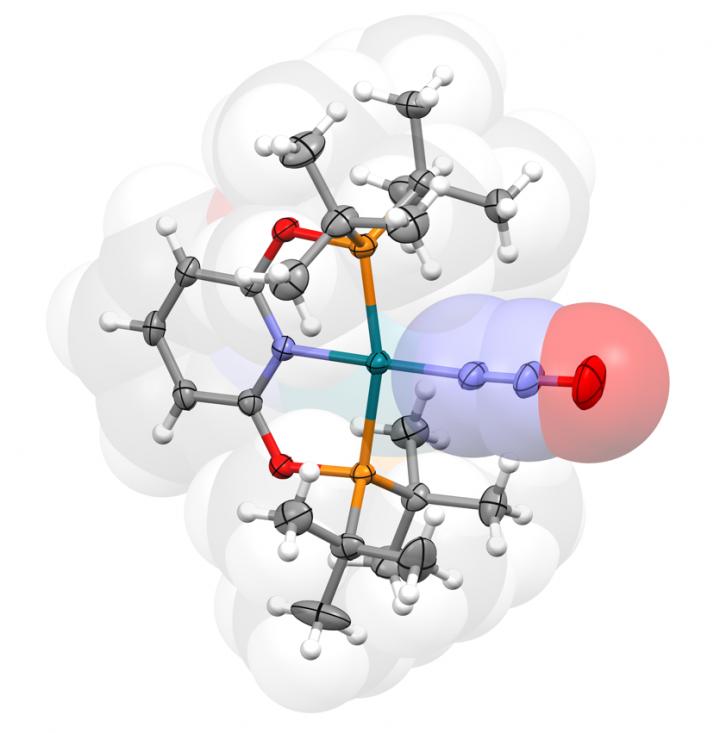
Credit: University of Warwick

  • Nitrous oxide is a greenhouse gas and ozone depleting substance.
  • The ability to exploit this gas as a chemical reagent is an attractive prospect, both as an abundant feedstock and means to remediate the detrimental impact it has on the environment.
  • Researchers at the University of Warwick have prepared transition metal compounds of nitrous oxide that provide a conceptional foundation for its application in new value-added chemical processes.

Nitrous oxide (N2O) is a potent atmospheric pollutant. Although naturally occurring, anthropogenic N2O emissions from intensive agricultural fertilisation, industrial processes, and combustion of fossil fuels and biomass are a major cause for concern. Researchers at the University of Warwick have isolated elusive transition metal compounds of N2O that provide clues into how it could be used in sustainable chemical technologies.

N2O is a powerful greenhouse gas, with a half life of 114 years in the atmosphere and global warming potential 300 times greater than carbon dioxide. It is also the dominant ozone depleting substance emitted in the 21st century.

As an abundant chemical feedstock, the use of N2O as a sustainable oxidant in synthetic organic chemistry is an attractive prospect, liberating environmentally benign dinitrogen (N2). Such reactions are encumbered by the robust triatomic formulation of this gas, typically requiring forcing reaction conditions that are energy intensive and undesirable from a remediation perspective. The development of mild and selective alternatives is a longstanding ambition of research scientists, but has been met with little success.

In their paper ‘Rhodium(I) Pincer Complexes of Nitrous Oxide’ published in the journal Angewandte Chemie, researchers from the University of Warwick’s Department of Chemistry have reported well-defined compounds of nitrous oxide that provide valuable insights into how this gas interacts with one of the most widely employed transition metals in organic synthesis.

The associated experimental data is the most comprehensive collected to date for any transition metal adduct, for which there are very few precedents. This work provides a fundamental reference point in the field and is likely to stimulate and guide future catalyst developments.

Dr Adrian Chaplin from the Department of Chemistry at the University of Warwick comments:

“Nitrous oxide is commonly known as laughing gas, but it’s environmental impact is certainly nothing to laugh about and often overlooked altogether. As a chemical reagent its potential has yet to be fully harnessed, and to do so a sustainable manner is formidable challenge for the scientific community.”

“In my team, we are trying to tackle this problem using a fundamental, bottom up, approach. The compounds that we have prepared represent the starting point of our journey, but the associated experimental data seems to be guiding us in the right direction and we are looking forward to where it takes us.”

###

NOTES TO EDITORS

Paper available to view at: http://doi.org/10.1002/anie.201908333

High-res images available credit to the University of Warwick:

https://warwick.ac.uk/services/communications/medialibrary/images/september2019/gg.png

For further information please contact:

Alice Scott

Media Relations Manager – Science

University of Warwick

Tel: +44 (0) 2476 574 255 or +44 (0) 7920 531 221

E-mail: [email protected]

Media Contact
Alice Scott
[email protected]

Original Source

https://warwick.ac.uk/newsandevents/pressreleases/elusive_compounds_of

Related Journal Article

http://dx.doi.org/10.1002/anie.201908333

Tags: Atmospheric ChemistryAtmospheric ScienceChemistry/Physics/Materials SciencesClimate Change
Share12Tweet8Share2ShareShareShare2

Related Posts

AI and Physics Collaborate to Design Advanced Hydrogen Storage Materials

June 25, 2026

International Team Including Dresden Scientists Develops Novel Designer Proteins for Advanced Study of Living Tissue

June 25, 2026

New Study Uncovers Key Factors Driving Water Chemistry in Nanoscale Environments

June 25, 2026

Plasma Technology Extends Catalyst Lifespan in Hydrogen Production

June 24, 2026
Please login to join discussion

POPULAR NEWS

  • Saying Goodbye to PGY-6: Pediatric Fellowship Realities

    103 shares
    Share 41 Tweet 26
  • Multi-Hospital Study Reveals Long Covid Burden Is Twice as High as Current Estimates

    92 shares
    Share 36 Tweet 23
  • Detection of EDCs in Breast Milk and Infant Urine Up to Six Months Highlights Early Exposure Risks

    77 shares
    Share 31 Tweet 19
  • New Drug Candidate Developed at McMaster Shows Potential for Treating Brain Cancer

    58 shares
    Share 23 Tweet 15

About

We bring you the latest biotechnology news from best research centers and universities around the world. Check our website.

Follow us

Recent News

Tracking Lanthanide-Labeled Microplastics in Plants

POSTECH Researchers Slash Cost of Reconstituted Cell-Free Systems by 95%

AI and Physics Collaborate to Design Advanced Hydrogen Storage Materials

Subscribe to Blog via Email

Success! An email was just sent to confirm your subscription. Please find the email now and click 'Confirm' to start subscribing.

Join 82 other subscribers
  • Contact Us

Bioengineer.org © Copyright 2023 All Rights Reserved.

Welcome Back!

Login to your account below

Forgotten Password?

Retrieve your password

Please enter your username or email address to reset your password.

Log In
No Result
View All Result
  • Homepages
    • Home Page 1
    • Home Page 2
  • News
  • National
  • Business
  • Health
  • Lifestyle
  • Science

Bioengineer.org © Copyright 2023 All Rights Reserved.