• HOME
  • NEWS
  • EXPLORE
    • CAREER
      • Companies
      • Jobs
    • EVENTS
    • iGEM
      • News
      • Team
    • PHOTOS
    • VIDEO
    • WIKI
  • BLOG
  • COMMUNITY
    • FACEBOOK
    • INSTAGRAM
    • TWITTER
Saturday, February 7, 2026
BIOENGINEER.ORG
No Result
View All Result
  • Login
  • HOME
  • NEWS
  • EXPLORE
    • CAREER
      • Companies
      • Jobs
        • Lecturer
        • PhD Studentship
        • Postdoc
        • Research Assistant
    • EVENTS
    • iGEM
      • News
      • Team
    • PHOTOS
    • VIDEO
    • WIKI
  • BLOG
  • COMMUNITY
    • FACEBOOK
    • INSTAGRAM
    • TWITTER
  • HOME
  • NEWS
  • EXPLORE
    • CAREER
      • Companies
      • Jobs
        • Lecturer
        • PhD Studentship
        • Postdoc
        • Research Assistant
    • EVENTS
    • iGEM
      • News
      • Team
    • PHOTOS
    • VIDEO
    • WIKI
  • BLOG
  • COMMUNITY
    • FACEBOOK
    • INSTAGRAM
    • TWITTER
No Result
View All Result
Bioengineer.org
No Result
View All Result
Home NEWS Science News Chemistry

Scientists’ design discovery doubles conductivity of indium oxide transparent coatings

Bioengineer by Bioengineer
September 17, 2019
in Chemistry
Reading Time: 2 mins read
0
IMAGE
Share on FacebookShare on TwitterShare on LinkedinShare on RedditShare on Telegram

IMAGE

Credit: University of Liverpool

Researchers at the University of Liverpool, University College London (UCL), NSG Group (Pilkington) and Diamond Light Source have made an important design discovery that could dramatically improve the performance of a key material used to coat touch screens and other devices.

Tin doped indium oxide -ITO – is the leading material used in the coating applied to the glass or clear plastic of touch screens, solar cells and light emitting diodes because it conducts electricity and allows light through.

ITO accounts for 60 per cent of the multibillion dollar transparent conducting oxide market and 60 per cent of global indium use. However, the search for materials that can replace ITO has increased significantly in recent years, as supplies of indium decrease and its price significantly increases.

Now, researchers have made an important design discovery that could see films and coatings which don’t rely so heavily on this rare element.

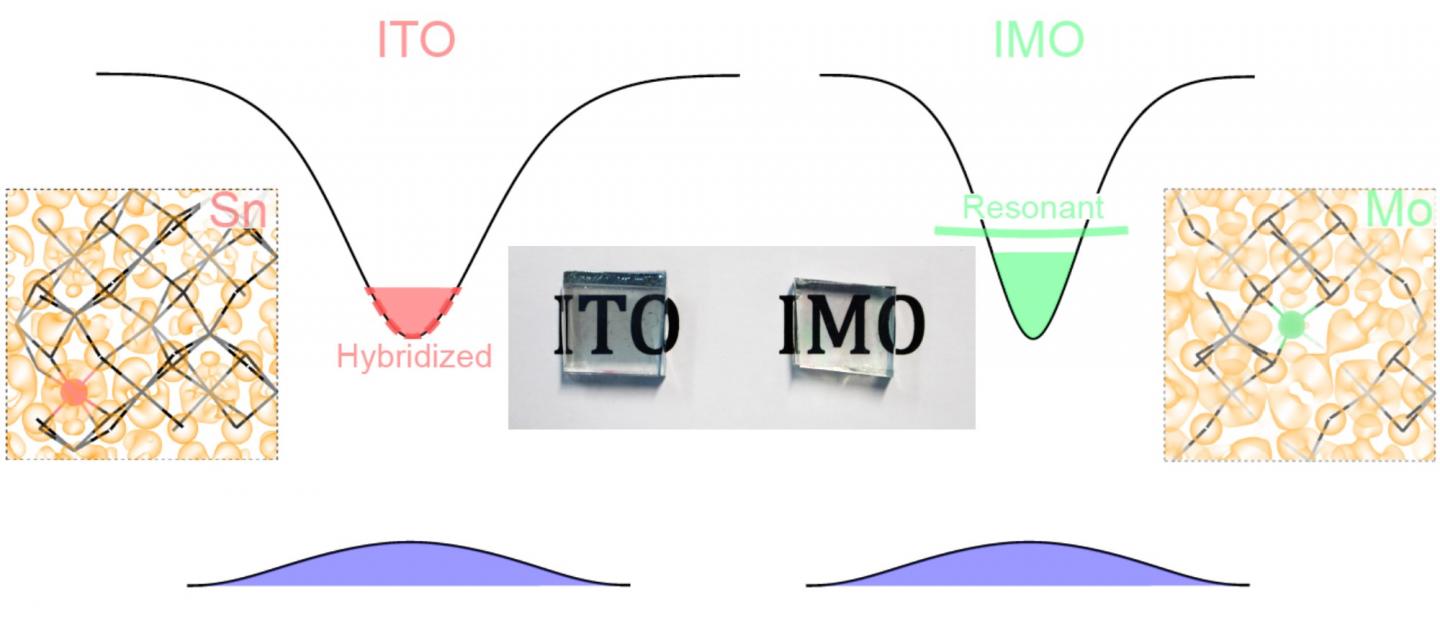
In a paper published in Materials Horizons, scientists used a combination of experimental and theoretical approaches to explain how replacing tin with the transition metal molybdenum creates a vastly superior material – IMO – that has twice the conductivity of ITO. It can deliver better performance than ITO with only half the thickness and half the amount of indium.

PhD student Jack Swallow, from the University of Liverpool’s Department of Physics and the Stephenson Institute for Renewable Energy, said: “This is an exciting new development in the field of transparent conductors and has the potential of extending the life of the world’s indium supplies, which are in increasingly short supply.”

Professor David Scanlon of UCL said: “Our work illustrates the power of combining chemistry and physics experimental approaches with computational materials design.”

The researchers now intend to apply their new understanding to find alternative novel dopants to improve other transparent conductors.

This includes tin dioxide which contains only earth abundant elements and so is cheap enough for large area uses such as solar cells and energy efficient windows.

Liverpool Professor, Tim Veal, a co-author on the paper said: “Although IMO was first made several years ago, the reason why it is so much better than ITO wasn’t understood.

“Our research finding represents a breakthrough and opens the way for industry to reduce its use of indium in displays and touch screens and provides a route for commercial development of better, cheaper transparent conductors for renewable energy applications.”

###

The paper “Resonant doping for high mobility transparent conductors: the case of Mo-doped In2O3” was published in Materials Horizons (DOI: 10.1039/c9mh01014a)

Media Contact
Sarah Stamper
[email protected]

Related Journal Article

http://dx.doi.org/10.1039/c9mh01014a

Tags: Chemistry/Physics/Materials SciencesMaterials
Share12Tweet8Share2ShareShareShare2

Related Posts

blank

Breakthrough in Environmental Cleanup: Scientists Develop Solar-Activated Biochar for Faster Remediation

February 7, 2026
blank

Cutting Costs: Making Hydrogen Fuel Cells More Affordable

February 6, 2026

Scientists Develop Hand-Held “Levitating” Time Crystals

February 6, 2026

Observing a Key Green-Energy Catalyst Dissolve Atom by Atom

February 6, 2026
Please login to join discussion

POPULAR NEWS

  • Robotic Ureteral Reconstruction: A Novel Approach

    Robotic Ureteral Reconstruction: A Novel Approach

    82 shares
    Share 33 Tweet 21
  • Digital Privacy: Health Data Control in Incarceration

    63 shares
    Share 25 Tweet 16
  • Study Reveals Lipid Accumulation in ME/CFS Cells

    57 shares
    Share 23 Tweet 14
  • Breakthrough in RNA Research Accelerates Medical Innovations Timeline

    53 shares
    Share 21 Tweet 13

About

We bring you the latest biotechnology news from best research centers and universities around the world. Check our website.

Follow us

Recent News

Urinary Clusterin: Tracking Kidney Disease and Treatment Response

Personalized Guide to Understanding and Reducing Chemicals

Inflammasome Protein ASC Drives Pancreatic Cancer Metabolism

Subscribe to Blog via Email

Enter your email address to subscribe to this blog and receive notifications of new posts by email.

Join 73 other subscribers
  • Contact Us

Bioengineer.org © Copyright 2023 All Rights Reserved.

Welcome Back!

Login to your account below

Forgotten Password?

Retrieve your password

Please enter your username or email address to reset your password.

Log In
No Result
View All Result
  • Homepages
    • Home Page 1
    • Home Page 2
  • News
  • National
  • Business
  • Health
  • Lifestyle
  • Science

Bioengineer.org © Copyright 2023 All Rights Reserved.