• HOME
  • NEWS
  • EXPLORE
    • CAREER
      • Companies
      • Jobs
    • EVENTS
    • iGEM
      • News
      • Team
    • PHOTOS
    • VIDEO
    • WIKI
  • BLOG
  • COMMUNITY
    • FACEBOOK
    • INSTAGRAM
    • TWITTER
Sunday, December 21, 2025
BIOENGINEER.ORG
No Result
View All Result
  • Login
  • HOME
  • NEWS
  • EXPLORE
    • CAREER
      • Companies
      • Jobs
        • Lecturer
        • PhD Studentship
        • Postdoc
        • Research Assistant
    • EVENTS
    • iGEM
      • News
      • Team
    • PHOTOS
    • VIDEO
    • WIKI
  • BLOG
  • COMMUNITY
    • FACEBOOK
    • INSTAGRAM
    • TWITTER
  • HOME
  • NEWS
  • EXPLORE
    • CAREER
      • Companies
      • Jobs
        • Lecturer
        • PhD Studentship
        • Postdoc
        • Research Assistant
    • EVENTS
    • iGEM
      • News
      • Team
    • PHOTOS
    • VIDEO
    • WIKI
  • BLOG
  • COMMUNITY
    • FACEBOOK
    • INSTAGRAM
    • TWITTER
No Result
View All Result
Bioengineer.org
No Result
View All Result
Home NEWS Science News Chemistry

Virginia Tech researchers lead breakthrough in quantum computing

Bioengineer by Bioengineer
July 25, 2019
in Chemistry
Reading Time: 2 mins read
0
IMAGE
Share on FacebookShare on TwitterShare on LinkedinShare on RedditShare on Telegram

IMAGE

Credit: Virginia Tech

The large, error-correcting quantum computers envisioned today could be decades away, yet experts are vigorously trying to come up with ways to use existing and near-term quantum processors to solve useful problems despite limitations due to errors or “noise.”

A key envisioned use is simulating molecular properties. In the long run, this can lead to advances in materials improvement and drug discovery. But not with noisy calculations confusing the results.

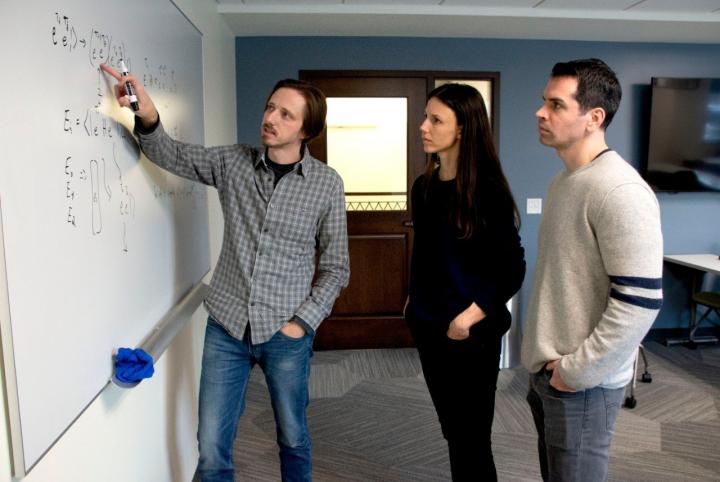
Now, a team of Virginia Tech chemistry and physics researchers have advanced quantum simulation by devising an algorithm that can more efficiently calculate the properties of molecules on a noisy quantum computer. Virginia Tech College of Science faculty members Ed Barnes, Sophia Economou, and Nick Mayhall recently published a paper in Nature Communications detailing the advancement.

Quantum computers are expected to be able to carry out certain kinds of calculations far more efficiently than the “classical” computers in use today. They are similar to classical computers, however, in that they run algorithms by applying sequences of logic gates — in this case, “quantum gates,” which together form quantum circuits — to bits of information. For today’s noisy quantum computers, the problem has been that so much noise would accumulate within a circuit that the computation would degrade and render any subsequent calculations inaccurate. Scientists have had difficulty designing circuits that are both shorter and more accurate.

The Virginia Tech team addressed this issue by developing a method that grows the circuit in an iterative way. “We start with a minimal circuit, then grow it as we add on logic gate after logic gate in short circuits until the computer finds the solution,” said Mayhall, an assistant professor in the Department of Chemistry.

A second major benefit of the algorithm is that Barnes, Economou, and Mayhall designed it to adapt itself based upon the molecular system being simulated. Different molecules will dictate their own circuits, uniquely tailored to them.

The interdisciplinary collaboration between Virginia Tech’s departments of Chemistry and Physics — Barnes, Economou, and Mayhall and a team of graduate students and postdocs from both departments — have received grants from the National Science Foundation and the U.S. Department of Energy totaling more than $2.8 million.

Virginia Tech and IBM recently established a partnership that gives the researchers access to IBM’s quantum computing hardware. “Our team at Virginia Tech is really excited for the next steps in our work,” said Economou, an associate professor in the Department of Physics, “which include implementing our algorithm on IBM’s processors.”

###

Media Contact
Lon Wagner
[email protected]

Original Source

http://vtnews.vt.edu/articles/2019/07/science-quantum_computing_nature_communications.html

Related Journal Article

http://dx.doi.org/10.1038/s41467-019-10988-2

Tags: Chemistry/Physics/Materials SciencesEducationMedicine/HealthScience/MathTechnology/Engineering/Computer Science
Share12Tweet8Share2ShareShareShare2

Related Posts

Cutting Electrolyte Reduction Boosts High-Energy Battery Performance

Cutting Electrolyte Reduction Boosts High-Energy Battery Performance

December 19, 2025
Microenvironment Shapes Gold-Catalysed CO2 Electroreduction

Microenvironment Shapes Gold-Catalysed CO2 Electroreduction

December 11, 2025

Photoswitchable Olefins Enable Controlled Polymerization

December 11, 2025

Cation Hydration Entropy Controls Chloride Ion Diffusion

December 10, 2025
Please login to join discussion

POPULAR NEWS

  • Nurses’ Views on Online Learning: Effects on Performance

    Nurses’ Views on Online Learning: Effects on Performance

    70 shares
    Share 28 Tweet 18
  • NSF funds machine-learning research at UNO and UNL to study energy requirements of walking in older adults

    71 shares
    Share 28 Tweet 18
  • Unraveling Levofloxacin’s Impact on Brain Function

    53 shares
    Share 21 Tweet 13
  • Exploring Audiology Accessibility in Johannesburg, South Africa

    51 shares
    Share 20 Tweet 13

About

We bring you the latest biotechnology news from best research centers and universities around the world. Check our website.

Follow us

Recent News

Empowerment Model Boosts COPD Patients via Telenursing

Insights from Canadian Physicians on Deprescribing in Seniors

Staphylococcus Fatty Acids Control Joint Infection Aggregation

Subscribe to Blog via Email

Enter your email address to subscribe to this blog and receive notifications of new posts by email.

Join 70 other subscribers
  • Contact Us

Bioengineer.org © Copyright 2023 All Rights Reserved.

Welcome Back!

Login to your account below

Forgotten Password?

Retrieve your password

Please enter your username or email address to reset your password.

Log In
No Result
View All Result
  • Homepages
    • Home Page 1
    • Home Page 2
  • News
  • National
  • Business
  • Health
  • Lifestyle
  • Science

Bioengineer.org © Copyright 2023 All Rights Reserved.