Credit: Kobe University
When cells change to a more specialized type, we call this process cellular differentiation. Scientists have revealed that protein secretions by skin cells known as keratinocytes control the differentiation of subsurface skin fat cells. This discovery could potentially help to treat obesity. Associate Professor Takehiko Ueyama and Professor Naoaki Saito at the Biosignal Research Center of Kobe University led the research team, and the findings were published on July 24 in the online edition of the Journal of Investigative Dermatology.
There are two main types of fat cells: white adipose tissue or “white fat” that stores energy and contributes to obesity, and brown adipose tissue or “brown fat” that consumes energy and helps prevent obesity. White fat can convert to brown fat in the “browning” phenomenon.
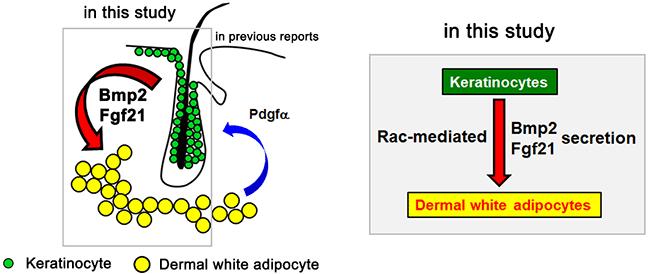
Researchers already knew about signaling from subsurface skin fat cells to keratinocytes that promotes cell differentiation. However, there were no clear reports about signaling in the opposite direction (see Figure 1).
In this study, the team found that genetically altered mice with Rac molecules removed from their keratinocytes had extremely thin layers of skin fat (see Figure 2). The team carried out comprehensive genetic analysis of the Rac-deficient mice, comparing them with wild-type mice, and found that the Rac-deficient keratinocytes had notably low levels of six growth factor proteins. When they applied these growth factors to fat precursor cells, they found that simultaneous treatment of factors BMP2 and FGF21 encouraged differentiation into white fat cells, and suppressed differentiation into brown fat cells (see Figure 2). They were able to substitute the effects of BMP2 and FGF21 with a culture medium of human-derived keratinocytes, proving that the growth factor proteins secreted in human keratinocytes contribute to differentiation of fat cells.
We already knew that FGF21 promotes differentiation into brown fat cells, but this study showed that BMP2 inhibits this process. This means that suppressing BMP2 can decrease the number of white fat cells and increase brown fat cells. The team also discovered that simultaneous application of both BMP2 and FGF21 causes fibroblasts – skin pluripotent cells that can produce fat precursor cells – to differentiate into fat cells.
This study proved the existence of differentiation signaling (BMP2 and FGF21 from keratinocytes/skin cells/epidermal cells to fat cells) in the opposite direction to the previous reports (from fat cells to keratinocytes). It shows that paracrine-based differentiation signaling occurs in both directions between cells in the epidermal (surface skin) and intradermal (subsurface skin) layers. This also revealed the potential for transforming the type and composition of subsurface fat cells by controlling the signals from surface skin to subsurface skin and fat layers.
Obesity is a growing problem in modern societies. One way to tackle this disease is influencing the body’s metabolism by changing the ratios of white fat cells to brown fat cells. This study revealed that BMP2 and FGF21 secreted from keratinocytes regulate the ratios of skin fat cells. By adjusting levels of BMP2 and FGF21, we could potentially control the ratio of white to brown fat cells. This could include a skin-based anti-obesity treatment – for example, developing a cream to be absorbed through the skin.
###
Media Contact
Eleanor Wyllie
[email protected]
Original Source
http://www.
Related Journal Article
http://dx.