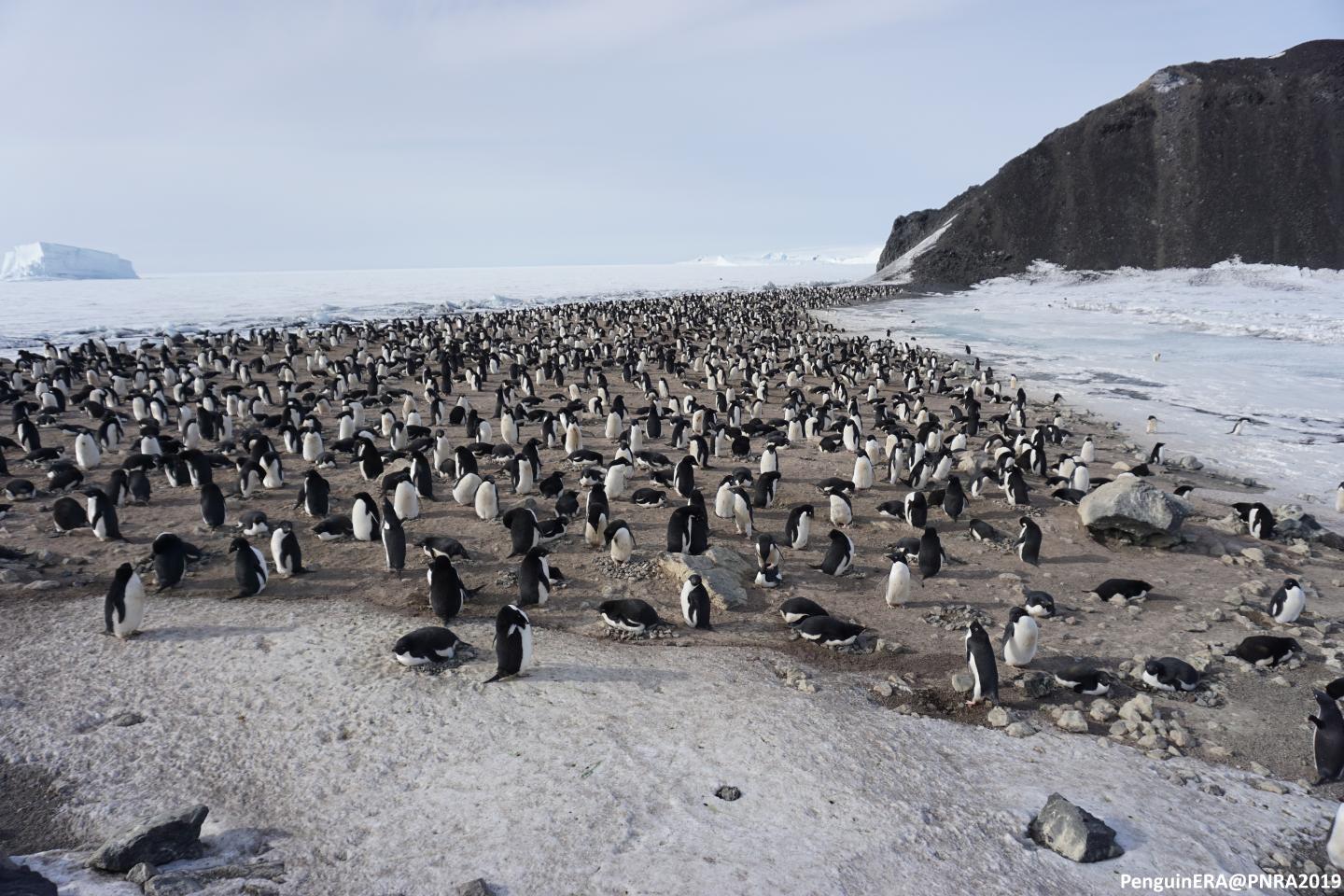
Credit: Silvia Olmastroni, University of Siena
Scientists have completed the first study of immune and genetic stability among a colony of penguins living in a remote corner of southern Antarctica.
Researchers examined erythrocyte nuclear abnormality (ENA) and white blood cell (WBC) levels in Adélie penguins breeding at Edmonson Point.
Through blood tests conducted on 19 adult penguins, they found quantities of cell types associated with future cell death, genomic instability or cancer development.
The study’s findings will act as baseline data for future studies into the health status of breeding penguins and how they are responding to environmental changes.
Edmonson Point is an Antarctic Specially Protected Area (ASPA) in the Ross Sea, which in turn is home to 38% of the global population of Adélie penguin.
The Adélie is considered a keystone species of the Antarctic environment so it is considered mandatory to address the current health status of population living in this territory to prove the efficacy of the protected area and to monitor any potential impact in the future.
The research was undertaken through a collaboration between the University of Siena and the University of Plymouth, as part of an Erasmus student exchange between the universities. It was funded by the Italian National Antarctic Research Programme.
Dr Silvia Olmastroni, from the University of Siena and the Italian National Antarctic Museum, led the research along with University of Siena colleague Dr Ilaria Corsi. She said: “Antarctic seabirds are well adapted to extreme environments and often deal with sub-optimal conditions and severe environmental stress. Climate change, pollution, habitat loss and increasing human presence can all significantly affect organism’s health status and long-term survival. For that reason, it is crucial to have this understanding of a species’ immune and genetic system so that any changes can be identified at the earliest opportunity.”
It is well known that climate change is affecting the bioavailability of toxic contaminants in the wildlife of Antarctica, leading to changes in organism homeostasis and other physiological defence mechanisms.
This means that during a penguin’s lifetime, contaminant exposure – both in its breeding and feeding habitats – may vary according to the ecosystem changes.
However, in comparison with other Antarctic territories, the Ross Sea is still considered a pristine area even though human pressure has increased significantly in the last 20 years due to growth of fisheries, tourism and number of scientific bases.
The current research showed that ENA and WBC levels are consistent with studies of other Adelie penguin colonies across the Antarctic peninsula.
However heterophil:leukocyte ratios, which can represent an evolutionary response to natural stressors, was higher in the Edmonson Point colony than in other Adélie penguin populations.
Awadhesh Jha, Professor of Ecotoxicology at the University of Plymouth, added: “It is difficult at this stage to connect what we found in this study to any particular contamination or stress sources. However, over coming decades and beyond, environmental stressors and an increase in associated impacts on wildlife are expected to grow in Antarctica. This information provides us with a series of useful biological indicators for future monitoring and conservation studies to assess potential impact on population and ecosystem health in changing environments.”
###
Media Contact
Alan Williams
[email protected]
Original Source
https:/
Related Journal Article
http://dx.