KIST-Stanford University team develops new material for wearable devices that can self-heal and recover its original electrical conductivity even after being significantly stretched or completely cut
Credit: Korea Institute of Science and Technology (KIST)
The research team of researcher Hyunseon Seo and senior researcher Dr. Donghee Son of the Korea Institute of Science and Technology’s (KIST, president: Byung-gwon Lee) Biomedical Research Institute and postdoctoral candidate Dr. Jiheong Kang and Professor Zhenan Bao of Stanford University (chemical engineering) announced a new material, developed via joint convergence research, that simultaneously possesses high stretchability, high electrical conductivity, and self-healability even after being subjected to severe mechanical strain.
Currently, interest in the development of wearable electronic devices is growing rapidly. Prior to this study, Dr. Donghee Son, Dr. Jiheong Kang, and Prof. Zhenan Bao developed a polymer material that is highly elastic, can self-heal without the help of external stimuli even when exposed to water or sweat, and has a mechanical strength similar to that of human skin, making it comfortable to wear for long periods of time. (Advanced Materials 30, 1706846, 2018)
In its most recent study, the KIST-Stanford research team developed a new material that can be utilized as an interconnect,* because it has the same properties as existing wearable materials as well as high levels of electrical conductivity and stretchability, which allow the stable transmission of electricity and data from the human body to electronic devices.
*Interconnect: a material that serves as a channel for the stable and accurate transmission of biosignals from the human body to an electronic device
The KIST-Stanford team dispersed silver micro-/nano-particles throughout the highly stretchable and self-healable polymer material to achieve a new design for a nanocomposite material with high stretchability and high electrical conductivity.
During tests, the material developed by the KIST team was utilized as an interconnect and attached to the human body to allow for the measurement of biometric signals in real time. The signals were then transmitted to a robotic arm, which successfully and accurately imitated (in real time) the movements of a human arm.
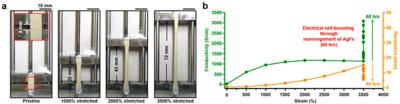
Contrary to typical materials, the electrical conductivity (and thus performance) of which decreases when the shape of the materials is changed by an applied tensile strain, the new material developed by the KIST research team shows a dramatic increase in conductivity under a tensile strain of 3,500 percent. In fact, electrical conductivity rose over 60-fold, achieving the highest conductivity level reported worldwide so far. Even if the material is damaged or completely cut through, it is able to self-heal, a property that is already gaining attention from academia.
The KIST team investigated phenomena that have not yet been studied in existing conductive materials. The phenomenon exhibited in the new material developed by the team is electrical “self-boosting,” which refers to the self-improvement of electrical conductivity through the rearrangement and self-alignment of a material’s micro-/nano-particles when the material is stretched. The team also discovered the mechanism of such dynamic behavior of micro-/nano-particles by using SEM and microcomputed tomography (μ-CT) analyses.
Seo said, “Our material is able to function normally even after being subjected to extreme external forces that cause physical damages, and we believe that it will be actively utilized in the development and commercialization of next-generation wearable electronic devices,” while Son stated, “Because the outcome of this study is essentially the foundational technology necessary for the development of materials that can be used in major areas of the Fourth Industrial Revolution, such as medical engineering, electrical engineering, and robotics, we expect that it will be applicable to diverse fields.”
###
This study was conducted with support from the Ministry of Science and Technology (minister: Young-min Yoo) as a project of KIST and the National Research Foundation of Korea. The outcomes of this study, which was conducted in cooperation with Stanford University, were published in the most recent issue of ACS Nano (IF: 13.709, top 4.035% in JCR sector).
Media Contact
Dohyun Kim
[email protected]
Related Journal Article
http://dx.