• HOME
  • NEWS
  • EXPLORE
    • CAREER
      • Companies
      • Jobs
    • EVENTS
    • iGEM
      • News
      • Team
    • PHOTOS
    • VIDEO
    • WIKI
  • BLOG
  • COMMUNITY
    • FACEBOOK
    • INSTAGRAM
    • TWITTER
Saturday, February 7, 2026
BIOENGINEER.ORG
No Result
View All Result
  • Login
  • HOME
  • NEWS
  • EXPLORE
    • CAREER
      • Companies
      • Jobs
        • Lecturer
        • PhD Studentship
        • Postdoc
        • Research Assistant
    • EVENTS
    • iGEM
      • News
      • Team
    • PHOTOS
    • VIDEO
    • WIKI
  • BLOG
  • COMMUNITY
    • FACEBOOK
    • INSTAGRAM
    • TWITTER
  • HOME
  • NEWS
  • EXPLORE
    • CAREER
      • Companies
      • Jobs
        • Lecturer
        • PhD Studentship
        • Postdoc
        • Research Assistant
    • EVENTS
    • iGEM
      • News
      • Team
    • PHOTOS
    • VIDEO
    • WIKI
  • BLOG
  • COMMUNITY
    • FACEBOOK
    • INSTAGRAM
    • TWITTER
No Result
View All Result
Bioengineer.org
No Result
View All Result
Home NEWS Science News Chemistry

Solving the salt problem for seismic imaging

Bioengineer by Bioengineer
July 22, 2019
in Chemistry
Reading Time: 2 mins read
0
IMAGE
Share on FacebookShare on TwitterShare on LinkedinShare on RedditShare on Telegram

IMAGE

Credit: © 2019 Mahesh Kalita

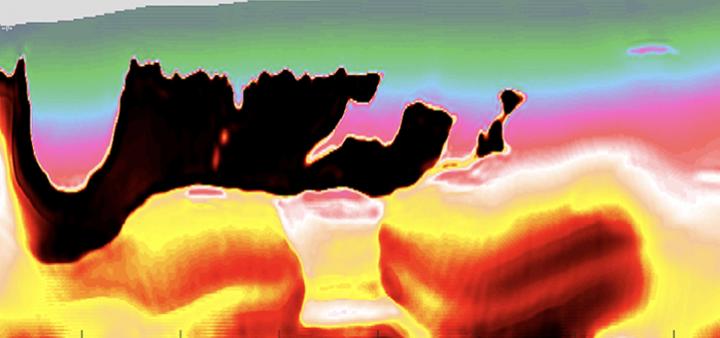
The efficient extraction of oil and gas from within the Earth’s crust requires accurate images of subsurface rock structures. Some materials are hard to capture, so KAUST researchers have developed a computational method for modeling large accumulations of subsurface salt, a challenging material to derive accurately from seismic imaging data.

Seismic imaging involves sending soundwaves into the ground, where they will be reflected at boundaries between rock structures. Scientists analyze the reflected soundwaves to determine subsurface rock types and formations, and to pinpoint fossil fuel reservoirs.

However, in some regions, such as the Gulf of Mexico, the subsurface is peppered with salt bodies, which are huge accumulations of salt formed millions of years ago deep inside the Earth. Salt is a low-density, buoyant substance, meaning that salt bodies gradually rise through the Earth’s crust over time. This causes stress-related complexities between the salt and the surrounding rock layers. Furthermore, the salt’s crystal structure means that soundwaves are reflected at random, and there are no useable low frequencies retained in the seismic data.

“Data from salt zones are presently analyzed by highly trained experts rather than modeled by a computer,” explains Mahesh Kalita, a KAUST Ph.D. student in Tariq Alkhalifah’s group. “This is a time-consuming and expensive process that carries the risk of human error. We’ve developed a robust computational method for interpreting seismic data from salt bodies quickly and more accurately.”

Existing models use a technique called full waveform inversion (FWI) to minimize the disparity between observed and modeled data. However, the lack of low frequencies in soundwave data from salt bodies means that a traditional FWI fails. Kalita and the team developed a two-part optimization process to refine FWI for salt body imaging.

“For the topmost layer of salt, we get a good enough signal to determine where the salt body begins, but then the soundwave energy rapidly disperses,” says Kalita. “Our technique takes the initial data from this top layer and ‘smears’ it across the most likely area that the salt body encompasses. We call this technique ‘flooding’.”

The resulting model is then tested alongside observed data to check that the surrounding rock structures match up and to ensure the model has not been “over-flooded.” Initial trials using a 1990s dataset from the Gulf of Mexico showed promise, with the new technique generating an accurate representation of local salt bodies.

“We will next trial our automated technique on recent, high-quality datasets that incorporate more three-dimensional details,” says Kalita.

###

Media Contact
Carolyn Unck
[email protected]

Original Source

https://discovery.kaust.edu.sa/en/article/855/solving-the-salt-problem-for-seismic-imaging

Related Journal Article

http://dx.doi.org/10.1190/geo2018-0146.1

Tags: Civil EngineeringEarth ScienceGeographyGeology/SoilGeophysics/Gravity
Share12Tweet8Share2ShareShareShare2

Related Posts

blank

Breakthrough in Environmental Cleanup: Scientists Develop Solar-Activated Biochar for Faster Remediation

February 7, 2026
blank

Cutting Costs: Making Hydrogen Fuel Cells More Affordable

February 6, 2026

Scientists Develop Hand-Held “Levitating” Time Crystals

February 6, 2026

Observing a Key Green-Energy Catalyst Dissolve Atom by Atom

February 6, 2026
Please login to join discussion

POPULAR NEWS

  • Robotic Ureteral Reconstruction: A Novel Approach

    Robotic Ureteral Reconstruction: A Novel Approach

    82 shares
    Share 33 Tweet 21
  • Digital Privacy: Health Data Control in Incarceration

    63 shares
    Share 25 Tweet 16
  • Study Reveals Lipid Accumulation in ME/CFS Cells

    57 shares
    Share 23 Tweet 14
  • Breakthrough in RNA Research Accelerates Medical Innovations Timeline

    53 shares
    Share 21 Tweet 13

About

We bring you the latest biotechnology news from best research centers and universities around the world. Check our website.

Follow us

Recent News

Phage-Antibiotic Combo Beats Resistant Peritoneal Infection

Boosting Remote Healthcare: Stepped-Wedge Trial Insights

Barriers and Boosters of Seniors’ Physical Activity in Karachi

Subscribe to Blog via Email

Enter your email address to subscribe to this blog and receive notifications of new posts by email.

Join 73 other subscribers
  • Contact Us

Bioengineer.org © Copyright 2023 All Rights Reserved.

Welcome Back!

Login to your account below

Forgotten Password?

Retrieve your password

Please enter your username or email address to reset your password.

Log In
No Result
View All Result
  • Homepages
    • Home Page 1
    • Home Page 2
  • News
  • National
  • Business
  • Health
  • Lifestyle
  • Science

Bioengineer.org © Copyright 2023 All Rights Reserved.