• HOME
  • NEWS
  • EXPLORE
    • CAREER
      • Companies
      • Jobs
    • EVENTS
    • iGEM
      • News
      • Team
    • PHOTOS
    • VIDEO
    • WIKI
  • BLOG
  • COMMUNITY
    • FACEBOOK
    • INSTAGRAM
    • TWITTER
Saturday, February 7, 2026
BIOENGINEER.ORG
No Result
View All Result
  • Login
  • HOME
  • NEWS
  • EXPLORE
    • CAREER
      • Companies
      • Jobs
        • Lecturer
        • PhD Studentship
        • Postdoc
        • Research Assistant
    • EVENTS
    • iGEM
      • News
      • Team
    • PHOTOS
    • VIDEO
    • WIKI
  • BLOG
  • COMMUNITY
    • FACEBOOK
    • INSTAGRAM
    • TWITTER
  • HOME
  • NEWS
  • EXPLORE
    • CAREER
      • Companies
      • Jobs
        • Lecturer
        • PhD Studentship
        • Postdoc
        • Research Assistant
    • EVENTS
    • iGEM
      • News
      • Team
    • PHOTOS
    • VIDEO
    • WIKI
  • BLOG
  • COMMUNITY
    • FACEBOOK
    • INSTAGRAM
    • TWITTER
No Result
View All Result
Bioengineer.org
No Result
View All Result
Home NEWS Science News Health

Operative versus non-operative treatment for 2-part proximal humerus fracture

Bioengineer by Bioengineer
July 19, 2019
in Health
Reading Time: 2 mins read
0
IMAGE
Share on FacebookShare on TwitterShare on LinkedinShare on RedditShare on Telegram

IMAGE

Credit: PLOS Medicine

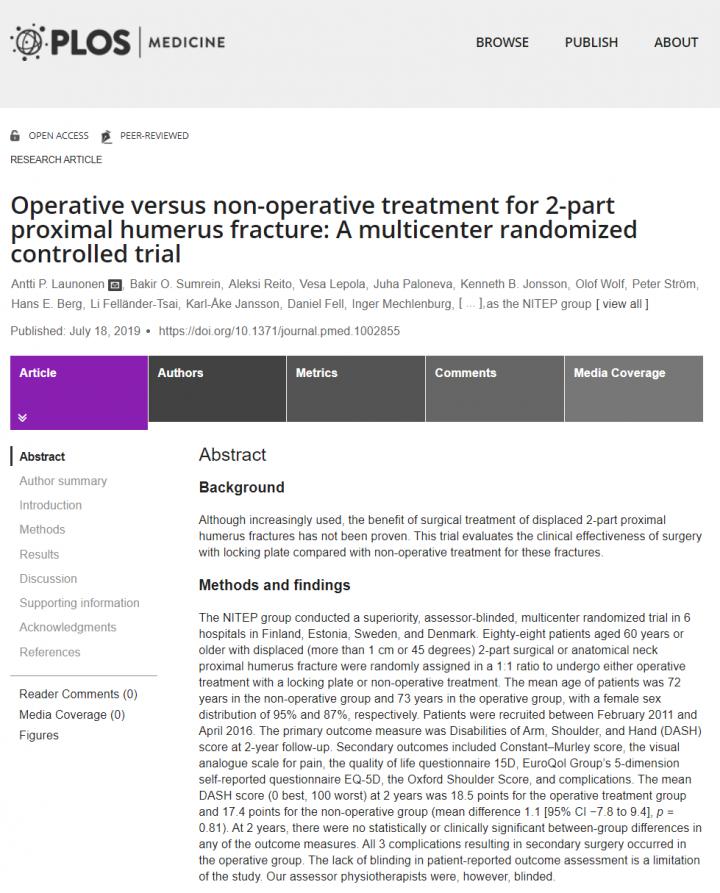
The results of a recent Nordic collaboration study showed that there is no difference in functional results between operative and non-operative treatment in persons aged 60 or more with displaced proximal humerus fractures.

Proximal humerus fractures are more common in older persons than in younger adults. This fracture usually occurs as a result of falling, usually at home, directly on to the shoulder. In the proximal humerus, the bone is more fragile than lower in the forearm. The healing potential in the proximal humerus is, however, better than lower in the forearm.

In the study, published in Plos Medicine journal, only fractures with a significant displacement between bone fragments were included. Traditionally, humerus fractures have been operatively treated using a metal plate and screws. In the non-operative treatment group, patients used a collar and cuff sling for three weeks and underwent instructed physiotherapy.

The trial included 88 patients who were followed for two years, and was conducted as a multinational, multicenter study in six trauma centers.

The findings of the study are novel and challenge current treatment protocols. “Moreover the result had a positive impact on both the lives of the patients as well as on the economic cost of treatment,” says Aare Märtson, Professor in Orthopedics at the University of Tartu Institute of Clinical Medicine.

Abandoning those procedures that offer no benefit to the patient could result in savings of up to one million euros per year. Furthermore, patient recovery will be as successful as previously but without the surgery-related pain and complications.

The leading center was Tampere University Hospital, Finland. Other centers included Jyväskylä Central Hospital, Finland, Karolinska Hospital, Stockholm and Uppsala University Hospital from Sweden, Viborg Hospital from Denmark, and Tartu University Hospital from Estonia.

Next object for the NITEP study group is to assess whether older adults would benefit from surgery after distal radius fracture.

###

Media Contact
Aare Märtson
[email protected]

Tags: Medicine/Health
Share12Tweet8Share2ShareShareShare2

Related Posts

Exploring Decision-Making in Dementia Caregivers’ Mobility

February 7, 2026

Succinate Receptor 1 Limits Blood Cell Formation, Leukemia

February 7, 2026

Palmitoylation of Tfr1 Drives Platelet Ferroptosis and Exacerbates Liver Damage in Heat Stroke

February 7, 2026

Oxygen-Enhanced Dual-Section Microneedle Patch Improves Drug Delivery and Boosts Photodynamic and Anti-Inflammatory Treatment for Psoriasis

February 7, 2026
Please login to join discussion

POPULAR NEWS

  • Robotic Ureteral Reconstruction: A Novel Approach

    Robotic Ureteral Reconstruction: A Novel Approach

    82 shares
    Share 33 Tweet 21
  • Digital Privacy: Health Data Control in Incarceration

    63 shares
    Share 25 Tweet 16
  • Study Reveals Lipid Accumulation in ME/CFS Cells

    57 shares
    Share 23 Tweet 14
  • Breakthrough in RNA Research Accelerates Medical Innovations Timeline

    53 shares
    Share 21 Tweet 13

About

We bring you the latest biotechnology news from best research centers and universities around the world. Check our website.

Follow us

Recent News

Exploring Decision-Making in Dementia Caregivers’ Mobility

Succinate Receptor 1 Limits Blood Cell Formation, Leukemia

Palmitoylation of Tfr1 Drives Platelet Ferroptosis and Exacerbates Liver Damage in Heat Stroke

Subscribe to Blog via Email

Enter your email address to subscribe to this blog and receive notifications of new posts by email.

Join 73 other subscribers
  • Contact Us

Bioengineer.org © Copyright 2023 All Rights Reserved.

Welcome Back!

Login to your account below

Forgotten Password?

Retrieve your password

Please enter your username or email address to reset your password.

Log In
No Result
View All Result
  • Homepages
    • Home Page 1
    • Home Page 2
  • News
  • National
  • Business
  • Health
  • Lifestyle
  • Science

Bioengineer.org © Copyright 2023 All Rights Reserved.