South Africa’s greatest fossil discoveries in modern times to be showcased for the first time at the Perot Museum in America
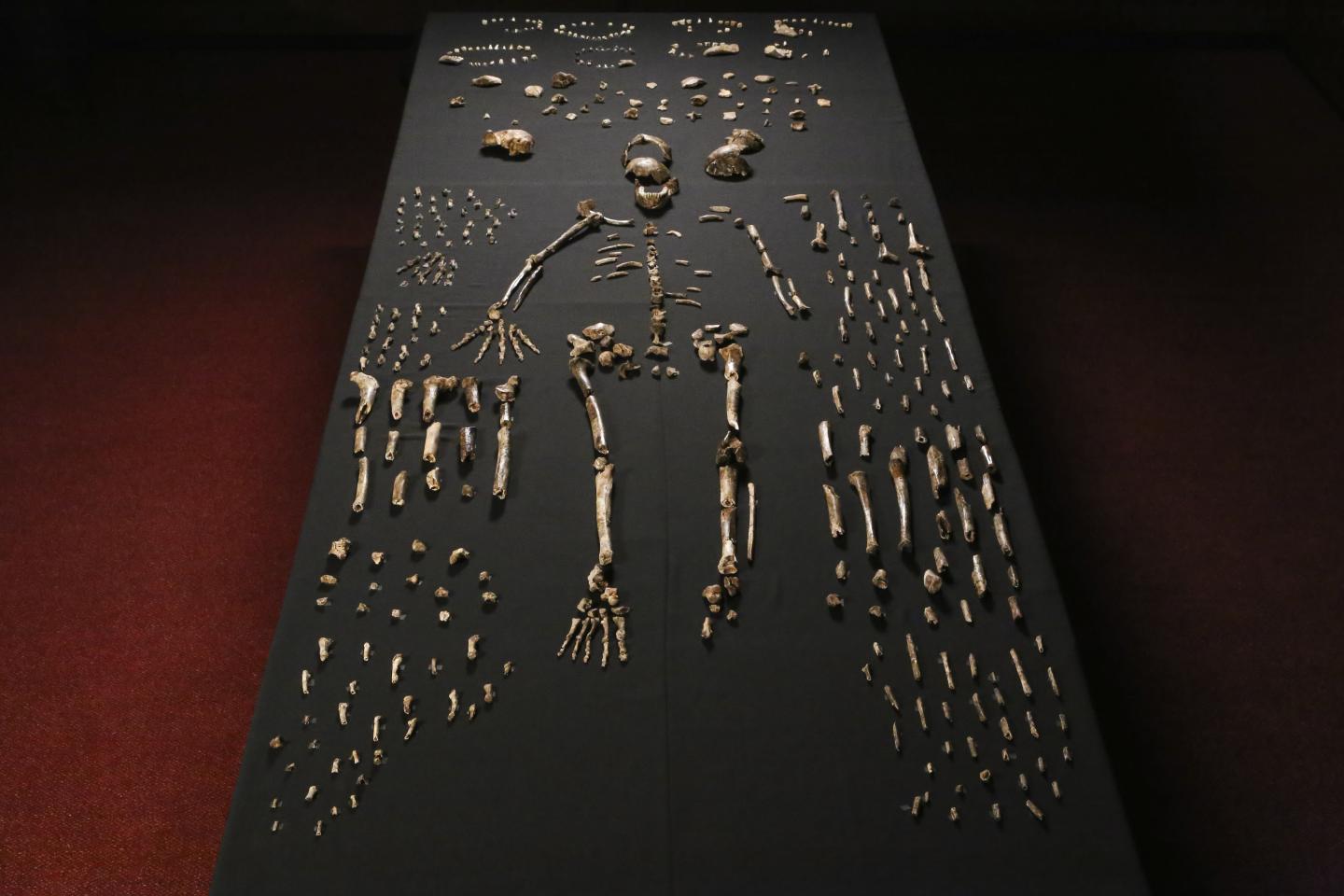
Credit: John Hawks/Wits University
The University of Witwatersrand (Wits University), the Perot Museum of Nature and Science in the U.S. and the National Geographic Society have partnered to bring the rare fossils of two recently discovered ancient human relatives (Australopithecus sediba and Homo naledi) to the U.S. for the first, and likely only, time to be featured in the limited-run exhibition – ORIGINS: FOSSILS FROM THE CRADLE OF HUMANKIND.
Announced during Nelson Mandela Day celebrations, Wits University confirmed that South Africa’s national treasures, Homo naledi and Australopithecus sediba, will be on public display in a ground-breaking exhibition in Dallas, Texas, over a five-month period beginning in October.
Discovered in 2008 by then nine-year-old Matthew Berger, the Australopithecus sediba fossils were some of the most complete hominin skeletons known in the fossil record at the time. Just five years later, the first fossils of another new ancient relative, Homo naledi (formally described in 2015), were dramatically unearthed in South Africa by a Wits University team led by Wits University Professor Lee Berger, and including the Perot Museum’s Dr. Becca Peixotto, director and research scientist of the Center for the Exploration of the Human Journey. Together, these two remarkable discoveries provide further compelling evidence for the complex and nuanced processes of human evolution.
“We are excited to share these South African national treasures, of which Wits University is the custodian, to audiences across the world. Science should have no boundaries and our collective knowledge must be made available,” says Professor Adam Habib, Vice-Chancellor and Principal of Wits University. “These fossils are evidence of our common origins and the research and knowledge thereof must transcend institutional, national and even disciplinary boundaries so that they mark a path to a collective future defined by human solidarity. Our partnership with the Perot Museum is built in this spirit, and we look forward to enhancing it in the coming years.”
ORIGINS: FOSSILS FROM THE CRADLE OF HUMANKIND will bring to life years of scientific research tied to the Perot Museum’s recently launched Center for the Exploration of the Human Journey, a global hub for education, communication and research in the study of human origins. The exhibition will also showcase the collaboration and dedication demonstrated by a diverse, multinational scientific team of women and men, led by Berger, a world-renowned paleoanthropologist and National Geographic Explorer-at-Large. Berger also serves as the distinguished science advisor for the Museum’s Center for the Exploration of the Human Journey.
“As humans, we are innately compelled to explore and understand our origins, and this exhibition provides an extraordinary and historic opportunity to come face-to-face with two newly discovered species of our ancient human relatives,” said Dr. Linda Silver, Eugene McDermott Chief Executive Officer of the Perot Museum. “The fossils featured in ORIGINS have never been displayed outside South Africa – and probably never will be again. The Perot Museum is honored to host the exclusive exhibition of these significant specimens and thrilled to have our scientists involved in their actual discovery.”
ORIGINS was developed in partnership with the National Geographic Society and made possible through the Perot Museum’s official alliance with Wits University. The Wits University partnership will increase research, cultivate scientific communication and maximize accessibility around the world through projects that strengthen international scientific and academic cooperation.
The National Geographic Society partnership will help tell the story by providing photographs, maps, illustrations, graphics and videos of the historic discoveries.
“Today’s announcement represents years of work by so many dedicated scientists and demonstrates a remarkable collaboration between the Perot Museum, Wits University, National Geographic Society, and numerous government and cultural entities within South Africa,” said Berger. “We are eager to have a chance to share these findings – which shape our understanding of our early origins – with the people of Texas and the world.”
The Perot Museum will present ORIGINS from Oct. 19, 2019 – March 22, 2020. Further details on the fossils’ journey from South Africa to Dallas can be found at: perotmuseum.org/press.
###
MEDIA CONTACTS:
Edelman for Perot Museum of Nature and Science
Tori Cox: 1-405-808-2327
Schalk Mouton, Wits University
+27 11 717 1017
Media Contact
Schalk Mouton
[email protected]
Original Source
http://www.