• HOME
  • NEWS
  • EXPLORE
    • CAREER
      • Companies
      • Jobs
    • EVENTS
    • iGEM
      • News
      • Team
    • PHOTOS
    • VIDEO
    • WIKI
  • BLOG
  • COMMUNITY
    • FACEBOOK
    • INSTAGRAM
    • TWITTER
Sunday, May 10, 2026
BIOENGINEER.ORG
No Result
View All Result
  • Login
  • HOME
  • NEWS
  • EXPLORE
    • CAREER
      • Companies
      • Jobs
        • Lecturer
        • PhD Studentship
        • Postdoc
        • Research Assistant
    • EVENTS
    • iGEM
      • News
      • Team
    • PHOTOS
    • VIDEO
    • WIKI
  • BLOG
  • COMMUNITY
    • FACEBOOK
    • INSTAGRAM
    • TWITTER
  • HOME
  • NEWS
  • EXPLORE
    • CAREER
      • Companies
      • Jobs
        • Lecturer
        • PhD Studentship
        • Postdoc
        • Research Assistant
    • EVENTS
    • iGEM
      • News
      • Team
    • PHOTOS
    • VIDEO
    • WIKI
  • BLOG
  • COMMUNITY
    • FACEBOOK
    • INSTAGRAM
    • TWITTER
No Result
View All Result
Bioengineer.org
No Result
View All Result
Home NEWS Science News Health

Radiation in parts of Marshall Islands is higher than Chernobyl

Bioengineer by Bioengineer
July 17, 2019
in Health
Reading Time: 2 mins read
0
IMAGE
Share on FacebookShare on TwitterShare on LinkedinShare on RedditShare on Telegram

A Columbia University study suggests residents not return to several uninhabited islands until areas are thoroughly cleaned and further assessed for safety
IMAGE

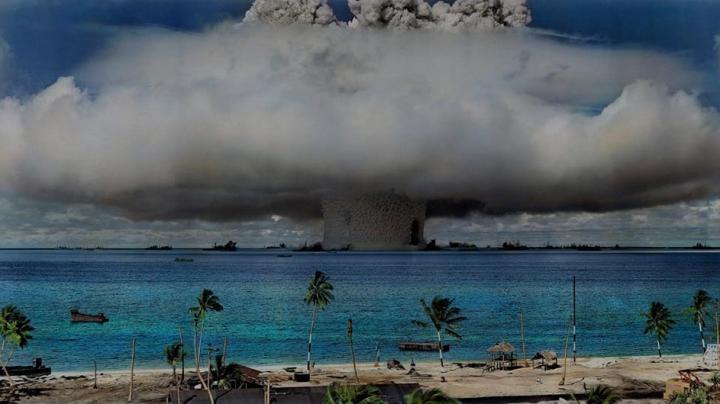
Credit: World Future Council

Radiation levels in some regions of the Marshall Islands in the central Pacific, where the United States conducted nuclear tests during the Cold War, are far higher than in areas affected by the Chernobyl and Fukushima nuclear disasters, according to new research from Columbia University.

Three studies published July 15 in Proceedings of the National Academy of Sciences (PNAS) by a Columbia research team, led by Emlyn Hughes and Malvin Ruderman from the Columbia Center for Nuclear Studies, showed that the concentration of nuclear isotopes on some of the islands was well above the legal exposure limit established in agreements between the U.S. and Republic of the Marshall Islands. The studies measured soil samples, ocean sediment and a variety of fruit.

Nearly 70 nuclear bombs the United States detonated between 1946 and 1958 left widespread contamination on the islands, a chain of atolls halfway between Australia and Hawaii. The largest nuclear detonation, “Castle Bravo,” in 1954 at Bikini Atoll, was 1,000 times more powerful than either of the bombs dropped on the Japanese cities of Hiroshima and Nagasaki.

The Marshall Islands have experienced rapid growth since the 1960s. Most of the nation’s residents live on two crowded islands and are unable to return to their home islands because of nuclear contamination. Nuclear fallout from the tests is most concentrated on the Bikini, Enewetak, Rongelap and Utirik atolls.

“Based upon our results, we conclude that to ensure safe relocation to Bikini and Rongelap Atolls, further environmental remediation… appears to be necessary to avoid potentially harmful exposure to radiation,” wrote the study authors, who also include Ivana Nikolic Hughes, associate professor of chemistry at Columbia.

###

Media Contact
Carla Cantor
[email protected]

Related Journal Article

http://dx.doi.org/10.1073/pnas.1903478116

Tags: Atmospheric ChemistryAtomic PhysicsAtomic/Molecular/Particle PhysicsEnvironmental HealthMedical/Scientific EthicsMedicine/HealthNuclear PhysicsPollution/RemediationPublic Health
Share12Tweet8Share2ShareShareShare2

Related Posts

Evaluating Digoxin Use in Patients with Symptomatic Rheumatic Heart Disease

May 10, 2026

Evaluating the Effectiveness and Safety of Digitalis Glycosides in Treating Heart Failure

May 10, 2026

Urdu Fall Risk Questionnaire Adapted for Elderly

May 10, 2026

Key Pharmacological Markers for HIV Prevention in MSM

May 10, 2026
Please login to join discussion

POPULAR NEWS

  • Research Indicates Potential Connection Between Prenatal Medication Exposure and Elevated Autism Risk

    840 shares
    Share 336 Tweet 210
  • New Study Reveals Plants Can Detect the Sound of Rain

    727 shares
    Share 290 Tweet 181
  • Scientists Investigate Possible Connection Between COVID-19 and Increased Lung Cancer Risk

    68 shares
    Share 27 Tweet 17
  • Salmonella Haem Blocks Macrophages, Boosts Infection

    61 shares
    Share 24 Tweet 15

About

We bring you the latest biotechnology news from best research centers and universities around the world. Check our website.

Follow us

Recent News

Evaluating Digoxin Use in Patients with Symptomatic Rheumatic Heart Disease

Evaluating the Effectiveness and Safety of Digitalis Glycosides in Treating Heart Failure

Urdu Fall Risk Questionnaire Adapted for Elderly

Subscribe to Blog via Email

Success! An email was just sent to confirm your subscription. Please find the email now and click 'Confirm' to start subscribing.

Join 82 other subscribers
  • Contact Us

Bioengineer.org © Copyright 2023 All Rights Reserved.

Welcome Back!

Login to your account below

Forgotten Password?

Retrieve your password

Please enter your username or email address to reset your password.

Log In
No Result
View All Result
  • Homepages
    • Home Page 1
    • Home Page 2
  • News
  • National
  • Business
  • Health
  • Lifestyle
  • Science

Bioengineer.org © Copyright 2023 All Rights Reserved.