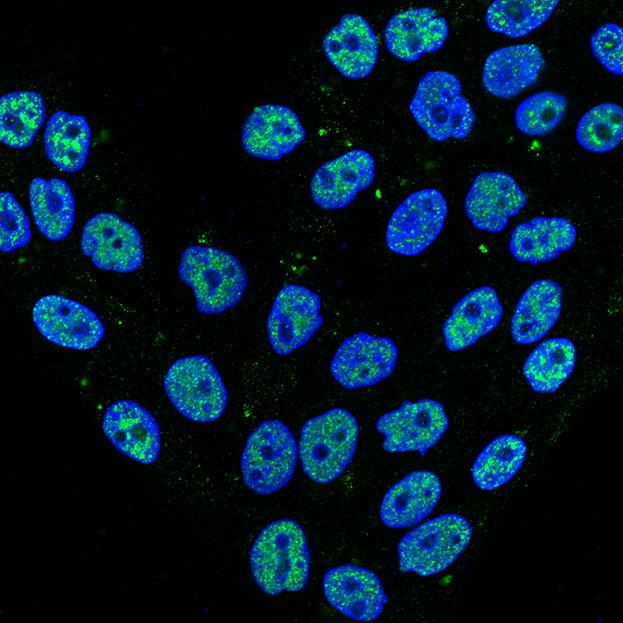
Credit: Kuperwasser Lab/Tufts University School of Medicine (Image courtesy of Cell Reports)
BOSTON (July 16, 2019)– A new study published in Cell Reports found that a transcription factor called Slug serves as ‘command central’ for determining breast stem cell health, regulating both stem cell activity and repair of DNA damage. The research team also discovered that Slug likely functions as a safeguard against age-related decline of breast stem cell function.
Transcription factors are proteins that bind to DNA sequences and play a role in cancer. The research team previously reported that Slug plays a central role in some types of breast cancers. Building on their prior work, the researchers used breast cells from both humans and mice to explore how Slug might be helpful in maintaining cell fitness.
“These findings help us understand how Slug functions in normal breast tissue and how it may function in breast cancer,” said breast cancer researcher Charlotte Kuperwasser at Tufts University School of Medicine. “Slug is overexpressed in a subtype of breast cancer called basal-like breast cancer. If Slug is also critical for DNA damage repair mechanisms in basal-like breast cancers, it might increase the attractiveness of Slug as a therapeutic target.”
The main function of stem cells in our bodies is to replenish tissues, and to do so, stem cells need to stay healthy. One of the most important ways stem cells do this is by efficiently repairing damaged DNA, as unrepaired damage can lead to mutations in DNA that disrupt normal stem cell behavior. Upon detecting DNA damage, stem cells activate checkpoints to prevent replication of damaged cells, and they only regain regenerative activity after damaged DNA has been properly repaired.
“Our previous work established that Slug is critical for stem cell activity in breast tissue, but we suspected that there was more to the story,” said Kuperwasser. “In asking what other functions Slug might be performing in breast tissue, particularly with regard to maintaining cell fitness, we found something quite interesting, which is that Slug regulates breast stem cell function partially through DNA damage repair.”
More specifically, the researchers found that Slug deficiency in human breast cells prevented recruitment of key proteins that are required for repairing DNA. This function of Slug appears to be independent of its role in regulating gene transcription.
While Kuperwasser and colleagues have yet to determine whether breast cancer cells utilize Slug’s DNA damage repair function, their current study did make a connection between Slug’s multifaceted roles in breast tissue and another biological process: aging.
As stem cells age, their ability to replicate and repair DNA damage decreases. The team found that breast tissue from aged mice had higher levels of DNA damage and lower stem cell activity. Importantly, these characteristics were also found in Slug-deficient breast tissue from young mice. The observation of these characteristics both in aged tissue and in young Slug-deficient breast tissue strongly suggests that Slug function is disrupted during aging. The precise mechanism of how that function is disrupted is still being investigated by the team.
“Our data point towards Slug acting as a safeguard against breast tissue aging, as it promotes both stem cell activity and efficient DNA damage repair, which are disrupted in aged breast tissue,” said co-first author Kayla Gross, who did this work as part of her Ph.D. dissertation at the Sackler School of Graduate Biomedical Sciences at Tufts.
“But these ‘fountain of youth’ properties of Slug are certainly a double-edged sword. Breast cancer cells may keep themselves up and running by co-opting the stem cell activity and DNA repair activity of Slug. What will be most important going forward is understanding how Slug is regulated. How do aged cells turn off its functions? How do breast cancer cells turn them on?” continued Gross.
###
The co-first author is Wenhui Zhou, who did this work as part of his M.D./Ph.D. program at Tufts.
Additional authors are Jerrica L. Breindel, Quinnipiac University and former member of the NIH-funded Institutional Research Career and Academic Development Awards Program, Training in Education and Critical Research Skills, at Tufts (TEACRS-IRACDA); Jian Ouyang, of Massachusetts General Hospital Cancer Center; Dexter X. Jin and Ethan S. Sokol, formerly of the Gupta Lab at the Whitehead Institute for Biomedical Research; Lee Zou, Massachusetts General Hospital Cancer Center and Harvard Medical School; Piyush Gupta, MIT and Whitehead Institute; and Kathryn Huber, Tufts Medical Center and Tufts University School of Medicine.
This work was supported by awards from National Institutes of Health’s National Institute of General Medical Sciences (R01GM124491), the Raymond and Beverly Sackler Convergence Laboratory, Find The Cause Breast Cancer Foundation, Breast Cancer Research Foundation, and Neuroendocrine Tumor Research Foundation. Please see the study for conflicts of interest. This content is solely the responsibility of the authors and does not necessarily represent the official views of the National Institutes of Health or other funders.
Gross, K. M., Zhou, W., Breindel, J. L., Ouyang, J., Jin, D. X., Sokol, E. S., Gupta, P.B., Huber, K., Zou, L., Kuperwasser, C. (2019). Loss of Slug compromises DNA damage repair and accelerates stem cell aging in mammary epithelium. Cell Reports, 28, 1-14. https:/
Media Contact
Audrey Jenkins
[email protected]
Related Journal Article
http://dx.