• HOME
  • NEWS
  • EXPLORE
    • CAREER
      • Companies
      • Jobs
    • EVENTS
    • iGEM
      • News
      • Team
    • PHOTOS
    • VIDEO
    • WIKI
  • BLOG
  • COMMUNITY
    • FACEBOOK
    • INSTAGRAM
    • TWITTER
Saturday, February 7, 2026
BIOENGINEER.ORG
No Result
View All Result
  • Login
  • HOME
  • NEWS
  • EXPLORE
    • CAREER
      • Companies
      • Jobs
        • Lecturer
        • PhD Studentship
        • Postdoc
        • Research Assistant
    • EVENTS
    • iGEM
      • News
      • Team
    • PHOTOS
    • VIDEO
    • WIKI
  • BLOG
  • COMMUNITY
    • FACEBOOK
    • INSTAGRAM
    • TWITTER
  • HOME
  • NEWS
  • EXPLORE
    • CAREER
      • Companies
      • Jobs
        • Lecturer
        • PhD Studentship
        • Postdoc
        • Research Assistant
    • EVENTS
    • iGEM
      • News
      • Team
    • PHOTOS
    • VIDEO
    • WIKI
  • BLOG
  • COMMUNITY
    • FACEBOOK
    • INSTAGRAM
    • TWITTER
No Result
View All Result
Bioengineer.org
No Result
View All Result
Home NEWS Science News Chemistry

Robert Alfano team identifies new ‘Majorana Photons’

Bioengineer by Bioengineer
July 15, 2019
in Chemistry
Reading Time: 2 mins read
0
IMAGE
Share on FacebookShare on TwitterShare on LinkedinShare on RedditShare on Telegram

IMAGE

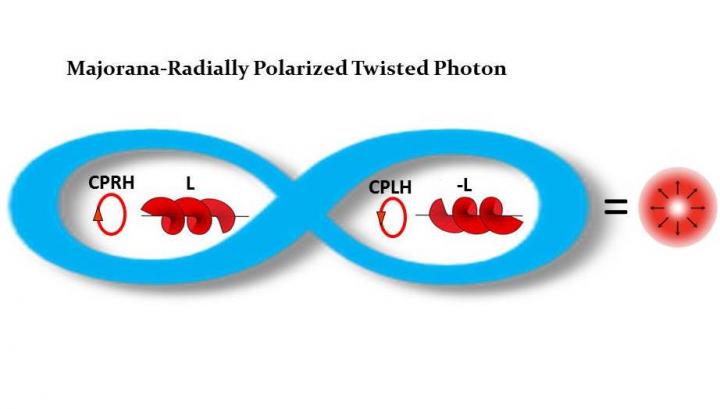
Credit: Robert R. Alfano & Yury Budansky

Hailed as a pioneer by Photonics Media for his previous discoveries of supercontinuum and Cr tunable lasers, City College of New York Distinguished Professor of Science and Engineering Robert R. Alfano and his research team are claiming another breakthrough with a new super class of photons dubbed “Majorana photons.” They could lead to enhanced information on quantum-level transition and imaging of the brain and its working.

Alfano’s group based its research on the fact that photons, while possessing salient properties of polarization, wavelength, coherence and spatial modes, take on several forms. “Photons are amazing and are all not the same,” Alfano states.

Their focus “was to use a ‘special super form’ of photons, which process the entanglement twists of both polarizations and the wavefront to probe and would propagate deeper in brain tissues, microtubules and neuron cells, giving more fundamental information of the brain than the conventional photon forms.”

These unique photons can travel with different wavefronts. They also have a vortex where the wavefront twists and polarization is non- homogenous in the wave beam diameter. These beams are called Cylindrical Vector Vortex Beams (CVVB).

Among these CVVB photons, the Alfano team identified a new “super special” class called classical entangled photon beams. These photons are mixed having both different types of circular polarization and + L and – L orbital angular momentum, locally. In addition, they are entangled with their own anti photon. Two stand out Radial and Azmuthal optical beams.

Alfano named them “Majorana Photons,” after Ettore Majorana, an Italian theoretical physicist and protégé of Enrico Fermi, who worked on neutrino masses.

“The ‘super special photon” will play an important role in understanding the fundamental and quantum processes in materials, deeper penetration and to advance applications in photo detection sensing, information, communication and future computers,” said Alfano, a prolific inventor whose research has led to advancements in ultrafast laser science and nonlinear optical imaging, since 1970.

###

This research was partly funded by a five-year $1.5 million grant from the United States Army Research Office (ARO) to investigate quantum effects in brain, microtubules, and neuron cells.

Alfano’s collaborators in ARO grant included Travis Craddock (Nova Southeastern University); Lingyan Shi (University of California San Diego) and Enrique Galvez (Colgate University), Daniel Nolan (Corning), and Sandra Mamani, an electrical engineering PhD student at CCNY.

Media Contact
Jay Mwamba
[email protected]

Original Source

https://www.ccny.cuny.edu/news/robert-alfano-team-identifies-new-%E2%80%9Cmajorana-photons%E2%80%9D

Tags: Atomic PhysicsAtomic/Molecular/Particle PhysicsChemistry/Physics/Materials SciencesMaterialsMolecular PhysicsOpticsParticle PhysicsResearch/Development
Share12Tweet8Share2ShareShareShare2

Related Posts

blank

Breakthrough in Environmental Cleanup: Scientists Develop Solar-Activated Biochar for Faster Remediation

February 7, 2026
blank

Cutting Costs: Making Hydrogen Fuel Cells More Affordable

February 6, 2026

Scientists Develop Hand-Held “Levitating” Time Crystals

February 6, 2026

Observing a Key Green-Energy Catalyst Dissolve Atom by Atom

February 6, 2026
Please login to join discussion

POPULAR NEWS

  • Robotic Ureteral Reconstruction: A Novel Approach

    Robotic Ureteral Reconstruction: A Novel Approach

    82 shares
    Share 33 Tweet 21
  • Digital Privacy: Health Data Control in Incarceration

    63 shares
    Share 25 Tweet 16
  • Study Reveals Lipid Accumulation in ME/CFS Cells

    57 shares
    Share 23 Tweet 14
  • Breakthrough in RNA Research Accelerates Medical Innovations Timeline

    53 shares
    Share 21 Tweet 13

About

We bring you the latest biotechnology news from best research centers and universities around the world. Check our website.

Follow us

Recent News

Phage-Antibiotic Combo Beats Resistant Peritoneal Infection

Boosting Remote Healthcare: Stepped-Wedge Trial Insights

Barriers and Boosters of Seniors’ Physical Activity in Karachi

Subscribe to Blog via Email

Enter your email address to subscribe to this blog and receive notifications of new posts by email.

Join 73 other subscribers
  • Contact Us

Bioengineer.org © Copyright 2023 All Rights Reserved.

Welcome Back!

Login to your account below

Forgotten Password?

Retrieve your password

Please enter your username or email address to reset your password.

Log In
No Result
View All Result
  • Homepages
    • Home Page 1
    • Home Page 2
  • News
  • National
  • Business
  • Health
  • Lifestyle
  • Science

Bioengineer.org © Copyright 2023 All Rights Reserved.