Credit: Elena Khavina/MIPT Press Office
A team of researchers from Russia, Germany, and France featuring materials scientists from the Moscow Institute of Science and Technology has investigated how the electrical properties of dihexyl-quarterthiophene thin films depend on their structure. This material is an organic semiconductor with prospects for flexible electronics. It turned out that once the thin films undergo a transition from the crystal to the liquid-crystal state, they lose some of their electrical conductivity. The team also discovered a “third phase” that does not occur in bulk material and corresponds to a monomolecular layer of the semiconductor. This structure could be favorable for charge transport across the films, with potential implications for microelectronics design. The research findings were published in Nanoscale Research Letters.
Oligothiophenes are promising organic semiconductors. Their rod-shaped molecules can orient at the surface on which they have been deposited, piling up cycles of hydrocarbons containing a sulfur atom known as thiophenes, like stacks of coins. The “coin edges” in the neighboring stacks form a herringbone pattern. This molecular arrangement enables the charge transfer from one molecule to the other.
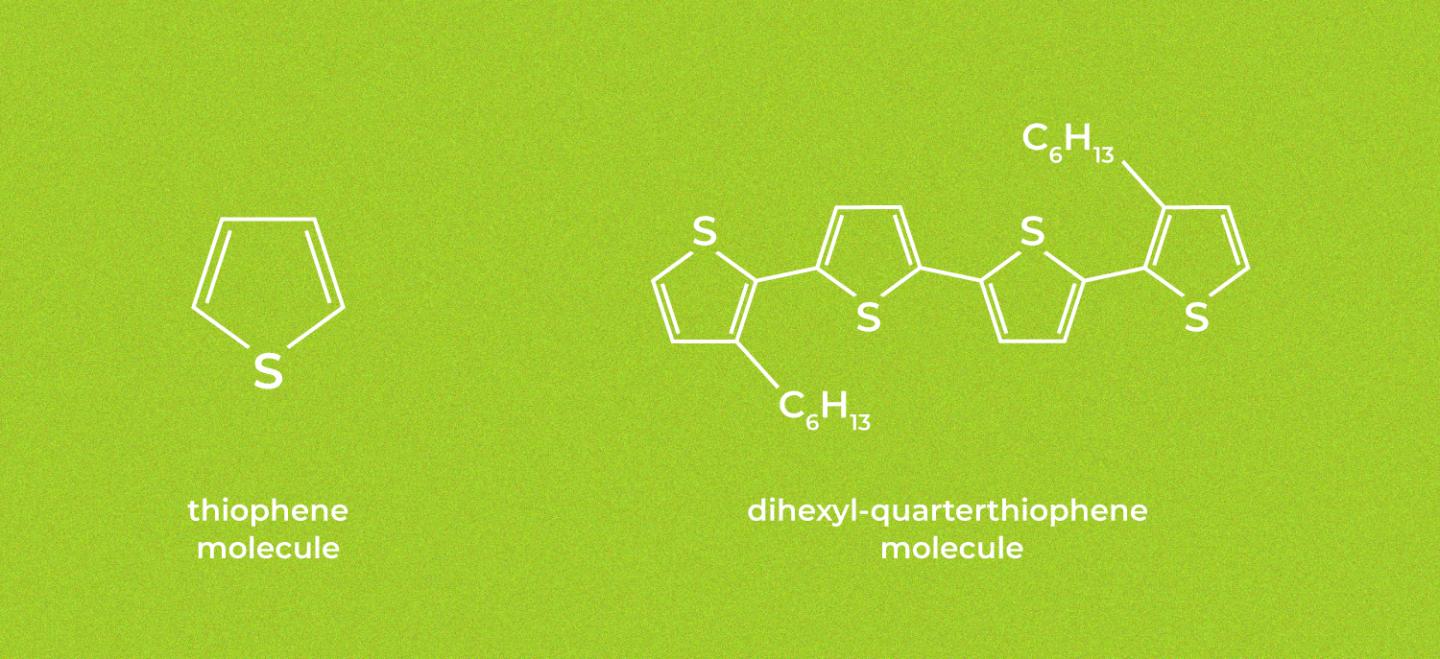
As the number of thiophenes in the molecule increased, so does the electrical conductivity, at the cost of the compound’s solubility. Four is believed to be the optimal number of these so-called thiophene moieties. To increase solubility, hexyl fragments are grafted to the ends of the conjugated molecular fragment (fig. 1).
The researchers dissolved and evaporated dihexyl-quarterthiophene (DH4T) in a vacuum reactor and deposited the material as thin films on a silicon substrate. They went on to study the crystal structure of the samples using grazing-incidence X-ray diffraction. This technique involves exposing a film to X-rays at a very small glancing angle to maximize the distance the X-ray beam travels in the film, undergoing numerous reflections. Otherwise, the signal from the thin film would be too faint to be distinguishable from the substrate signal. The diffraction measurements allowed the team to identify the molecular arrangement in the material deposited on the substrate.
Initially, DH4T was highly crystalline. Its molecules formed a herringbone pattern and were positioned almost perpendicular to the substrate. However, once heated to 85 degrees Celsius, the material underwent a phase transition: The molecular arrangement changed, forming a liquid crystal phase, and the electrical conductivity of the films dropped.
The sample was further heated to 130 C and subsequently cooled to room temperature. This partly restored the material’s crystallinity, and therefore conductivity.
Over the course of heating, a third structure emerged in the X-ray diffraction profile, indicated by weak diffraction maxima not corresponding to the liquid crystal phase. Prior research has correlated such maxima with monolayers of compounds like DH4T. Interestingly, this “third phase” was also observed at 70 C.
The structure of the monolayer discovered by the team is favorable for charge transport along the plane of the film, making it significant for flexible electronics applications. Besides that, the newly observed phase could also occur in the thin films of other compounds whose structure is similar to that of DH4T. Such materials are used in microelectronics. Since charge is predominantly transferred in a very thin layer near the substrate, the researchers’ findings point to the need to consider how the material’s nanostructure affects its conductivity.
Professor Dimitri Ivanov heads the Laboratory of Functional Organic and Hybrid Materials at MIPT and is also the director of research at the French National Center for Scientific Research (CNRS). He co-authored the study reported in this story and commented on its findings: “Using in situ methods, such as structural analysis, and at the same time measuring sample electrical properties enables us to gain insights into the nature of complex phase transitions in the material and assess its potential for practical applications in organic electronics.
###
Media Contact
Varvara Bogomolova
[email protected]
Original Source
https:/
Related Journal Article
http://dx.