• HOME
  • NEWS
  • EXPLORE
    • CAREER
      • Companies
      • Jobs
    • EVENTS
    • iGEM
      • News
      • Team
    • PHOTOS
    • VIDEO
    • WIKI
  • BLOG
  • COMMUNITY
    • FACEBOOK
    • INSTAGRAM
    • TWITTER
Monday, January 12, 2026
BIOENGINEER.ORG
No Result
View All Result
  • Login
  • HOME
  • NEWS
  • EXPLORE
    • CAREER
      • Companies
      • Jobs
        • Lecturer
        • PhD Studentship
        • Postdoc
        • Research Assistant
    • EVENTS
    • iGEM
      • News
      • Team
    • PHOTOS
    • VIDEO
    • WIKI
  • BLOG
  • COMMUNITY
    • FACEBOOK
    • INSTAGRAM
    • TWITTER
  • HOME
  • NEWS
  • EXPLORE
    • CAREER
      • Companies
      • Jobs
        • Lecturer
        • PhD Studentship
        • Postdoc
        • Research Assistant
    • EVENTS
    • iGEM
      • News
      • Team
    • PHOTOS
    • VIDEO
    • WIKI
  • BLOG
  • COMMUNITY
    • FACEBOOK
    • INSTAGRAM
    • TWITTER
No Result
View All Result
Bioengineer.org
No Result
View All Result
Home NEWS Science News Chemistry

New probe could help surgeons more accurately remove tumours

Bioengineer by Bioengineer
July 8, 2019
in Chemistry
Reading Time: 2 mins read
0
IMAGE
Share on FacebookShare on TwitterShare on LinkedinShare on RedditShare on Telegram

RCSI study has potential to transform surgical management of cancer
IMAGE

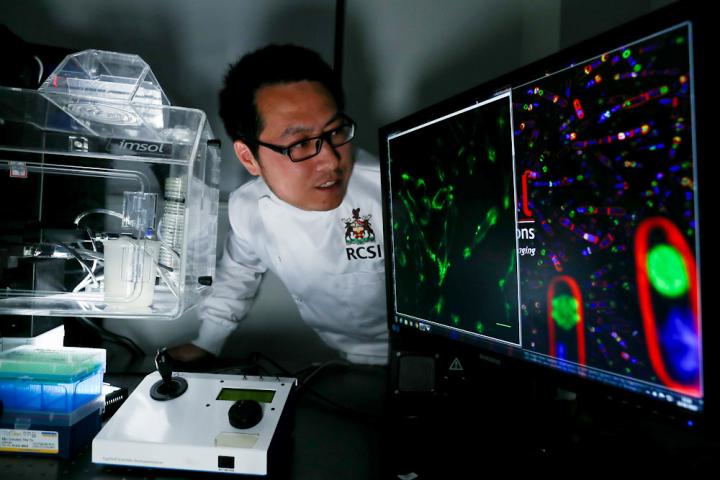
Credit: Maxwell Photography

DUBLIN, 2 July, 2019: A study led by researchers at RCSI’s Department of Chemistry has the potential to help surgeons more accurately remove tumours and detect cancer in lymph nodes during surgery. The research, led by RCSI Professor of Chemistry Donal O’Shea, has been published in Chemical Science.

Bringing together expertise in chemistry and biotechnology, the research team has identified the potential benefit of fluorescence imaging as a way of detecting cancer cells during surgery, developing a probe that lights up when it detects cancer.

According to Professor O’Shea, “This is a very significant development which has the potential to transform the surgical management of cancer, improving outcomes for patients. Almost 60% of all cancer patients will undergo surgery as part of their treatment.”

“A new technology that could improve surgical outcomes by giving the surgical team real-time, informative images during the surgical procedure would have a wide-ranging and sustained impact on the care of cancer patients.”

Addressing the next steps, Professor O’Shea said, “At the moment, this is science. A clinical trial is our next goal and that would allow the full potential of this discovery to be realised for patients, enhancing detection of life-threatening diseases and improving outcomes of surgical procedures.”

The team has recently secured funding for a project on colorectal cancer diagnosis and treatment under the Project Ireland 2040 Disruptive Technology Innovation Fund in collaboration with leading cancer surgeon Professor Ronan Cahill in the Mater University Hospital, UCD and Dublin based industry partners IBM-research and Deciphex.

The project will look at combining tissues responsive probes, artificial intelligence and machine learning to transform medical care for colorectal cancer patients.

###

This paper, RGD Conjugated Cell Uptake Off to On Responsive NIR-AZA Fluorophores: Applications toward Intraoperative Fluorescence Guided Surgery published in the current edition of Chemical Science, is part of a series of research outputs on the clinical potential of fluorescence. Dr Dan Wu, Postdoctoral Fellow in the RCSI Department of Chemistry, is the first author on the paper. Another paper, on PEGylated BF2-Azadipyrromethene (NIR-AZA) fluorophores, for intraoperative imaging, was recently published in the European Journal of Medicinal Chemistry.

RCSI is ranked among the top 250 (top 2%) of universities worldwide in the Times Higher Education World University Rankings (2019) and its research is ranked first in Ireland for citations. It is an international not-for-profit health sciences institution, with its headquarters in Dublin, focused on education and research to drive improvements in human health worldwide. RCSI has been awarded Athena Swan Bronze accreditation for positive gender practice in higher education.

Media Contact
Michael Sullivan
[email protected]

Related Journal Article

http://dx.doi.org/10.1039/C9SC02197C

Tags: BiochemistrycancerMedicine/HealthSurgery
Share44Tweet8Share2ShareShareShare2

Related Posts

blank

Advancing Alkene Chemistry: Homologative Difunctionalization Breakthrough

January 8, 2026
Biocompatible Ligand Enables Safe In-Cell Protein Arylation

Biocompatible Ligand Enables Safe In-Cell Protein Arylation

January 8, 2026

Monovalent Pseudo-Natural Products Boost IDO1 Degradation

January 7, 2026

Catalytic Enantioselective [1,2]-Wittig Rearrangement Breakthrough

January 7, 2026
Please login to join discussion

POPULAR NEWS

  • Enhancing Spiritual Care Education in Nursing Programs

    154 shares
    Share 62 Tweet 39
  • PTSD, Depression, Anxiety in Childhood Cancer Survivors, Parents

    146 shares
    Share 58 Tweet 37
  • Robotic Ureteral Reconstruction: A Novel Approach

    69 shares
    Share 28 Tweet 17
  • Study Reveals Lipid Accumulation in ME/CFS Cells

    49 shares
    Share 20 Tweet 12

About

We bring you the latest biotechnology news from best research centers and universities around the world. Check our website.

Follow us

Recent News

Eight-Year CMSAR Follow-Up: New MDS Criteria Impact

Surgery Type Influences Nutrition Duration in NEC Infants

Skin-Implanted Living Sensor Enables Long-Term Biomarker Tracking

Subscribe to Blog via Email

Enter your email address to subscribe to this blog and receive notifications of new posts by email.

Join 71 other subscribers
  • Contact Us

Bioengineer.org © Copyright 2023 All Rights Reserved.

Welcome Back!

Login to your account below

Forgotten Password?

Retrieve your password

Please enter your username or email address to reset your password.

Log In
No Result
View All Result
  • Homepages
    • Home Page 1
    • Home Page 2
  • News
  • National
  • Business
  • Health
  • Lifestyle
  • Science

Bioengineer.org © Copyright 2023 All Rights Reserved.