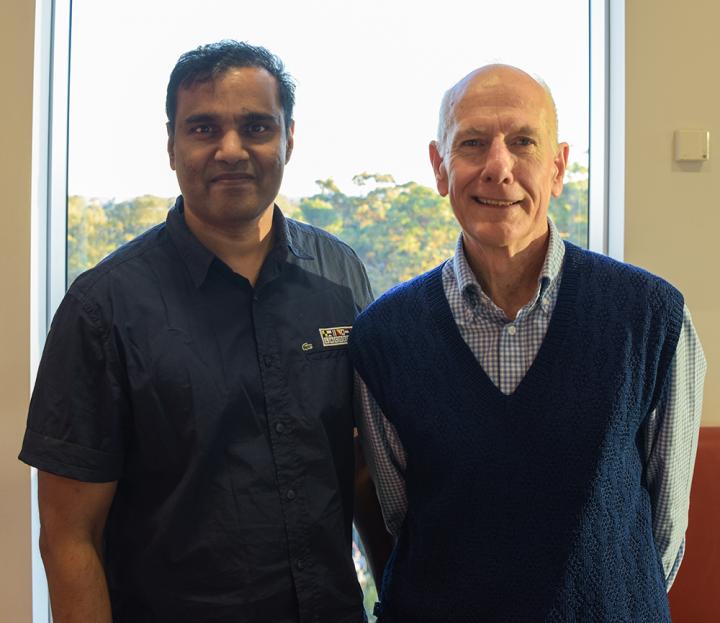
Credit: UQ QBI
A joint Australian-Indian 18-year study made possible by the recruitment, diagnosis, and the DNA screening of thousands of people in India has identified a new clue in the quest for causes of schizophrenia, and for potential treatments.
A collaboration between The University of Queensland (UQ) and a team of Indian researchers led by Professor Rangaswamy Thara, co- founder and director of the Schizophrenia Research Foundation in Chennai, searched the genomes of more than 3000 individuals and found those with schizophrenia were more likely to have a particular genetic variation.
Professor Bryan Mowry from UQ’s Queensland Brain Institute (QBI) said such studies had predominantly been done in populations with European ancestry, with more than 100 schizophrenia-associated variants identified previously.
“Looking at other populations can highlight different parts of the genome with a more robust association with the disease,” Professor Mowry said.
“This study identified a gene called NAPRT1 that encodes an enzyme involved in vitamin B3 metabolism–we were also able to find this gene in a large genomic dataset of schizophrenia patients with European ancestry.
“When we knocked out the NAPRT1 gene in zebrafish, brain development of the fish was impaired–we are now working to understand more deeply how this gene functions in the brain.”
“The zebrafish brain failed to divide symmetrically which is significant, because MRI studies in people with schizophrenia have shown defects in the corpus callosum – the bridge between the left and right sides of the brain.”
Professor Mowry said that much of the variation in schizophrenia, which occurred in about one per cent of the population, was due to genetic factors.
“Schizophrenia strikes at the heart of what it means to be human– it has devastating impacts on the sufferer and their ability to function.
“Our studies aim to shed more light on what makes people susceptible to schizophrenia and developing better treatments for the future,” he said.
“There are now a multitude of genetic variants linked to schizophrenia, but we don’t yet know what the hundreds of genes involved do.
“The next phase is to study their function in normal and diseased states using computational approaches and animal models, such as the zebrafish.
“We’d like to look further into populations in India, to increase our sample size to see if we can replicate this result and discover additional variants that might be involved.”
Professor Mowry and Professor Thara met in the late 1990s when they discussed studying a population in India–both are practicing psychiatrists and see first-hand the impact of schizophrenia on patients’ lives, their families and communities.
“Professor Thara is a driving force for research into schizophrenia in India, and her team in Chennai has been central in recruiting patients while QBI has been able to fund the processing of blood samples they’ve collected,” Professor Mowry said.
QBI’s Director, Professor Pankaj Sah, commended the collaborative effort of the team, which included Schizophrenia Research Foundation (SCARF) joint director Sujit John, who co-ordinated the recruitment of study participants, and QBI’s Dr Sathish Periyasamy, who analysed the data.
###
The research was published in JAMA Psychiatry (http://dx.
Media Contact
Bryan Mowry
[email protected]