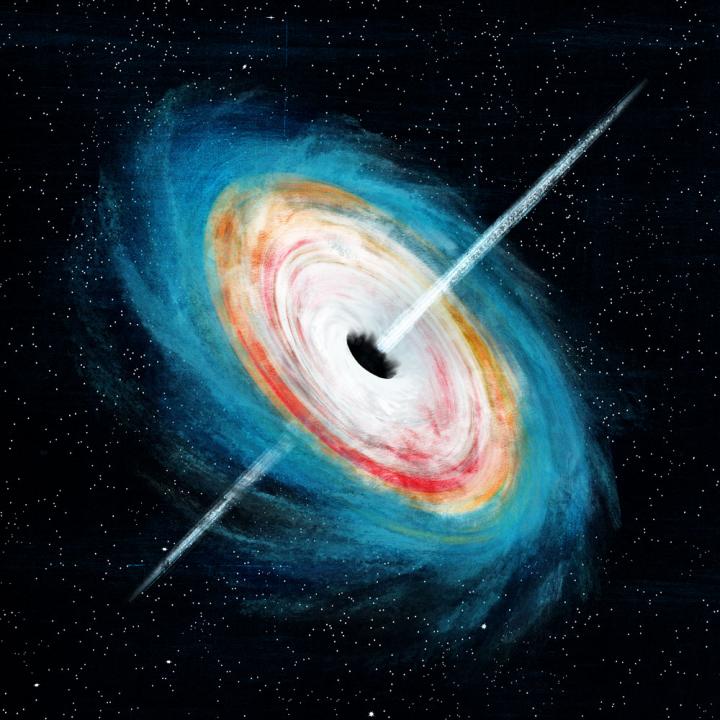
Credit: Scott Woods, Western University
Astrophysicists at Western University have found evidence for the direct formation of black holes that do not need to emerge from a star remnant. The production of black holes in the early universe, formed in this manner, may provide scientists with an explanation for the presence of extremely massive black holes at a very early stage in the history of our universe.
Shantanu Basu and Arpan Das from Western’s Department of Physics & Astronomy have developed an explanation for the observed distribution of supermassive black hole masses and luminosities, for which there was previously no scientific explanation. The findings were published today by Astrophysical Journal Letters.
The model is based on a very simple assumption: supermassive black holes form very, very quickly over very, very short periods of time and then suddenly, they stop. This explanation contrasts with the current understanding of how stellar-mass black holes are formed, which is they emerge when the centre of a very massive star collapses in upon itself.
“This is indirect observational evidence that black holes originate from direct-collapses and not from stellar remnants,” says Basu, an astronomy professor at Western who is internationally recognized as an expert in the early stages of star formation and protoplanetary disk evolution.
Basu and Das developed the new mathematical model by calculating the mass function of supermassive black holes that form over a limited time period and undergo a rapid exponential growth of mass. The mass growth can be regulated by the Eddington limit that is set by a balance of radiation and gravitation forces or can even exceed it by a modest factor.
“Supermassive black holes only had a short time period where they were able to grow fast and then at some point, because of all the radiation in the universe created by other black holes and stars, their production came to a halt,” explains Basu. “That’s the direct-collapse scenario.”
During the last decade, many supermassive black holes that are a billion times more massive than the Sun have been discovered at high ‘redshifts,’ meaning they were in place in our universe within 800 million years after the Big Bang. The presence of these young and very massive black holes question our understanding of black hole formation and growth. The direct-collapse scenario allows for initial masses that are much greater than implied by the standard stellar remnant scenario, and can go a long way to explaining the observations. This new result provides evidence that such direct-collapse black holes were indeed produced in the early universe.
Basu believes that these new results can be used with future observations to infer the formation history of the extremely massive black holes that exist at very early times in our universe.
###
MEDIA CONTACT: Jeff Renaud, Senior Media Relations Officer, 519-661-2111, ext. 85165, 519-520-7281 (mobile), [email protected], @jeffrenaud99
ABOUT WESTERN
Western University delivers an academic experience second to none. Since 1878, The Western Experience has combined academic excellence with life-long opportunities for intellectual, social and cultural growth in order to better serve our communities. Our research excellence expands knowledge and drives discovery with real-world application. Western attracts individuals with a broad worldview, seeking to study, influence and lead in the international community.
Follow Western online:
Website: http://communications.
RSS: http://feeds.
Twitter: https:/
Media Contact
Jeff Renaud
[email protected]
Original Source
https:/