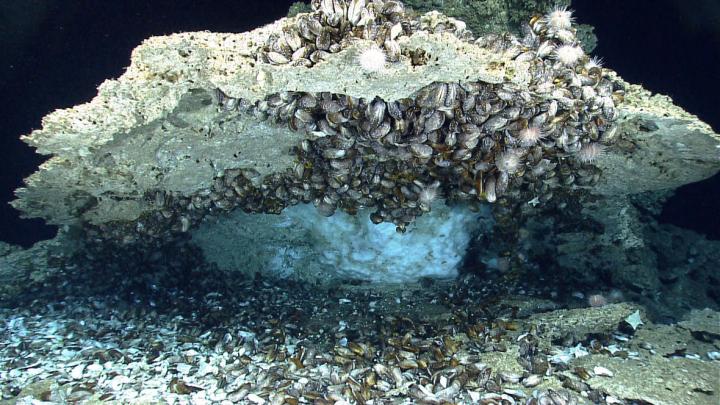
Credit: NOAA
New research at The University of Texas at Austin shows that injecting air and carbon dioxide into methane ice deposits buried beneath the Gulf of Mexico could unlock vast natural gas energy resources while helping fight climate change by trapping the carbon dioxide underground.
The study, published June 27 in the journal Water Resources Research, used computer models to simulate what happens when mixtures of carbon dioxide and air are injected into deposits of methane hydrate, an ice-like, water-rich chemical compound that forms naturally in high-pressure, low-temperature environments, such as deep in the Gulf of Mexico and under Arctic permafrost.
Lead author Kris Darnell, a recent doctoral graduate from the UT Jackson School of Geosciences, said the research is the next step in solving two significant global challenges: energy security and carbon storage.
“Our study shows that you can store carbon dioxide in hydrates and produce energy at the same time,” said Darnell, whose research was funded by the University of Texas Institute for Geophysics (UTIG).
In the process, the nitrogen in the injected air sweeps the methane toward a production well and allows carbon dioxide to take its place, researchers said. The beauty of this approach is that it extracts natural gas from methane hydrate deposits and at the same time stores carbon dioxide, a greenhouse gas, in a deep environment where it is unlikely to be released into the atmosphere where it could contribute to climate change.
This is not the first time that hydrate deposits have been proposed for carbon dioxide storage. Earlier attempts either failed or produced lackluster results. The new study breaks down the physics behind the process to reveal why previous attempts failed and how to get it right.
The next step, said Darnell, is to test their findings in a lab. The Jackson School and the UT Hildebrand Department of Petroleum and Geosystems Engineering are currently testing the method in a specialized facility in the Jackson School, which is one of the few in the world that can store and test methane hydrate. This work is being led by Peter Flemings, a Jackson School professor and senior UTIG research scientist, and David DiCarlo, a professor in the Hildebrand Department. Both are co-authors on the paper.
“Two things are really cool. First, we can produce natural gas to generate energy and sequester CO2,” said Flemings. “Second, by swapping the methane hydrate with CO2 hydrate, we disturb the (geologic) formation less, lowering the environmental impact, and we make the process energetically more efficient.”
If the process can be shown to work in the field on an industrial scale, it has enormous potential.
Methane hydrate is one of a group of chemical compounds known as gas hydrates in which gas molecules become trapped inside cages of water ice molecules rather than chemically bonding with them. UT and the U.S. Department of Energy (DOE) are working together to study naturally forming methane hydrates with the aim of figuring out their potential as an energy resource. This is important because estimates suggest that methane harvested from hydrate deposits found beneath the Gulf of Mexico alone could power the country for hundreds of years.
In the paper, the authors showed that a process in which one type of molecule trapped in hydrate is exchanged for another (called guest molecule exchange) is a two-stage process and not a single, simultaneous process, as it was previously thought to be.
First, nitrogen breaks down the methane hydrate. Second, the carbon dioxide crystalizes into a slow-moving wave of carbon dioxide hydrate behind the escaping methane gas.
The computer simulations indicate that the process can be repeated with increasing concentrations of carbon dioxide until the reservoir becomes saturated. The authors said that unlike some methods of carbon storage, this provides a ready incentive for industry to begin storing carbon dioxide, a major driver of climate change.
“We’re now openly inviting the entire scientific community to go out and use what we’re learning to move the ball forward,” Flemings said.
###
The research that led to the paper was supported by DOE.
Media Contact
Constantino Panagopulos
[email protected]
Related Journal Article
http://dx.