• HOME
  • NEWS
  • EXPLORE
    • CAREER
      • Companies
      • Jobs
    • EVENTS
    • iGEM
      • News
      • Team
    • PHOTOS
    • VIDEO
    • WIKI
  • BLOG
  • COMMUNITY
    • FACEBOOK
    • INSTAGRAM
    • TWITTER
Saturday, February 7, 2026
BIOENGINEER.ORG
No Result
View All Result
  • Login
  • HOME
  • NEWS
  • EXPLORE
    • CAREER
      • Companies
      • Jobs
        • Lecturer
        • PhD Studentship
        • Postdoc
        • Research Assistant
    • EVENTS
    • iGEM
      • News
      • Team
    • PHOTOS
    • VIDEO
    • WIKI
  • BLOG
  • COMMUNITY
    • FACEBOOK
    • INSTAGRAM
    • TWITTER
  • HOME
  • NEWS
  • EXPLORE
    • CAREER
      • Companies
      • Jobs
        • Lecturer
        • PhD Studentship
        • Postdoc
        • Research Assistant
    • EVENTS
    • iGEM
      • News
      • Team
    • PHOTOS
    • VIDEO
    • WIKI
  • BLOG
  • COMMUNITY
    • FACEBOOK
    • INSTAGRAM
    • TWITTER
No Result
View All Result
Bioengineer.org
No Result
View All Result
Home NEWS Science News Health

Methylmercury precipitates heart failure by increasing Drp1-mediated mitochondrial fission

Bioengineer by Bioengineer
June 26, 2019
in Health
Reading Time: 2 mins read
0
IMAGE
Share on FacebookShare on TwitterShare on LinkedinShare on RedditShare on Telegram

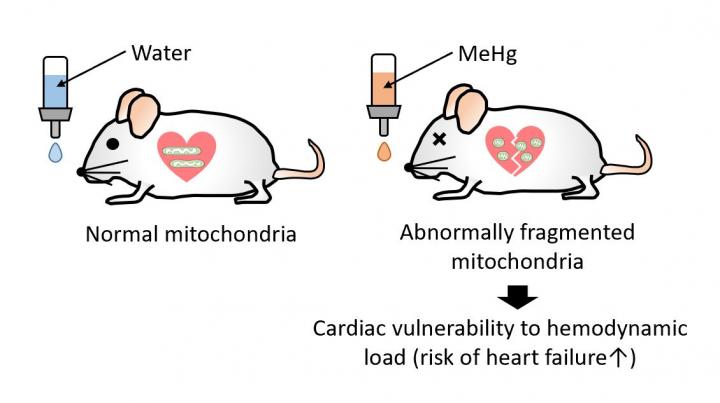
Researchers from National Institute for Physiological Sciences in Japan identify the mechanism underlying environmental stress-induced cardiac vulnerability to hemodynamic load in mice
IMAGE

Credit: National Institute for Physiological Sciences

Okazaki, Japan – Although the widespread environmental contaminant methylmercury is largely associated with neurotoxic effects, it is also associated with increased risk for cardiovascular disease. Nishimura et al. found that mice exposed to a dose of methylmercury that was too low to cause neurotoxicity were more vulnerable to heart failure in response to pressure overload. Methylmercury removed a polysulfide group from Drp1, thereby removing an inhibitory brake on this protein, which resulted in increased Drp1-mediated mitochondrial fission. Treating mice or human cardiomyocytes with a polysulfide group-releasing compound reversed fragility to mechanical overload induced by methylmercury. These results provide a molecular mechanism for the cardiotoxic effects of methylmercury and a possible strategy to avert these effects.

Chronic exposure to methylmercury (MeHg), an environmental electrophilic pollutant, reportedly increases the risk of human cardiac events. We report that exposure to a low, non-neurotoxic dose of MeHg precipitated heart failure induced by pressure overload in mice. Exposure to MeHg at 10 ppm did not induce weight loss typical of higher doses but caused mitochondrial hyperfission in myocardium through the activation of Drp1 by its guanine nucleotide exchange factor filamin-A. Treatment of neonatal rat cardiomyocytes (NRCMs) with cilnidipine, an inhibitor of the interaction between Drp1 and filamin-A, suppressed mitochondrial hyperfission caused by low-dose MeHg exposure. Modification of cysteine residues in proteins with polysulfides is important for redox signaling and mitochondrial homeostasis in mammalian cells. We found that MeHg targeted rat Drp1 at Cys624, a redox-sensitive residue whose SH side chain forms a bulky and nucleophilic polysulfide (Cys624-S(n)H). MeHg exposure induced the depolysulfidation of Cys624-S(n)H in Drp1, which led to filamin-dependent activation of Drp1 and mitochondrial hyperfission. Treatment with NaHS, which acts as a donor for reactive polysulfides, reversed MeHg-evoked Drp1 depolysulfidation and vulnerability to mechanical load in rodent and human cardiomyocytes and mouse hearts. These results suggest that depolysulfidation of Drp1 at Cys624-S(n)H by low-dose MeHg increases cardiac fragility to mechanical load through filamin-dependent mitochondrial hyperfission.

This work newly suggests the molecular mechanism how low-dose methylmercury makes hearts more fragile.

###

Media Contact
Motohiro Nishid
[email protected]

Related Journal Article

http://dx.doi.org/10.1126/scisignal.aaw1920

Tags: BiologyCell BiologyEcology/EnvironmentMolecular BiologyPharmaceutical Sciences
Share12Tweet8Share2ShareShareShare2

Related Posts

Decoding Prostate Cancer Origins via snFLARE-seq, mxFRIZNGRND

February 7, 2026

Digital Health Perspectives from Baltic Sea Experts

February 7, 2026

Exploring Decision-Making in Dementia Caregivers’ Mobility

February 7, 2026

Succinate Receptor 1 Limits Blood Cell Formation, Leukemia

February 7, 2026
Please login to join discussion

POPULAR NEWS

  • Robotic Ureteral Reconstruction: A Novel Approach

    Robotic Ureteral Reconstruction: A Novel Approach

    82 shares
    Share 33 Tweet 21
  • Digital Privacy: Health Data Control in Incarceration

    63 shares
    Share 25 Tweet 16
  • Study Reveals Lipid Accumulation in ME/CFS Cells

    57 shares
    Share 23 Tweet 14
  • Breakthrough in RNA Research Accelerates Medical Innovations Timeline

    53 shares
    Share 21 Tweet 13

About

We bring you the latest biotechnology news from best research centers and universities around the world. Check our website.

Follow us

Recent News

Decoding Prostate Cancer Origins via snFLARE-seq, mxFRIZNGRND

Digital Health Perspectives from Baltic Sea Experts

Florida Cane Toad: Complex Spread and Selective Evolution

Subscribe to Blog via Email

Enter your email address to subscribe to this blog and receive notifications of new posts by email.

Join 73 other subscribers
  • Contact Us

Bioengineer.org © Copyright 2023 All Rights Reserved.

Welcome Back!

Login to your account below

Forgotten Password?

Retrieve your password

Please enter your username or email address to reset your password.

Log In
No Result
View All Result
  • Homepages
    • Home Page 1
    • Home Page 2
  • News
  • National
  • Business
  • Health
  • Lifestyle
  • Science

Bioengineer.org © Copyright 2023 All Rights Reserved.