Discovery leads to promising new materials for converting waste heat to power
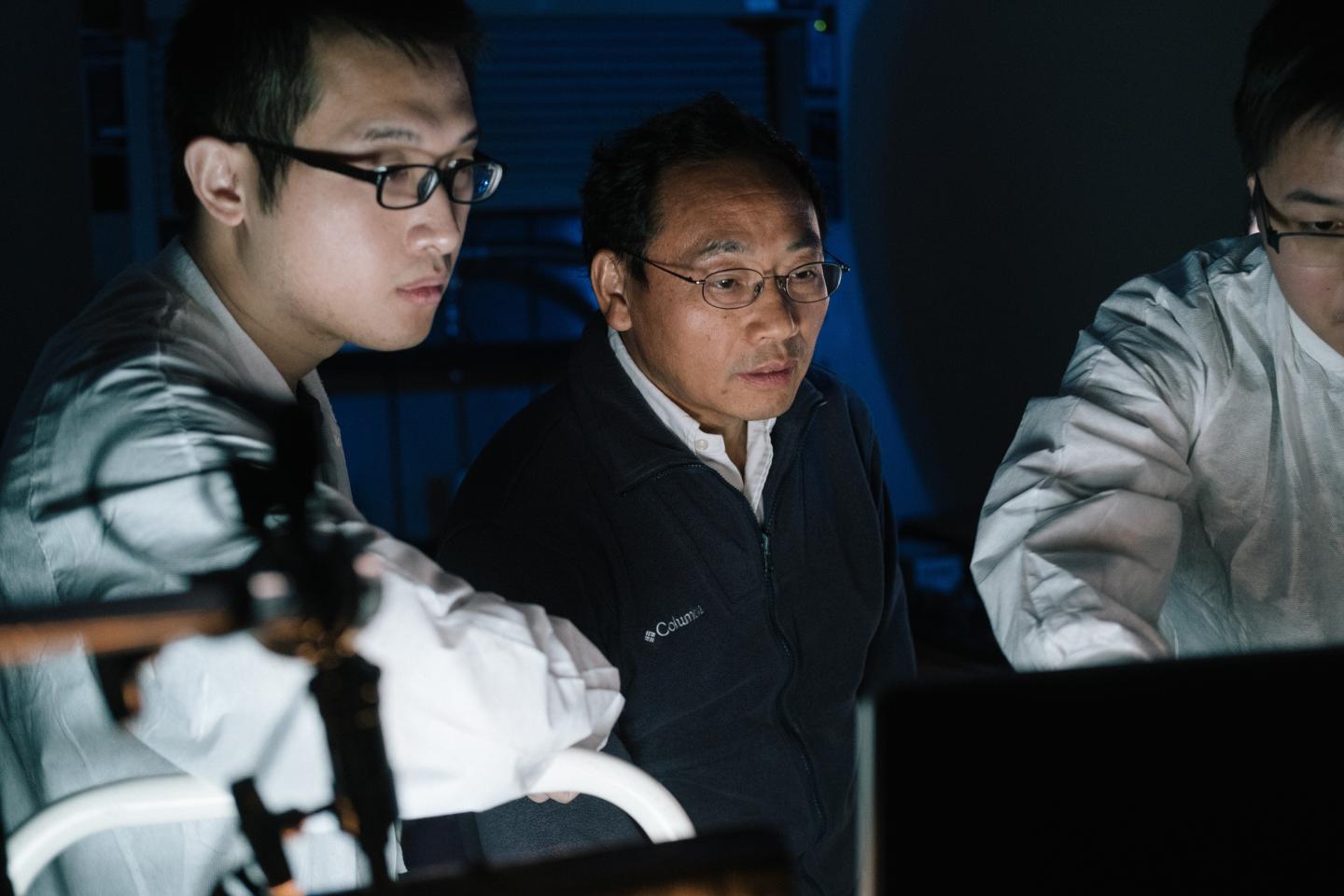
Credit: University of Houston
The promise of thermoelectric materials as a source of clean energy has driven the search for materials that can efficiently produce substantial amounts of power from waste heat.
Researchers reported a major step forward Friday, publishing in Science Advances the discovery of a new explanation for asymmetrical thermoelectric performance, the phenomenon that occurs when a material that is highly efficient in a form which carries a positive charge is far less efficient in the form which carries a negative charge, or vice versa.
Zhifeng Ren, M. D. Anderson Chair Professor of Physics at the University of Houston, director of the Texas Center for Superconductivity at UH and corresponding author on the paper, said they have developed a model to explain the previously unaddressed disparity in performance between the two types of formulations. They then applied the model to predict promising new materials to generate power using waste heat from power plants and other sources.
The researchers already knew thermoelectric efficiency depends on the performance of the material in both forms, known as “p-type” and “n-type” for carrying a positive and negative charge, respectively. But most materials either don’t exist in both formulations or one type is more efficient than the other.
Promising New Material Synthesized
It is possible to build effective thermoelectric devices using just a p-type or n-type compound, but it is easier to design a device that contains both types; Ren said the best performance would come when both types exhibit similar properties.
The researchers synthesized one of the predicted materials, a zirconium-cobalt-bismuth compound, and reported a measured heat-to-electricity conversion efficiency of 10.6% at both the cold side, about 303 Kelvin, or about 86 degrees Fahrenheit, and the hot side, about 983 Kelvin (1,310 Fahrenheit) for both the p-type and the n-type.
Jun Mao, a post-doctoral researcher at UH and a first author of the report, said they determined the asymmetrical performance of some materials is linked to the fact that the charge moves at different rates in the two types of formulation. “If the charge movement of both the positive charge, for p-type, and the negative charge, for n-type, is similar, the thermoelectric performance of both types is similar,” he said.
Knowing that, they were able to use the mobility ratio to predict performance of previously unstudied formulations.
“When the thermoelectric performance for one type of a material has been experimentally studied, while the other type has not yet been investigated, it is possible to predict the ZT by using the identified relationship between the asymmetry and weighted mobility ratio,” the researchers wrote. ZT, or the figure of merit, is a metric used to determine how efficiently a thermoelectric material converts heat to electricity.
New Model Predicts Highly Efficient Materials
Hangtian Zhu, a post-doctoral researcher at UH and the report’s other first author, said the next step is determining how to formulate the corresponding type of material, once a material with a high efficiency in either p-type or n-type is found.
That can require experimentation to determine the best dopant – researchers tweak performance by adding a tiny amount of an additional element to the compound, known as “doping” – to improve performance, Zhu said.
That’s where the new understanding of asymmetrical performance comes in. Zhu said by predicting which compounds will have high performance in both types, researchers are encouraged to continue looking for the best combination, even if early efforts did not succeed.
###
Other researchers involved in the project are: Qing Zhu and Zihang Liu, both of UH; Yumei Wang of the Beijing National Laboratory for Condensed Matter Physics; and Zhenzhen Feng, Jifeng Sun and David J. Singh of the University of Missouri.
Media Contact
Jeannie Kever
[email protected]