• HOME
  • NEWS
  • EXPLORE
    • CAREER
      • Companies
      • Jobs
    • EVENTS
    • iGEM
      • News
      • Team
    • PHOTOS
    • VIDEO
    • WIKI
  • BLOG
  • COMMUNITY
    • FACEBOOK
    • INSTAGRAM
    • TWITTER
Thursday, July 16, 2026
BIOENGINEER.ORG
No Result
View All Result
  • Login
  • HOME
  • NEWS
  • EXPLORE
    • CAREER
      • Companies
      • Jobs
        • Lecturer
        • PhD Studentship
        • Postdoc
        • Research Assistant
    • EVENTS
    • iGEM
      • News
      • Team
    • PHOTOS
    • VIDEO
    • WIKI
  • BLOG
  • COMMUNITY
    • FACEBOOK
    • INSTAGRAM
    • TWITTER
  • HOME
  • NEWS
  • EXPLORE
    • CAREER
      • Companies
      • Jobs
        • Lecturer
        • PhD Studentship
        • Postdoc
        • Research Assistant
    • EVENTS
    • iGEM
      • News
      • Team
    • PHOTOS
    • VIDEO
    • WIKI
  • BLOG
  • COMMUNITY
    • FACEBOOK
    • INSTAGRAM
    • TWITTER
No Result
View All Result
Bioengineer.org
No Result
View All Result
Home NEWS Science News Chemistry

Ice lithography: opportunities and challenges in 3D nanofabrication

Bioengineer by Bioengineer
June 21, 2019
in Chemistry
Reading Time: 2 mins read
0
IMAGE
Share on FacebookShare on TwitterShare on LinkedinShare on RedditShare on Telegram

IMAGE

Credit: ©Science China Press

Nanotechnology and nanoscience are enabled by nanofabrication. Electron-beam lithography (EBL), which makes patterns down to a few nanometers, is one of the fundamental pillars of nanofabrication. In the past decade, significant progress has been made in electron-beam-based nanofabrication, such as the emerging ice lithography (IL) technology, in which ice thin-films are used as resists and patterned by a focused electron-beam. The entire process of IL nanofabrication is sustainable and streamlined because spin coating and chemical developing steps commonly required for EBL resists are made needless.

A fresh review “Ice lithography for 3D nanofabrication” by Prof. Min Qiu at Westlake University is published in Science Bulletin. In this review, the authors present current status and future perspectives of ice lithography (IL). Different ice resists and IL instrument design are also introduced. Special emphasis is placed on advantages of IL for 3D nanofabrication.

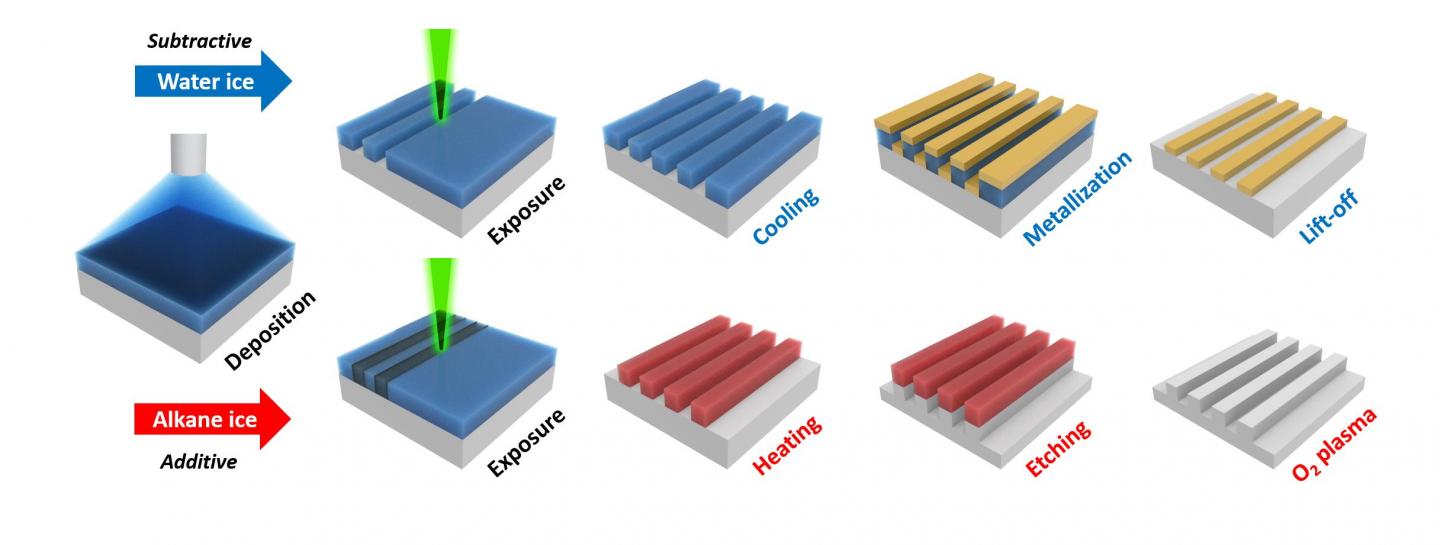
The IL technology was first proposed by the Nanopore group at Harvard University in 2005. Water ice is the first identified ice resist for IL, and it is still the only one positive-tone lithography resist so far. As shown in Fig.1, water ice is easily removed within the electron-beam exposure area. Organic ice condensed from simple organic molecules, such as alkanes, demonstrates a negative-resist-like capability, which means only exposed patterns remain on the substrate after heating the sample to room temperature.

IL research is still in its infancy, and this method has already exhibited great advantages in efficient 3D nanofabrication. Different from spin coating of EBL resists, ice resists are able to coat all accessible freezing surfaces of the sample during ice deposition. Therefore, IL can process samples with non-flat and irregular surfaces, such as patterning on AFM probes, and pattern on a tiny and fragile nanostructure, such as suspended single-walled carbon nanotubes. Benefiting from the very low sensitivity of water ice, IL allows in situ observing nanostructures under the ice resist through SEM imaging. This feature not only improves the alignment accuracy but also simplifies the processing steps in fabricating 3D layered nanostructures.

As cutting-edge instrument research and development is essential for advancing the IL technology, this review finally discusses the evolution of IL instruments and provides a clear guidance on the construction of a dedicated IL instrument. With the discovery of new functional ice resists in future, more cutting-edge and interdisciplinary researches are expected to exploit the potentials of IL.

###

This work was supported by the National Natural Science Foundation of China (Grant No. 61425023), National Key Research and Development Program of China (Grant No. 2017YFA0205700), European Union’s Horizon 2020 research and innovation program under the Marie Skodowska-Curie grant agreement (Grant No. 713683).

See the article:

Ding Zhao, Anpan Han, and Min Qiu, Ice lithography for 3D nanofabrication, Science Bulletin, 2019, vol. 64, No.12, 865-871

https://www.sciencedirect.com/science/article/pii/S209592731930324X?via%3Dihub

Media Contact
Min Qiu
[email protected]

Related Journal Article

http://dx.doi.org/10.1016/j.scib.2019.06.001

Tags: Chemistry/Physics/Materials Sciences
Share12Tweet8Share2ShareShareShare2

Related Posts

Scientists Identify Invisible Early Indicators of Skin Aging

Scientists Identify Invisible Early Indicators of Skin Aging

July 16, 2026
Roadmap Outlines Self-Powered Tactile Sensors for Robots and Wearable Devices

Roadmap Outlines Self-Powered Tactile Sensors for Robots and Wearable Devices

July 16, 2026

AI and Quantum Chemistry Reveal Dual-Modulated Catalysts for Next-Gen Fuel Cells

July 16, 2026

Bioinspired Hierarchical Hydrogel Electrolyte Enables Ultralong-Life Flexible Zinc Batteries

July 16, 2026
Please login to join discussion

POPULAR NEWS

  • New Drug Candidate Developed at McMaster Shows Potential for Treating Brain Cancer

    58 shares
    Share 23 Tweet 15
  • Scientists Overcome Antimicrobial Resistance in Bacteria Linked to Cystic Fibrosis

    42 shares
    Share 17 Tweet 11
  • Porcine Heart Transplant

    50 shares
    Share 20 Tweet 13
  • A varied menu

    51 shares
    Share 22 Tweet 12

About

We bring you the latest biotechnology news from best research centers and universities around the world. Check our website.

Follow us

Recent News

Programming Fracture Resistance in Metamaterials through Elastic Instability Design

Scientists Identify Invisible Early Indicators of Skin Aging

More Smokers Purchase Illicit Tobacco, Report Finds

Subscribe to Blog via Email

Enter your email address to subscribe to this blog and receive notifications of new posts by email.

Join 85 other subscribers
  • Contact Us

Bioengineer.org © Copyright 2023 All Rights Reserved.

Welcome Back!

Login to your account below

Forgotten Password?

Retrieve your password

Please enter your username or email address to reset your password.

Log In
No Result
View All Result
  • Homepages
    • Home Page 1
    • Home Page 2
  • News
  • National
  • Business
  • Health
  • Lifestyle
  • Science

Bioengineer.org © Copyright 2023 All Rights Reserved.