Credit: The University of Texas at Arlington
There are 15 new cases of amyotrophic lateral sclerosis, or ALS, diagnosed in the U.S. each day. The disease causes patients to slowly lose the ability to speak, eat, move and breathe, and comes with an average life expectancy of two to five years after diagnosis.
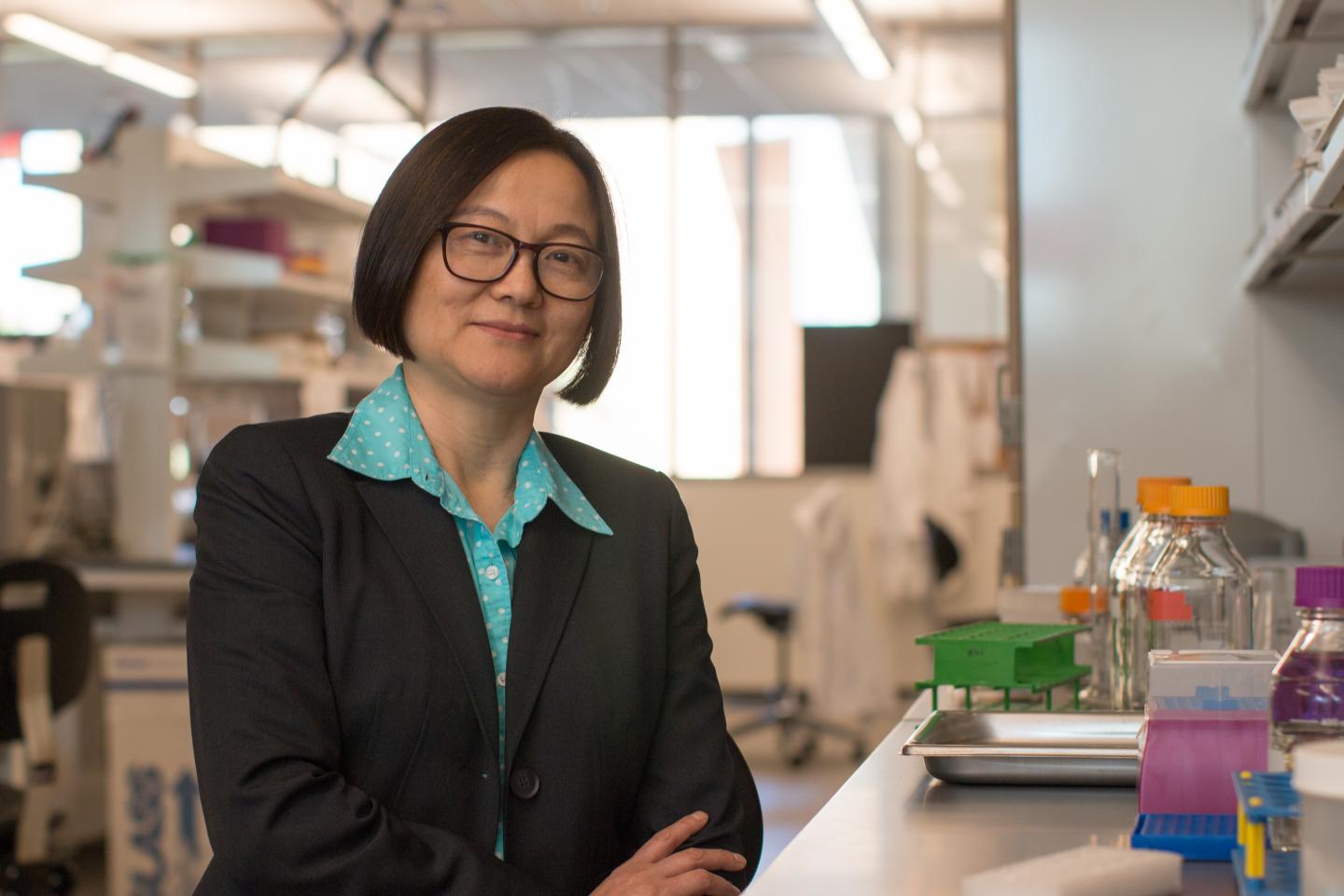
Jingsong Zhou, professor of kinesiology at The University of Texas at Arlington, believes this debilitating disease requires a novel approach.
The majority of research on ALS, also known as Lou Gehrig’s disease, focuses on the spinal cord because of how the disease affects neurological function. But Zhou is investigating the theory that ALS affects the physiology of the whole body through defective cells in multiple organs.
“Twelve years ago, my lab made a discovery in the muscle defects of ALS, and we have been looking closely at the disease ever since,” she said. “In the beginning, we believed the muscle atrophy ALS causes was secondary to the death of the neurons in the spinal cord, but we have evidence that indicates the muscle is not only a victim of the disease, rather it actively contributes to it. This is a systemic disorder affecting the whole body.”
A respected leader in her field, Zhou has published more than 70 peer-reviewed articles and received more than $4 million in grants in the last decade. She recently received a $2.88 million award from the National Institutes of Health and was invited to serve as a member of the NIH Center for Scientific Review’s Skeletal Muscle and Exercise Physiology Study Section.
The NIH grant supports Zhou’s work to preserve mitochondria as it functions or dysfunctions in a diseased cell–part of her pursuit to understand the mechanisms behind why multiple organs are involved in ALS deterioration.
“We are ultimately working to find some potential therapeutic means to treat the disease with a new understanding,” Zhou said. “Once we understand why the cells are damaged, we can test potential compounds or therapies.”
The NIH-funded study is the continuation of a project Zhou started with funding from the ALS Association. Zhou’s was one of 58 labs selected to receive grants funded by donations raised in 2014 through the viral ALS Ice Bucket Challenge.
Since Zhou began her work on ALS, she has heard countless stories of how the disease has impacted patients and their families. These personal stories, she says, motivate her to keep going.
Paul Fadel, CONHI’s associate dean for research, said Zhou’s expertise fortifies the College’s reputation as an innovative center for research and advances UTA’s pursuit of being a leader in serving health and the human condition.
“Dr. Zhou’s research explores new territories in an effort to bring relief to ALS patients and their families,” Fadel said. “Her work is groundbreaking, and she plays an essential role in the growth and leadership of the Bone-Muscle Research Center. She is a renowned expert in the field and an enthusiastic collaborator that strengthens our faculty and student experience. We are fortunate to have Dr. Zhou on our team at UTA.”
Zhou came to UTA in July 2018 as associate director of the College of Nursing and Health Innovation’s Bone-Muscle Research Center. Zhou said she was attracted to UTA because of the opportunity for collaborative research the new Science & Engineering Innovation & Research Building provides.
“I was looking for a big stage, a big scientific environment, and that’s what UTA offered,” Zhou said. “The SEIR Building and collaboration through our Bone-Muscle Research Center helps us be more competitive for funding. That allows us to do better science, make a stronger impact on the research field and provide significant benefits for our society.”
Zhou’s work in examining mitochondria in diseased cells in cases of ALS has translated to other areas of medical research. In February, she was awarded a $610,000 grant from the NIH to apply the concept to the heart muscle in cases of cardiovascular disease.
“When you look at cells through a microscope, it’s the same as looking through a telescope at the universe–the discoveries are infinite,” she said. “It’s extremely important to take our time to explore and understand as many elements of the disease as possible so we can fight it efficiently.”
###
Media Contact
Dana Jennings
[email protected]
Original Source
https:/