• HOME
  • NEWS
  • EXPLORE
    • CAREER
      • Companies
      • Jobs
    • EVENTS
    • iGEM
      • News
      • Team
    • PHOTOS
    • VIDEO
    • WIKI
  • BLOG
  • COMMUNITY
    • FACEBOOK
    • INSTAGRAM
    • TWITTER
Tuesday, June 30, 2026
BIOENGINEER.ORG
No Result
View All Result
  • Login
  • HOME
  • NEWS
  • EXPLORE
    • CAREER
      • Companies
      • Jobs
        • Lecturer
        • PhD Studentship
        • Postdoc
        • Research Assistant
    • EVENTS
    • iGEM
      • News
      • Team
    • PHOTOS
    • VIDEO
    • WIKI
  • BLOG
  • COMMUNITY
    • FACEBOOK
    • INSTAGRAM
    • TWITTER
  • HOME
  • NEWS
  • EXPLORE
    • CAREER
      • Companies
      • Jobs
        • Lecturer
        • PhD Studentship
        • Postdoc
        • Research Assistant
    • EVENTS
    • iGEM
      • News
      • Team
    • PHOTOS
    • VIDEO
    • WIKI
  • BLOG
  • COMMUNITY
    • FACEBOOK
    • INSTAGRAM
    • TWITTER
No Result
View All Result
Bioengineer.org
No Result
View All Result
Home NEWS Science News Chemistry

OU physicists show novel Mott state in twisted graphene bilayers at ‘magic angle’

Bioengineer by Bioengineer
June 19, 2019
in Chemistry
Reading Time: 2 mins read
0
IMAGE
Share on FacebookShare on TwitterShare on LinkedinShare on RedditShare on Telegram

IMAGE

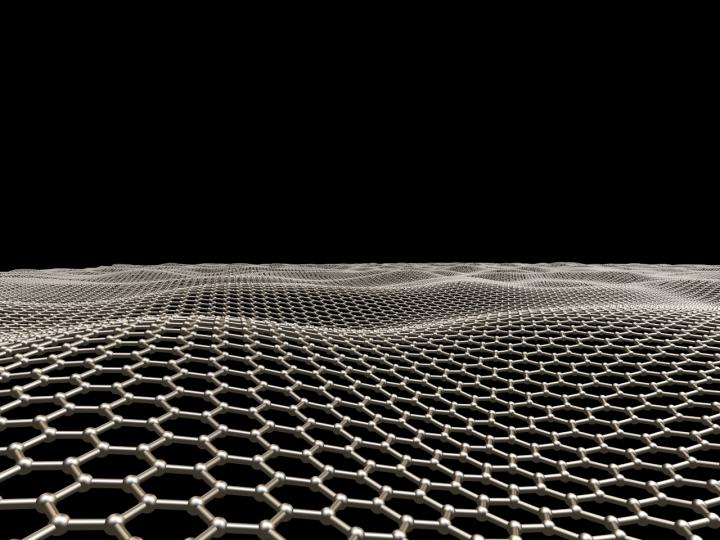
Credit: University of Oklahoma

A University of Oklahoma physics group sheds light on a novel Mott state observed in twisted graphene bilayers at the ‘magic angle’ in a recent study just published in Physical Review Letters. OU physicists show the Mott state in graphene bilayers favors ferromagnetic alignment of the electron spins, a phenomenon unheard of in conventional Mott insulators, and a new concept on the novel insulating state observed in twisted graphene bilayers.

“We are trying to understand the nature of the Mott state in this system,” said Bruno Uchoa, associate professor in the Homer L. Dodge Department of Physics and Astrophysics. “The Mott state we proposed is an insulating state that may lead to superconductivity in some conditions, yet is different from Mott states observed in other systems. There are fundamental differences, however, and this is what we are studying.”

Mott physics has been extensively investigated in the last decades in high-temperature cuprate superconductors – materials that in some conditions can transmit charge currents at relatively high temperature without producing any heat dissipation. In the Mott phase, however, the motion of charge carriers is confined by their strong mutual electric repulsion, which leads to insulating behavior, when a material is unable to conduct any electricity.

It also leads to anti-ferromagnetism, a state where the spins of two electrons sitting next to each other are anti-parallel. The latter property is the result of the Pauli exclusion principle, one of the many exotic properties of quantum mechanics, which states that the two electrons cannot occupy the same quantum state. The new study shows that the Mott state in graphene departs from other known examples in fundamental ways.

Using two sheets of graphene twisted at a very small angle, known as the ‘magic angle,’ the system correlates with properties seen in high-temperature superconductors. Graphene is made of carbon and the thinnest material in the universe, only one atom thick. The material is like a honeycomb lattice, so two layers twisted at a very small angle result in the electrons moving differently. The new work shows that lattice constraints imposed by the small twist angle can strongly favor parallel alignment of the electronic spins even when electrons are strongly repelling each other. The OU physicists proposed a novel Mott state where these electrons behave in ways not seen before.

“Twisted graphene bilayers are very promising for a variety of technological applications in nanodevices,” said Kangjun Seo, a postdoctoral researcher in the OU group, who was first author on the study. “This is a very interesting and important physical system.”

###

The OU paper, “Ferromagnetic Mott State in Twisted Graphene Bilayers at the Magic Angle,” recently was published in Physical Review Letters. A National Science Foundation grant funded the OU research. For more information about this study, contact Uchoa at [email protected].

Media Contact
JanaSmith
[email protected]

Original Source

https://bit.ly/2Fj9rWU

Tags: Chemistry/Physics/Materials SciencesMaterialsSuperconductors/Semiconductors
Share12Tweet8Share2ShareShareShare2

Related Posts

AI and Physics Collaborate to Design Advanced Hydrogen Storage Materials

June 25, 2026

International Team Including Dresden Scientists Develops Novel Designer Proteins for Advanced Study of Living Tissue

June 25, 2026

New Study Uncovers Key Factors Driving Water Chemistry in Nanoscale Environments

June 25, 2026

Plasma Technology Extends Catalyst Lifespan in Hydrogen Production

June 24, 2026
Please login to join discussion

POPULAR NEWS

  • Saying Goodbye to PGY-6: Pediatric Fellowship Realities

    103 shares
    Share 41 Tweet 26
  • Multi-Hospital Study Reveals Long Covid Burden Is Twice as High as Current Estimates

    92 shares
    Share 36 Tweet 23
  • Detection of EDCs in Breast Milk and Infant Urine Up to Six Months Highlights Early Exposure Risks

    77 shares
    Share 31 Tweet 19
  • New Drug Candidate Developed at McMaster Shows Potential for Treating Brain Cancer

    58 shares
    Share 23 Tweet 15

About

We bring you the latest biotechnology news from best research centers and universities around the world. Check our website.

Follow us

Recent News

Tracking Lanthanide-Labeled Microplastics in Plants

POSTECH Researchers Slash Cost of Reconstituted Cell-Free Systems by 95%

AI and Physics Collaborate to Design Advanced Hydrogen Storage Materials

Subscribe to Blog via Email

Success! An email was just sent to confirm your subscription. Please find the email now and click 'Confirm' to start subscribing.

Join 82 other subscribers
  • Contact Us

Bioengineer.org © Copyright 2023 All Rights Reserved.

Welcome Back!

Login to your account below

Forgotten Password?

Retrieve your password

Please enter your username or email address to reset your password.

Log In
No Result
View All Result
  • Homepages
    • Home Page 1
    • Home Page 2
  • News
  • National
  • Business
  • Health
  • Lifestyle
  • Science

Bioengineer.org © Copyright 2023 All Rights Reserved.