• HOME
  • NEWS
  • EXPLORE
    • CAREER
      • Companies
      • Jobs
    • EVENTS
    • iGEM
      • News
      • Team
    • PHOTOS
    • VIDEO
    • WIKI
  • BLOG
  • COMMUNITY
    • FACEBOOK
    • INSTAGRAM
    • TWITTER
Saturday, February 7, 2026
BIOENGINEER.ORG
No Result
View All Result
  • Login
  • HOME
  • NEWS
  • EXPLORE
    • CAREER
      • Companies
      • Jobs
        • Lecturer
        • PhD Studentship
        • Postdoc
        • Research Assistant
    • EVENTS
    • iGEM
      • News
      • Team
    • PHOTOS
    • VIDEO
    • WIKI
  • BLOG
  • COMMUNITY
    • FACEBOOK
    • INSTAGRAM
    • TWITTER
  • HOME
  • NEWS
  • EXPLORE
    • CAREER
      • Companies
      • Jobs
        • Lecturer
        • PhD Studentship
        • Postdoc
        • Research Assistant
    • EVENTS
    • iGEM
      • News
      • Team
    • PHOTOS
    • VIDEO
    • WIKI
  • BLOG
  • COMMUNITY
    • FACEBOOK
    • INSTAGRAM
    • TWITTER
No Result
View All Result
Bioengineer.org
No Result
View All Result
Home NEWS Science News Biology

Research shows wind can prevent seabirds accessing their most important habitat

Bioengineer by Bioengineer
June 19, 2019
in Biology
Reading Time: 2 mins read
0
IMAGE
Share on FacebookShare on TwitterShare on LinkedinShare on RedditShare on Telegram

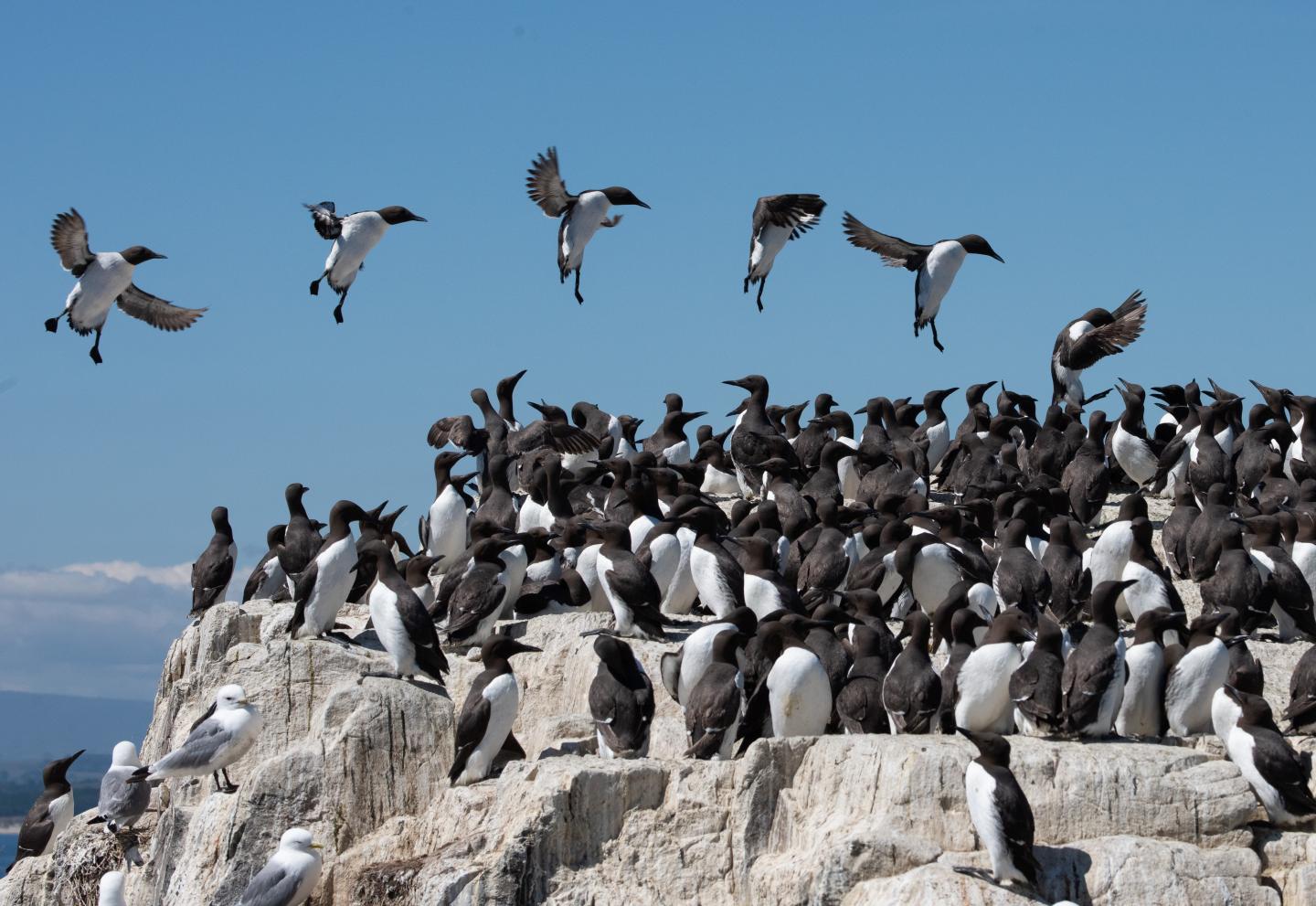
We marvel at flying animals because it seems like they can access anywhere, but a first study of its kind has revealed that wind can prevent seabirds from accessing the most important of habitats: their nests
IMAGE

Credit: Glynn Trueman

We marvel at flying animals because it seems like they can access anywhere, but a first study of its kind has revealed that wind can prevent seabirds from accessing the most important of habitats: their nests.

If human pilots or animals are to land safely, they must monitor and respond to the wind. These ideas are well established in aeronautical engineering, but how the win affects the ability of birds to land has never been considered before.

In a paper published by eLife, biologists including Dr Emily Shepard at Swansea University observed common guillemots and razorbills attempting to land on their breeding cliffs on Skomer Island, Wales. They then teamed up with Dr Andrew Ross, a meteorologist at Leeds University, to assess how the number of successful and aborted landings varied with the wind and turbulence around Skomer.

Seabirds live in windy, often remote places. Many species choose to breed on steep cliffs, where nests cannot be reached by land-based predators. Here, adults must land on small ledges, and they must do this with sufficient control that they do not dislodge their egg or chick.

While all birds landed when it was wind still, 60% of attempts failed in a strong breeze. This increased to 80% in near-gale winds. Razorbills, the more manoeuvrable of the two species, were better at landing overall, but “runway” size was important for all birds, which could land more easily on larger ledges where there is more airspace to manoeuvre above their landing spot.

As a result, adults have to make repeated landing attempts on windy days – something that is costly for these birds. In fact, modelling by mathematician Dr Andrew Neate showed that in strong winds, only 50% of birds are likely to land in the first seven attempts. These results have implications for where birds should nest, providing a clear reason for birds to colonise cliffs that are sheltered from prevailing winds.

Dr Emily Shepard, Associate Professor at Swansea University said:

“Landing is a taxing and risky process for human pilots and it was fascinating to look at the conditions that make landing challenging for auks.

“These birds are able to land (and even breed) on cliff ledges so small that their tails hang over the edge, but it was striking how wind upsets this delicate balancing act.”

###

Media Contact
Ben Donovan
[email protected]

Original Source

https://elifesciences.org/articles/43842?utm_source=content_alert&utm_medium=email&utm_content=fulltext&utm_campaign=17-June-19-elife-alert

Related Journal Article

http://dx.doi.org/10.7554/eLife.43842

Tags: AgricultureAnimal Research/RightsEcology/EnvironmentEvolutionGeographyPets/Ethology
Share12Tweet8Share2ShareShareShare2

Related Posts

Florida Cane Toad: Complex Spread and Selective Evolution

Florida Cane Toad: Complex Spread and Selective Evolution

February 7, 2026
New Study Uncovers Mechanism Behind Burn Pit Particulate Matter–Induced Lung Inflammation

New Study Uncovers Mechanism Behind Burn Pit Particulate Matter–Induced Lung Inflammation

February 6, 2026

DeepBlastoid: Advancing Automated and Efficient Evaluation of Human Blastoids with Deep Learning

February 6, 2026

Navigating the Gut: The Role of Formic Acid in the Microbiome

February 6, 2026
Please login to join discussion

POPULAR NEWS

  • Robotic Ureteral Reconstruction: A Novel Approach

    Robotic Ureteral Reconstruction: A Novel Approach

    82 shares
    Share 33 Tweet 21
  • Digital Privacy: Health Data Control in Incarceration

    63 shares
    Share 25 Tweet 16
  • Study Reveals Lipid Accumulation in ME/CFS Cells

    57 shares
    Share 23 Tweet 14
  • Breakthrough in RNA Research Accelerates Medical Innovations Timeline

    53 shares
    Share 21 Tweet 13

About

We bring you the latest biotechnology news from best research centers and universities around the world. Check our website.

Follow us

Recent News

Phage-Antibiotic Combo Beats Resistant Peritoneal Infection

Boosting Remote Healthcare: Stepped-Wedge Trial Insights

Barriers and Boosters of Seniors’ Physical Activity in Karachi

Subscribe to Blog via Email

Enter your email address to subscribe to this blog and receive notifications of new posts by email.

Join 73 other subscribers
  • Contact Us

Bioengineer.org © Copyright 2023 All Rights Reserved.

Welcome Back!

Login to your account below

Forgotten Password?

Retrieve your password

Please enter your username or email address to reset your password.

Log In
No Result
View All Result
  • Homepages
    • Home Page 1
    • Home Page 2
  • News
  • National
  • Business
  • Health
  • Lifestyle
  • Science

Bioengineer.org © Copyright 2023 All Rights Reserved.