• HOME
  • NEWS
  • EXPLORE
    • CAREER
      • Companies
      • Jobs
    • EVENTS
    • iGEM
      • News
      • Team
    • PHOTOS
    • VIDEO
    • WIKI
  • BLOG
  • COMMUNITY
    • FACEBOOK
    • INSTAGRAM
    • TWITTER
Thursday, March 26, 2026
BIOENGINEER.ORG
No Result
View All Result
  • Login
  • HOME
  • NEWS
  • EXPLORE
    • CAREER
      • Companies
      • Jobs
        • Lecturer
        • PhD Studentship
        • Postdoc
        • Research Assistant
    • EVENTS
    • iGEM
      • News
      • Team
    • PHOTOS
    • VIDEO
    • WIKI
  • BLOG
  • COMMUNITY
    • FACEBOOK
    • INSTAGRAM
    • TWITTER
  • HOME
  • NEWS
  • EXPLORE
    • CAREER
      • Companies
      • Jobs
        • Lecturer
        • PhD Studentship
        • Postdoc
        • Research Assistant
    • EVENTS
    • iGEM
      • News
      • Team
    • PHOTOS
    • VIDEO
    • WIKI
  • BLOG
  • COMMUNITY
    • FACEBOOK
    • INSTAGRAM
    • TWITTER
No Result
View All Result
Bioengineer.org
No Result
View All Result
Home NEWS Science News Biology

First step towards a better prosthetic leg? Trip people over and over

Bioengineer by Bioengineer
June 19, 2019
in Biology
Reading Time: 3 mins read
0
IMAGE
Share on FacebookShare on TwitterShare on LinkedinShare on RedditShare on Telegram

Vanderbilt team builds device to capture stumble response
IMAGE

Credit: CREATE at Vanderbilt University

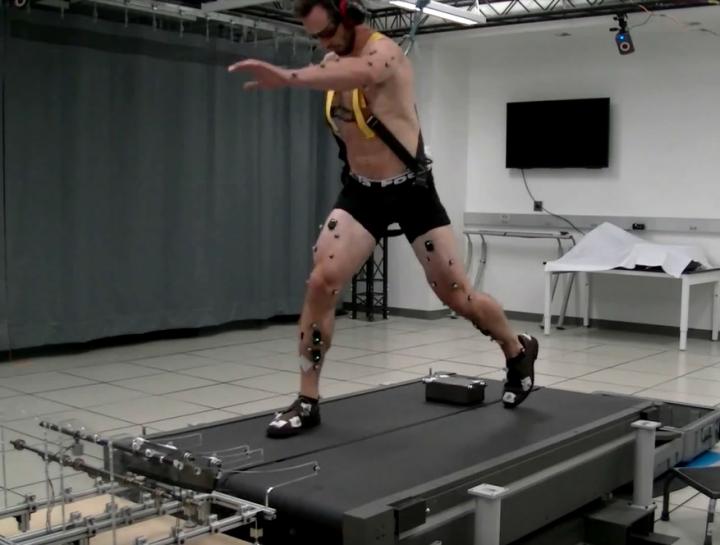
Andrés Martínez strode briskly on the treadmill, staring straight ahead and counting backwards by seven from 898, a trick to keep his brain from anticipating the literal stumbling block heading his way: a compact 35 pounds of steel specifically designed to make him fall.

Special goggles kept him from looking down. Arrows on an eye-level screen kept him from walking off the sides. A harness attached to a ceiling beam kept him safe. Sure enough, when a computer program released the steel block, it glided onto the treadmill, and the Vanderbilt University PhD student struggled to stay on his feet.

That automatic stumble response, so natural for most people, is virtually impossible for those who use prosthetic legs, simply because even state-of-the-art prosthetics cannot adapt to stumbling. Patients with above-the-knee amputations are far more likely to fall than typical counterparts in their age group.

The first step a Vanderbilt team took in addressing that challenge in lower-body prosthetics was coming to understand the way people with two legs catch themselves, accomplished by covering test subjects with motion-capturing sensors. It also required tripping them over and over – 190 times, to be exact — for a study published this month in the Journal of NeuroEngineering and Rehabilitation. But because humans are so mentally geared to resist stumbling, a team of Vanderbilt mechanical engineers first had to design the stumbling device described above.

“Not only did our treadmill device have to trip them, it had to trip them at specific points in their gait,” said Shane King, a PhD student and lead author on the paper. “People stumble differently depending on when their foot hits a barrier. The device also had to overcome their fear of falling, so they couldn’t see or feel when the block was coming.”

In addition to protecting test subjects, the harness included a scale. If a subject put 50 percent or more of their weight on it, that counted as a fall. The team’s design for the machine and outcomes of their tests are available for other labs to use in the open-source journal.

Michael Goldfarb, H. Fort Flowers Professor of Mechanical Engineering and the principal investigator on the study, said designing the stumble device and measuring outcomes was only the first of three parts.

“So now we understand what the stumble reflex should look like,” he said. “The next phase is to take that information and program it into computer-controlled prosthetic legs. After that, we will safely stumble amputees wearing both commercially available prosthetics and the ones we’ve designed with these reflexes and learn whether ours can prevent more falls.”

###

The work was performed through the Center for Rehabilitation Engineering and Assistive Technology at Vanderbilt University. Other team members were Karl Zelik, assistant professor of mechanical engineering, and Maura Eveld, a PhD student in mechanical engineering.

Media Contact
Heidi Nieland Hall
[email protected]

Original Source

https://news.vanderbilt.edu/2019/06/19/first-step-towards-a-better-prosthetic-leg-trip-people-over-and-over/

Related Journal Article

http://dx.doi.org/10.1186/s12984-019-0527-7

Tags: Disabled PersonsMechanical EngineeringOrthopedic MedicinePhysiologyRehabilitation/Prosthetics/Plastic SurgeryResearch/DevelopmentTechnology/Engineering/Computer Science
Share12Tweet8Share2ShareShareShare2

Related Posts

How to sway group opinions: Encourage opponents to stay undecided

How to sway group opinions: Encourage opponents to stay undecided

March 23, 2026
Deep Learning Model Maps How Individual Cells Shape Disease Outcomes

Deep Learning Model Maps How Individual Cells Shape Disease Outcomes

March 20, 2026

Removing only 15 female sharks annually could endanger the entire population, scientists warn

March 20, 2026

Scientists Urge Fragrance Industry to Transition from Sustainability Talk to Active Funding of Plant Conservation

March 20, 2026
Please login to join discussion

POPULAR NEWS

  • blank

    Revolutionary AI Model Enhances Precision in Detecting Food Contamination

    96 shares
    Share 38 Tweet 24
  • Imagine a Social Media Feed That Challenges Your Views Instead of Reinforcing Them

    1003 shares
    Share 397 Tweet 248
  • Uncovering Functions of Cavernous Malformation Proteins in Organoids

    54 shares
    Share 22 Tweet 14
  • Promising Outcomes from First Clinical Trials of Gene Regulation in Epilepsy

    51 shares
    Share 20 Tweet 13

About

We bring you the latest biotechnology news from best research centers and universities around the world. Check our website.

Follow us

Recent News

In-Sensor Cryptography Links Physical Process to Digital Identity

Can Psychosocial Factors Influence Cancer Risk?

Depression Factors in Elderly: Pre vs. Post-COVID Analysis

Subscribe to Blog via Email

Success! An email was just sent to confirm your subscription. Please find the email now and click 'Confirm' to start subscribing.

Join 78 other subscribers
  • Contact Us

Bioengineer.org © Copyright 2023 All Rights Reserved.

Welcome Back!

Login to your account below

Forgotten Password?

Retrieve your password

Please enter your username or email address to reset your password.

Log In
No Result
View All Result
  • Homepages
    • Home Page 1
    • Home Page 2
  • News
  • National
  • Business
  • Health
  • Lifestyle
  • Science

Bioengineer.org © Copyright 2023 All Rights Reserved.