Faculty of Mathematics and Natural Sciences
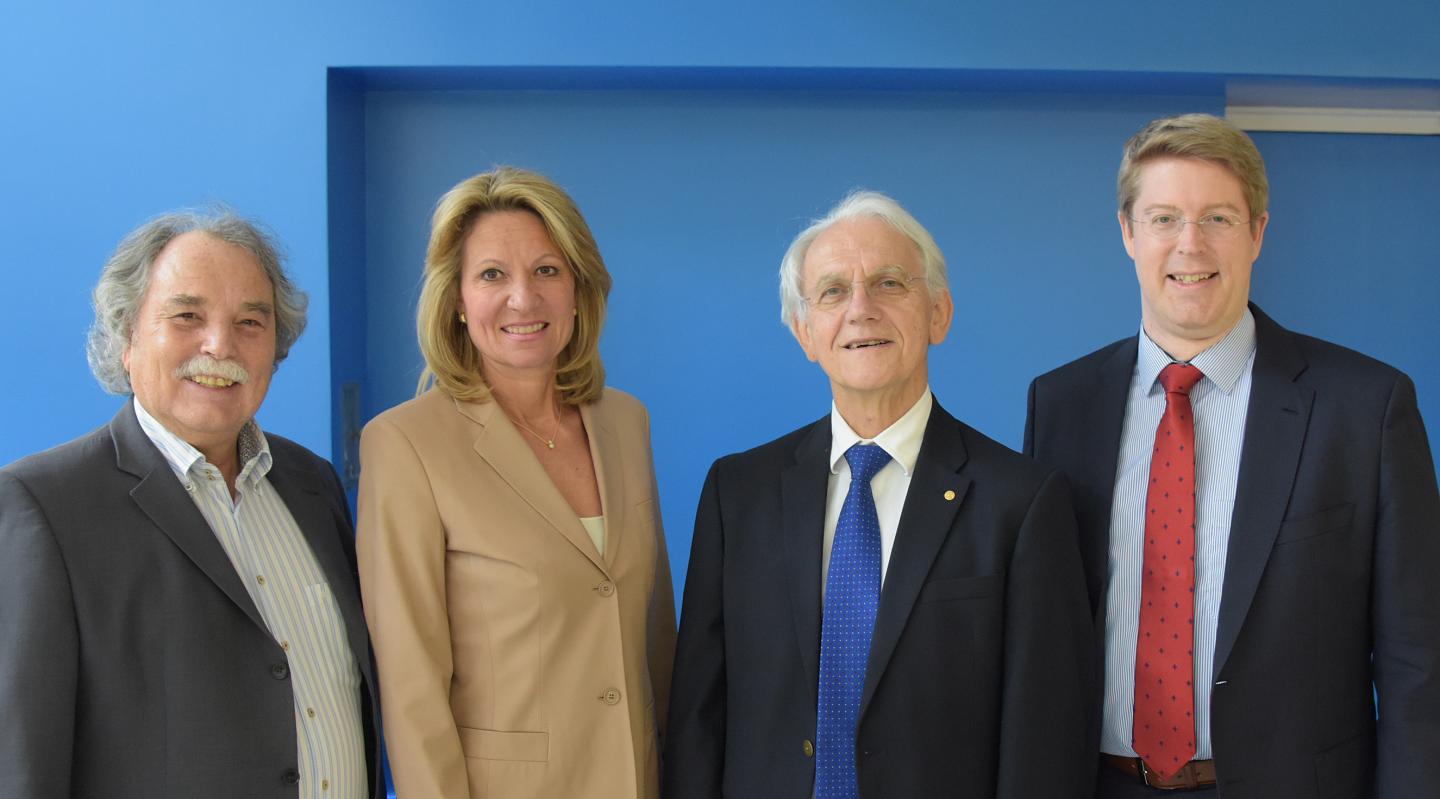
Credit: HHU / Wilfried Meyer
“Gerard Mourou has accrued great merit in our faculty through his support of Physics as a subject,” said Prof. Dr. Martin Mauve, Dean of the Faculty of Mathematics and Natural Sciences at HHU, in his laudatory speech. “His innovative research findings laid the central scientific foundations for the special research area TR18, which has shaped Physics at HHU for a period of over twelve years.” highlighted Prof. Mauve, who went on to say: “HHU is proud to include him as one of its honorary doctors.”
Gerard Mourou’s research deals with extreme light: He compresses light pulses from lasers and packs very large quantities of energy into these pulses. Back in the 1980s, he developed what is referred to as the “Chirped Pulse Amplification” technique (CPA) for this purpose together with his Canadian colleague Donna Strickland. Strickland and Mourou were awarded the Nobel Prize in Physics in 2018 for their research.
The CPA technique can be used to focus a high intensity of energy on a small material point for example. The extreme pulse duration means that only the point directly hit by the laser beam heats up so much that the material at that point evaporates and transforms into plasma. By contrast, the area surrounding that point remains untouched and does not heat up on a large scale – as would be the case with longer pulses. This narrowly localised depositing of energy has specific advantages for use, both in industry and in medicine. For example, it is used for eye operations.
But it’s also extremely important for science. “Prof. Mourou’s ground-breaking work has revolutionised research in the field of laser plasma physics. It’s what has made it possible to carry out research into high-intensity lasers at HHU,” said Prof. Dr. Oswald Willi from the Chair of Laser and Plasma Physics. ‘ARCTURUS’, one of the most intensive lasers in operation at a European university, is located in Prof. Willi’s laboratory in Düsseldorf. It serves among other things to develop laser accelerators, which could provide an alternative to large particle accelerators. The special research area TR18 “Relativistic Laser Plasma Dynamics” has worked on these questions in particular.
In his keynote address in Duesseldorf on 13 June, Prof. Mourou spoke about “Passion Extreme Light”. He introduced the possibilities offered by high-intensity lasers for answering the fundamental questions of physics, such as the origin of ultra high energy cosmic radiation, the structure of the vacuum and particle production “from empty space”. He also looked to the future, to potential new lasers with even shorter pulse lengths and even higher energy amounts in those pulses.
Gerard Mourou
was born in Albertville in the French department of Savoie in 1944. He studied Physics in Grenoble, and earned his PhD in 1973 at the University of Paris VI. He subsequently carried out research in Quebec/Canada, San Diego/USA, Paris, and Rochester/USA, where he was appointed Associate Professor in 1983 and Full Professor at the Institute of Optics in 1989. From 1991 to 2004, he was Director of the Center for Ultrafast Optical Science at the University of Michigan, before moving to the Ecole Polytechnique in Palaiseau near Paris in 2005.
Prof. Mourou’s key research areas involve the development of techniques to create and use ultra-short and extremely high-energy laser pulses. In the course of his academic career, He has published 387 works on this topic in many respected journals. He has received numerous awards and distinctions for his ground-breaking research on high-intensity lasers. For example, he is an honorary doctor and honorary professor of numerous universities as well as a member of the Academy of Sciences in Lombardy/Italy, Austria and Russia and a member of the US National Academy of Engineering. In 2012 he received the French Legion of Honour award. Last year he was awarded the Nobel Prize in Physics together with Donna Strickland. They share the Prize with American Arthur Ashkin, who was awarded for developing ‘optical tweezers’.
###
Media Contact
Arne Claussen
[email protected]
Original Source
https:/