• HOME
  • NEWS
  • EXPLORE
    • CAREER
      • Companies
      • Jobs
    • EVENTS
    • iGEM
      • News
      • Team
    • PHOTOS
    • VIDEO
    • WIKI
  • BLOG
  • COMMUNITY
    • FACEBOOK
    • INSTAGRAM
    • TWITTER
Saturday, February 7, 2026
BIOENGINEER.ORG
No Result
View All Result
  • Login
  • HOME
  • NEWS
  • EXPLORE
    • CAREER
      • Companies
      • Jobs
        • Lecturer
        • PhD Studentship
        • Postdoc
        • Research Assistant
    • EVENTS
    • iGEM
      • News
      • Team
    • PHOTOS
    • VIDEO
    • WIKI
  • BLOG
  • COMMUNITY
    • FACEBOOK
    • INSTAGRAM
    • TWITTER
  • HOME
  • NEWS
  • EXPLORE
    • CAREER
      • Companies
      • Jobs
        • Lecturer
        • PhD Studentship
        • Postdoc
        • Research Assistant
    • EVENTS
    • iGEM
      • News
      • Team
    • PHOTOS
    • VIDEO
    • WIKI
  • BLOG
  • COMMUNITY
    • FACEBOOK
    • INSTAGRAM
    • TWITTER
No Result
View All Result
Bioengineer.org
No Result
View All Result
Home NEWS Science News Chemistry

Research reveals liquid gold on the nanoscale

Bioengineer by Bioengineer
June 13, 2019
in Chemistry
Reading Time: 2 mins read
0
IMAGE
Share on FacebookShare on TwitterShare on LinkedinShare on RedditShare on Telegram

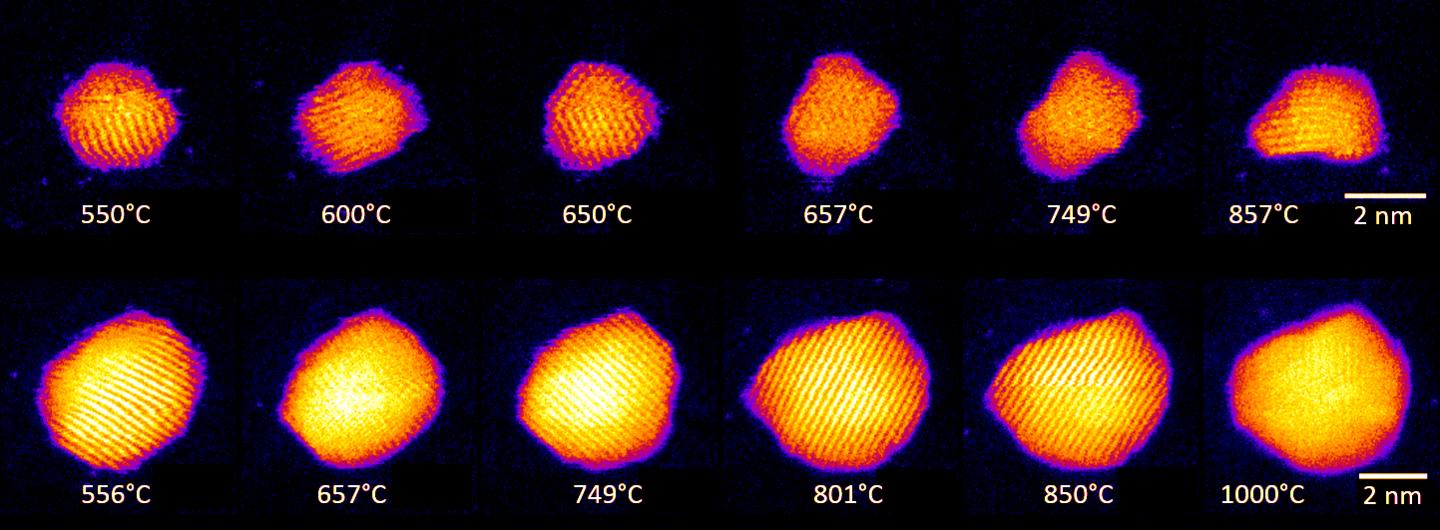
Researchers have mapped how gold nanoparticles melt
IMAGE

Credit: Swansea University.

The research published in Nature Communications set out to answer a simple question – how do nanoparticles melt? Although this question has been a focus of researchers for the past century, it still is an open problem – initial theoretical models describing melting date from around 100 years, and even the most relevant models being some 50 years old.

Professor Richard Palmer, who led the team based at the University’s College of Engineering said of the research: “Although melting behaviour was known to change on the nanoscale, the way in which nanoparticles melt was an open question. Given that the theoretical models are now rather old, there was a clear case for us to carry out our new imaging experiments to see if we could test and improve these theoretical models.”

The research team used gold in their experiments as it acts as a model system for noble and other metals. The team arrived at their results by imaging gold nanoparticles, with diameters ranging from 2 to 5 nanometres, via aberration corrected scanning transmission electron microscope. Their observations were later supported by large-scale quantum mechanical simulations.

Professor Palmer said: “We were able to prove the dependence of the melting point of the nanoparticles on their size and for the first time see directly the formation of a liquid shell around a solid core in the nanoparticles over a wide region of elevated temperatures, in fact for hundreds of degrees.

“This helps us to describe accurately how nanoparticles melt and to predict their behaviour at elevated temperatures. This is a science breakthrough in a field we can all relate to – melting – and will also help those producing nanotech devices for a range of practical and everyday uses, including medicine, catalysis and electronics.”

###

Media Contact
Delyth Purchase
[email protected]

Related Journal Article

http://dx.doi.org/10.1038/s41467-019-10713-z

Tags: Nanotechnology/MicromachinesTechnology/Engineering/Computer Science
Share12Tweet8Share2ShareShareShare2

Related Posts

blank

Breakthrough in Environmental Cleanup: Scientists Develop Solar-Activated Biochar for Faster Remediation

February 7, 2026
blank

Cutting Costs: Making Hydrogen Fuel Cells More Affordable

February 6, 2026

Scientists Develop Hand-Held “Levitating” Time Crystals

February 6, 2026

Observing a Key Green-Energy Catalyst Dissolve Atom by Atom

February 6, 2026
Please login to join discussion

POPULAR NEWS

  • Robotic Ureteral Reconstruction: A Novel Approach

    Robotic Ureteral Reconstruction: A Novel Approach

    82 shares
    Share 33 Tweet 21
  • Digital Privacy: Health Data Control in Incarceration

    63 shares
    Share 25 Tweet 16
  • Study Reveals Lipid Accumulation in ME/CFS Cells

    57 shares
    Share 23 Tweet 14
  • Breakthrough in RNA Research Accelerates Medical Innovations Timeline

    53 shares
    Share 21 Tweet 13

About

We bring you the latest biotechnology news from best research centers and universities around the world. Check our website.

Follow us

Recent News

TPMT Expression Predictions Linked to Azathioprine Side Effects

Improving Dementia Care with Enhanced Activity Kits

Decoding Prostate Cancer Origins via snFLARE-seq, mxFRIZNGRND

Subscribe to Blog via Email

Enter your email address to subscribe to this blog and receive notifications of new posts by email.

Join 73 other subscribers
  • Contact Us

Bioengineer.org © Copyright 2023 All Rights Reserved.

Welcome Back!

Login to your account below

Forgotten Password?

Retrieve your password

Please enter your username or email address to reset your password.

Log In
No Result
View All Result
  • Homepages
    • Home Page 1
    • Home Page 2
  • News
  • National
  • Business
  • Health
  • Lifestyle
  • Science

Bioengineer.org © Copyright 2023 All Rights Reserved.