• HOME
  • NEWS
  • EXPLORE
    • CAREER
      • Companies
      • Jobs
    • EVENTS
    • iGEM
      • News
      • Team
    • PHOTOS
    • VIDEO
    • WIKI
  • BLOG
  • COMMUNITY
    • FACEBOOK
    • INSTAGRAM
    • TWITTER
Sunday, January 11, 2026
BIOENGINEER.ORG
No Result
View All Result
  • Login
  • HOME
  • NEWS
  • EXPLORE
    • CAREER
      • Companies
      • Jobs
        • Lecturer
        • PhD Studentship
        • Postdoc
        • Research Assistant
    • EVENTS
    • iGEM
      • News
      • Team
    • PHOTOS
    • VIDEO
    • WIKI
  • BLOG
  • COMMUNITY
    • FACEBOOK
    • INSTAGRAM
    • TWITTER
  • HOME
  • NEWS
  • EXPLORE
    • CAREER
      • Companies
      • Jobs
        • Lecturer
        • PhD Studentship
        • Postdoc
        • Research Assistant
    • EVENTS
    • iGEM
      • News
      • Team
    • PHOTOS
    • VIDEO
    • WIKI
  • BLOG
  • COMMUNITY
    • FACEBOOK
    • INSTAGRAM
    • TWITTER
No Result
View All Result
Bioengineer.org
No Result
View All Result
Home NEWS Science News Chemistry

Small currents for big gains in spintronics

Bioengineer by Bioengineer
June 13, 2019
in Chemistry
Reading Time: 2 mins read
0
IMAGE
Share on FacebookShare on TwitterShare on LinkedinShare on RedditShare on Telegram

A new low-power magnetic switching component could aid spintronic devices
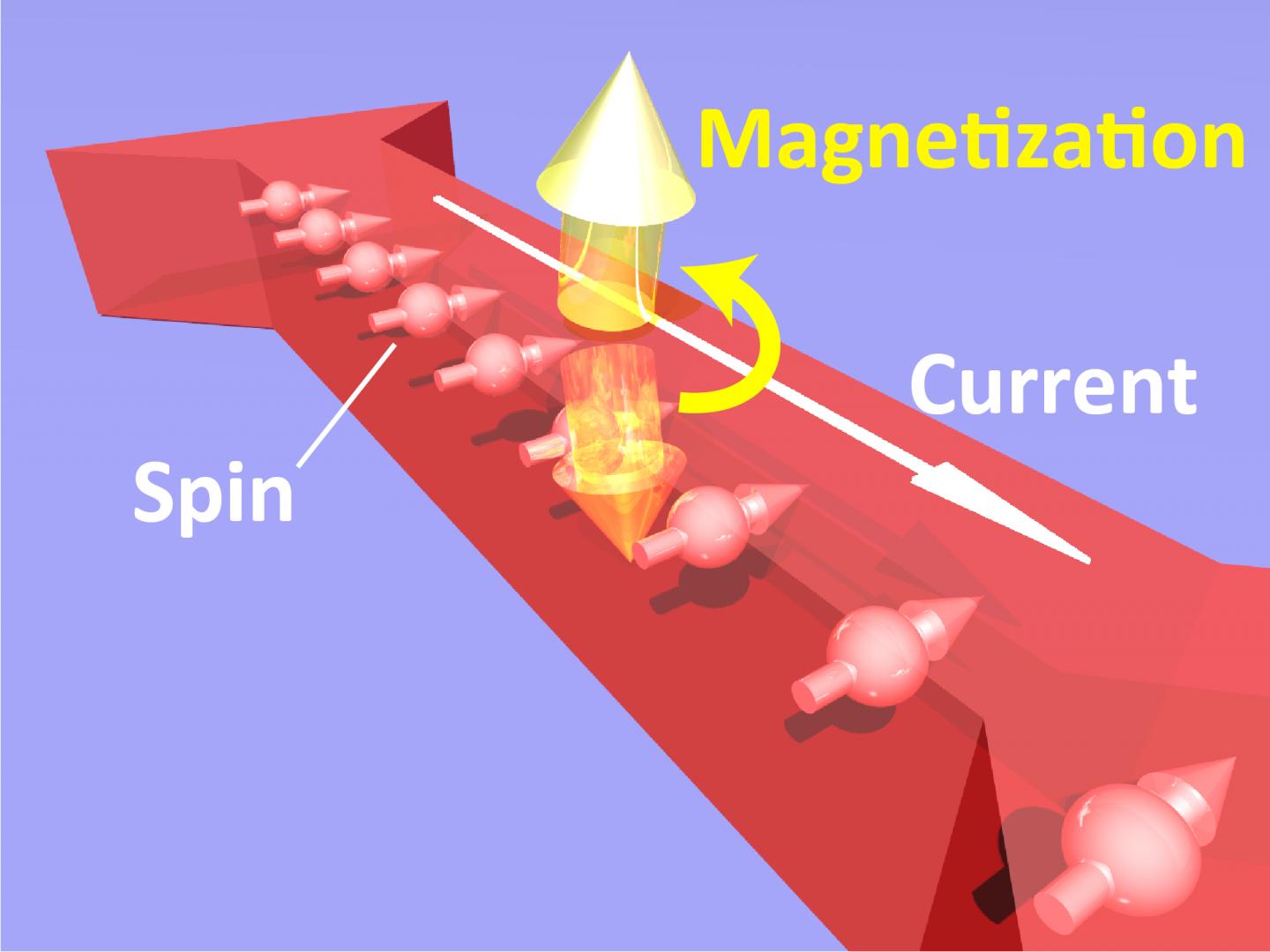
IMAGE

Credit: © 2019 Tanaka-Ohya Laboratory

UTokyo researchers have created an electronic component that demonstrates functions and abilities important to future generations of computational logic and memory devices. It is between one and two orders of magnitude more power efficient than previous attempts to create a component with the same kind of behavior. This fact could help it realize developments in the emerging field of spintronics.

If you’re a keen technophile and like to keep up to date with current and future developments in the field of computing, you might have come across the emerging field of spintronic devices. In a nutshell, spintronics explores the possibility of high-performance, low-power components for logic and memory. It’s based around the idea of encoding information into the spin — a property related to angular momentum — of an electron, rather than by using packets of electrons to represent logical bits, 1s and 0s.

One of the keys to unlock the potential of spintronics lies in the ability to quickly and efficiently magnetize materials. University of Tokyo Professor Masaaki Tanaka and colleagues have made an important breakthrough in this area. The team has created a component — a thin film of ferromagnetic material — the magnetization of which can be fully reversed with the application of very small current densities. These are between one and two orders of magnitude smaller than current densities required by previous techniques, so this device is far more efficient.

“We are trying to solve the problem of the large power consumption required for magnetization reversal in magnetic memory devices,” said Tanaka. “Our ferromagnetic semiconductor material — gallium manganese arsenide (GaMnAs) — is ideal for this task as it is a high-quality single crystal. Less ordered films have an undesirable tendency to flip electron spins. This is akin to resistance in electronic materials and it’s the kind of inefficiency we try to reduce.”

The GaMnAs film the team used for their experiment is special in another way too. It is especially thin thanks to a fabrication process known as molecular beam epitaxy. With this method devices can be constructed more simply than other analogous experiments which try and use multiple layers rather than single-layer thin films.

“We did not expect that the magnetization can be reversed in this material with such a low current density; we were very surprised when we found this phenomenon,” concludes Tanaka. “Our study will promote research of material development for more efficient magnetization reversal. And this in turn will help researchers realize promising developments in spintronics.”

###

Media Contact
Masaaki Tanaka
[email protected]

Original Source

http://doi.org/10.1038/s41467-019-10553-x

Related Journal Article

http://dx.doi.org/10.1038/s41467-019-10553-x

Tags: Atomic PhysicsChemistry/Physics/Materials SciencesElectromagneticsHardwareSuperconductors/SemiconductorsTheory/Design
Share12Tweet8Share2ShareShareShare2

Related Posts

blank

Advancing Alkene Chemistry: Homologative Difunctionalization Breakthrough

January 8, 2026
Biocompatible Ligand Enables Safe In-Cell Protein Arylation

Biocompatible Ligand Enables Safe In-Cell Protein Arylation

January 8, 2026

Monovalent Pseudo-Natural Products Boost IDO1 Degradation

January 7, 2026

Catalytic Enantioselective [1,2]-Wittig Rearrangement Breakthrough

January 7, 2026
Please login to join discussion

POPULAR NEWS

  • Enhancing Spiritual Care Education in Nursing Programs

    154 shares
    Share 62 Tweet 39
  • PTSD, Depression, Anxiety in Childhood Cancer Survivors, Parents

    146 shares
    Share 58 Tweet 37
  • Robotic Ureteral Reconstruction: A Novel Approach

    65 shares
    Share 26 Tweet 16
  • Impact of Vegan Diet and Resistance Exercise on Muscle Volume

    47 shares
    Share 19 Tweet 12

About

We bring you the latest biotechnology news from best research centers and universities around the world. Check our website.

Follow us

Recent News

Tomato Plants: How Heat Stress Affects Growth

PET Microplastics Harm Pig Pancreas Through Lipotoxicity

Tailored MobileNetV3Large Framework for Detecting Plant Diseases

Subscribe to Blog via Email

Enter your email address to subscribe to this blog and receive notifications of new posts by email.

Join 71 other subscribers
  • Contact Us

Bioengineer.org © Copyright 2023 All Rights Reserved.

Welcome Back!

Login to your account below

Forgotten Password?

Retrieve your password

Please enter your username or email address to reset your password.

Log In
No Result
View All Result
  • Homepages
    • Home Page 1
    • Home Page 2
  • News
  • National
  • Business
  • Health
  • Lifestyle
  • Science

Bioengineer.org © Copyright 2023 All Rights Reserved.