If sustainable energy communities are going to grow, power fluctuations need to be managed, perhaps in a centralized manner
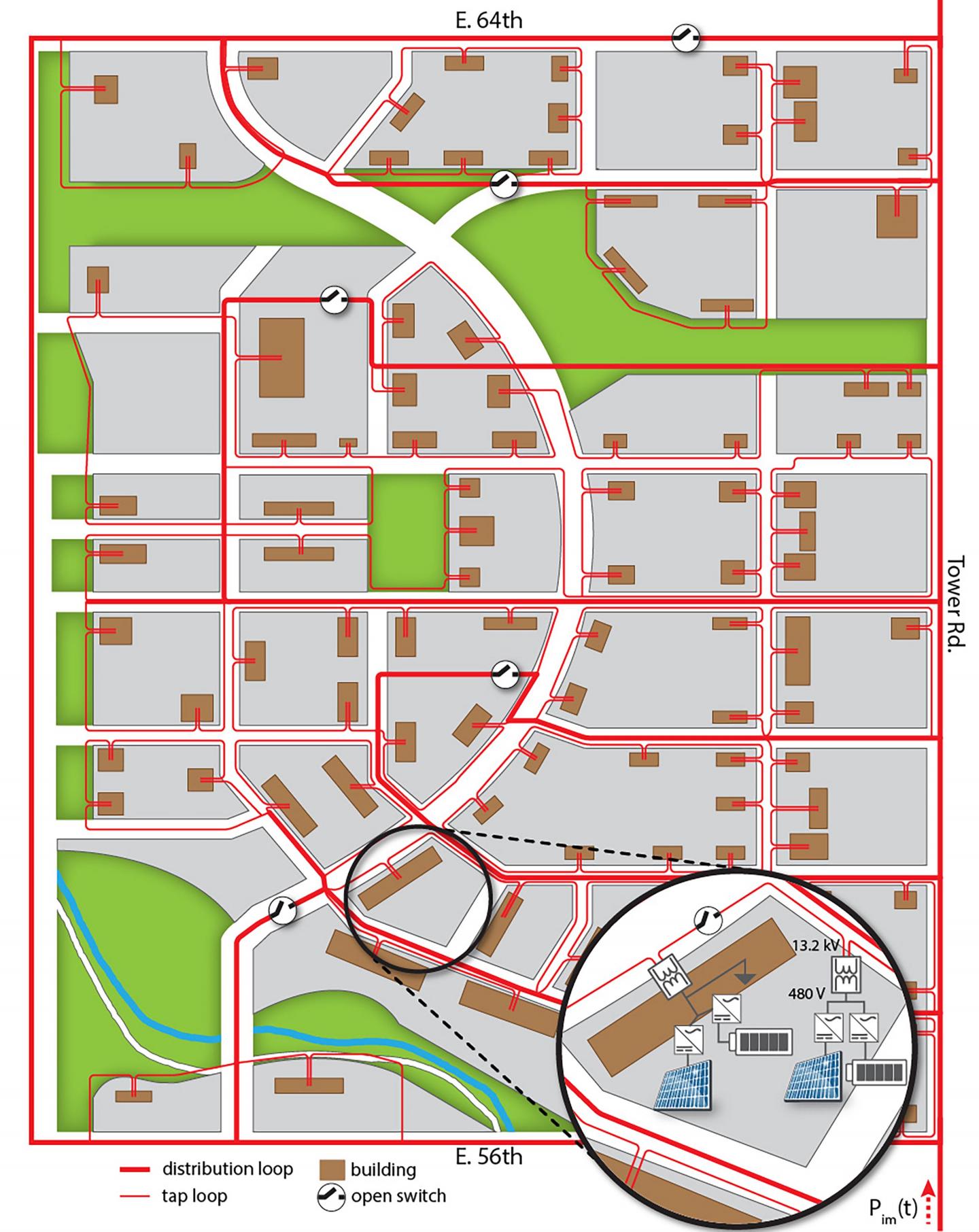
Credit: National Renewable Energy Laboratory
WASHINGTON, D.C., June 11, 2019 – Sustainable communities supplied by local renewable energy production are beginning to be established in the U.S. By using energy-efficient buildings and distributing means of energy generation, such as solar panels, throughout buildings in these districts, the communities manage to produce enough energy for their local needs — achieving a yearly net zero energy (NZE) balance.
However, this yearly average glosses over the local energy fluctuations that can challenge the supporting power grid. For example, a spike in energy production on a sunny day could cause voltage violations that might exceed appliance allowable standards.
To enable expansion of NZE districts to create more sustainable urban areas, researchers have integrated power grid considerations into the model of a newly planned NZE district and examined energy fluctuations at 15-minute intervals. The analysis and recommendations are presented in the Journal of Renewable and Sustainable Energy, from AIP Publishing.
“We had a unique partnership between electric utility suppliers, building developers, landowners and other stakeholders, which enabled us to look at this from a holistic perspective and come up with a solution that is better for everyone at a lower total cost,” said Bri-Mathias Hodge, who led the study at the National Renewable Energy Laboratory in Colorado.
Centralized planning provides a means to proactively ensure a reliable service of electricity to the districts. One way to achieve central management could be through utility ownership or operation of distributed devices, such as solar power systems and batteries.
To model this new centralized framework, the team combined power distribution software and energy efficiency modeling. They applied their integrated model to the 100-building solar-powered residential district planned in Denver, Colorado — Peña Station NEXT.
Using much more detailed solar and building data with higher time and geographic resolution than previously considered, the team was able to compute an exhaustive number of potential scenarios, finding the best way to achieve NZE at the lowest costs and with the least reliability impacts.
“The surprising thing was the magnitude of difference, from the power system perspective, between balancing NZE on the annual compared to the 15-minute basis,” said Hodge, who explained that alternative energy sources would be essential to pick up the daily slack in energy supply when the sun is low in the evenings, as well as seasonal fluctuations.
Another particularly important aspect for maintaining power grid operation and preventing costly rebuilds was the application of advanced solar power inverter control schemes to maintain local power balance.
Other NZE district planners are looking to apply the centralized planning tool. To speed up the process, Hodge’s team is automating the application of their model, as well as integrating other factors, such as electric car charging.
###
Learn how NREL researchers are using advanced modeling and visualization tools to help create the planned net-zero energy district, Peña Station NEXT, near the Denver International Airport in Denver, Colorado. This project will result in tools for smart city design that can be applied across the country. https:/
The article, “Toward a subhourly net zero energy district design through integrated building and distribution system modeling,” is authored by Kate Doubleday, Andrew Parker, Faeza Hafiz, Benjamin Irwin, Samuel Hancock, Shanti Pless and Bri-Mathias Hodge. The article will appear in the Journal of Renewable and Sustainable Energy on June 11, 2019 (DOI: 10.1063/1.5093917). After that date, it can be accessed at http://aip.
ABOUT THE JOURNAL
Journal of Renewable and Sustainable Energy is an interdisciplinary, peer-reviewed journal covering all areas of renewable and sustainable energy that apply to the physical science and engineering communities. See http://jrse.
Media Contact
Larry Frum
[email protected]
Related Journal Article
http://dx.