• HOME
  • NEWS
  • EXPLORE
    • CAREER
      • Companies
      • Jobs
    • EVENTS
    • iGEM
      • News
      • Team
    • PHOTOS
    • VIDEO
    • WIKI
  • BLOG
  • COMMUNITY
    • FACEBOOK
    • INSTAGRAM
    • TWITTER
Sunday, August 23, 2026
BIOENGINEER.ORG
No Result
View All Result
  • Login
  • HOME
  • NEWS
  • EXPLORE
    • CAREER
      • Companies
      • Jobs
        • Lecturer
        • PhD Studentship
        • Postdoc
        • Research Assistant
    • EVENTS
    • iGEM
      • News
      • Team
    • PHOTOS
    • VIDEO
    • WIKI
  • BLOG
  • COMMUNITY
    • FACEBOOK
    • INSTAGRAM
    • TWITTER
  • HOME
  • NEWS
  • EXPLORE
    • CAREER
      • Companies
      • Jobs
        • Lecturer
        • PhD Studentship
        • Postdoc
        • Research Assistant
    • EVENTS
    • iGEM
      • News
      • Team
    • PHOTOS
    • VIDEO
    • WIKI
  • BLOG
  • COMMUNITY
    • FACEBOOK
    • INSTAGRAM
    • TWITTER
No Result
View All Result
Bioengineer.org
No Result
View All Result
Home NEWS Science News Chemistry

Settling the debate: Solving the electronic surface states of samarium hexaboride

Bioengineer by Bioengineer
June 10, 2019
in Chemistry
Reading Time: 3 mins read
0
IMAGE
Share on FacebookShare on TwitterShare on LinkedinShare on RedditShare on Telegram

IMAGE

Credit: Osaka University

Osaka, Japan – A team led by Osaka University used angle-resolved photoelectron spectroscopy to probe the unusual surface conductivity of samarium hexaboride crystals. They showed that the material is a co-existing phase of “topological insulator” in which electrical current can flow along the surface but not through the bulk of the sample, a “Kondo insulator”, which undergoes a metal-to-insulator transition due to the strong electron correlation. This work, which demonstrates that topological insulators can simultaneously have strong electron correlations, may allow for the development of quantum spin devices that use the magnetic spins of individual electrons to outperform current computers.

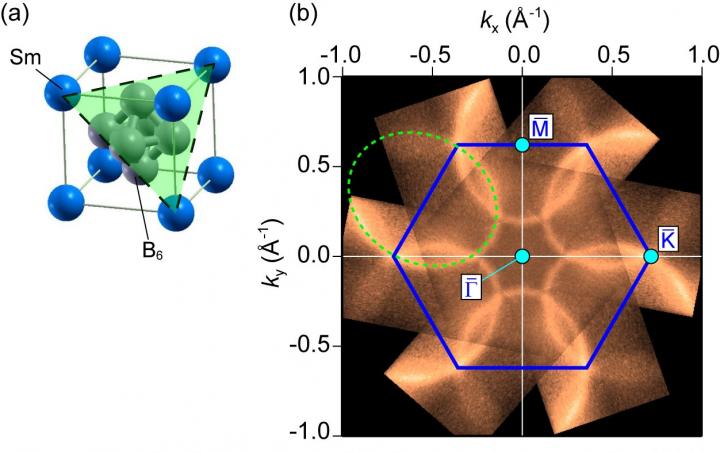
A long-standing debate has existed regarding the metallic surface electronic structure of samarium hexaboride (SmB6). SmB6 is known to be an insulator only at low temperatures due to strong electron correlations, called the “Kondo effect.” Unlike most materials, the resistance in Kondo insulators actually increases with decreasing temperature. However, the origin of the remnant conductivity at low temperatures has not yet been revealed. A popular hypothesis is that SmB6 is also a topological insulator, which can have metallic electronic states on its surface. However, the surface electronic structures of SmB6 obtained so far have been complex and difficult to interpret and thus this question of whether or not SmB6 is indeed topological has been a long-standing debate. In this work, the team observed the surface states from a new crystal orientation and succeeded in significantly simplifying the surface states.

The main insight was measuring along a particular surface direction, which had previously been difficult to do. To obtain this surface, the researchers first had to prepare an atomically flat, extremely clean surface of the crystal in a very precise manner. They accomplished this by heating a single crystal of samarium hexaboride to very high temperatures in an ultra-high vacuum chamber. They then performed angle-resolved photoelectron spectroscopy, which monitors the electrons ejected from the crystal when exposed to intense beams of light. Using a ferromagnetic detector, they were able to determine not only the speeds of the electrons, but also if they had their spins oriented up or down. “We were able to show that samarium hexaboride is a topological insulator, without any ambiguity,” says lead author Shin-ichi Kimura. “This opens a new research area in which strong correlations and topological effects can exist in the same material.”

###

The article “Non-trivial surface states of samarium hexaboride at the (111) surface” was published in Nature Communications at DOI: 10.1038/s41467-019-10353-3.

About Osaka University

Osaka University was founded in 1931 as one of the seven imperial universities of Japan and now has expanded to one of Japan’s leading comprehensive universities. The University has now embarked on open research revolution from a position as Japan’s most innovative university and among the most innovative institutions in the world according to Reuters 2015 Top 100 Innovative Universities and the Nature Index Innovation 2017. The university’s ability to innovate from the stage of fundamental research through the creation of useful technology with economic impact stems from its broad disciplinary spectrum.

Website: https://resou.osaka-u.ac.jp/en/top

Media Contact
Saori Obayashi
[email protected]

Original Source

https://www.nature.com/articles/s41467-019-10353-3

Related Journal Article

http://dx.doi.org/10.1038/s41467-019-10353-3

Tags: Atomic/Molecular/Particle PhysicsChemistry/Physics/Materials SciencesMaterialsMolecular PhysicsOptics
Share12Tweet8Share2ShareShareShare2

Related Posts

Scientists uncover design rules for high-performance thermoelectric materials

Scientists uncover design rules for high-performance thermoelectric materials

August 22, 2026
Bringing Optical Fibre Materials to Photonic Chips

Bringing Optical Fibre Materials to Photonic Chips

August 22, 2026

Nanoscience and Liquid Crystals Unite in Functional Hybrids With Transformative Applications

August 22, 2026

Designing Better Biomedical Hydrogels Through Molecular Building Blocks and Hierarchical Structures

August 22, 2026
Please login to join discussion

POPULAR NEWS

  • Dual-oxygen pancreatic cancer organoids mirror basal-classical diversity, spatial transcriptomics confirms

    29 shares
    Share 12 Tweet 7
  • Tirzepatide Versus GLP-1 Agonists for Stroke Risk in Atrial Fibrillation and Diabetes

    29 shares
    Share 12 Tweet 7
  • Real-world study examines psychotic complications of subcutaneous foslevodopa/foscarbidopa infusions in 198 patients

    29 shares
    Share 12 Tweet 7
  • Blood-flow signals from liver vessels direct region-specific liver function through Wnt pathways

    29 shares
    Share 12 Tweet 7

About

We bring you the latest biotechnology news from best research centers and universities around the world. Check our website.

Follow us

Recent News

Dual-oxygen pancreatic cancer organoids mirror basal-classical diversity, spatial transcriptomics confirms

Tirzepatide Versus GLP-1 Agonists for Stroke Risk in Atrial Fibrillation and Diabetes

Real-world study examines psychotic complications of subcutaneous foslevodopa/foscarbidopa infusions in 198 patients

Subscribe to Blog via Email

Enter your email address to subscribe to this blog and receive notifications of new posts by email.

Join 85 other subscribers
  • Contact Us

Bioengineer.org © Copyright 2023 All Rights Reserved.

Welcome Back!

Login to your account below

Forgotten Password?

Retrieve your password

Please enter your username or email address to reset your password.

Log In
No Result
View All Result
  • Homepages
    • Home Page 1
    • Home Page 2
  • News
  • National
  • Business
  • Health
  • Lifestyle
  • Science

Bioengineer.org © Copyright 2023 All Rights Reserved.