• HOME
  • NEWS
  • EXPLORE
    • CAREER
      • Companies
      • Jobs
    • EVENTS
    • iGEM
      • News
      • Team
    • PHOTOS
    • VIDEO
    • WIKI
  • BLOG
  • COMMUNITY
    • FACEBOOK
    • INSTAGRAM
    • TWITTER
Monday, March 30, 2026
BIOENGINEER.ORG
No Result
View All Result
  • Login
  • HOME
  • NEWS
  • EXPLORE
    • CAREER
      • Companies
      • Jobs
        • Lecturer
        • PhD Studentship
        • Postdoc
        • Research Assistant
    • EVENTS
    • iGEM
      • News
      • Team
    • PHOTOS
    • VIDEO
    • WIKI
  • BLOG
  • COMMUNITY
    • FACEBOOK
    • INSTAGRAM
    • TWITTER
  • HOME
  • NEWS
  • EXPLORE
    • CAREER
      • Companies
      • Jobs
        • Lecturer
        • PhD Studentship
        • Postdoc
        • Research Assistant
    • EVENTS
    • iGEM
      • News
      • Team
    • PHOTOS
    • VIDEO
    • WIKI
  • BLOG
  • COMMUNITY
    • FACEBOOK
    • INSTAGRAM
    • TWITTER
No Result
View All Result
Bioengineer.org
No Result
View All Result
Home NEWS Science News Biology

Proof of sandwiched graphene-membrane superstructure opens up a membrane-specific drug delivery mode

Bioengineer by Bioengineer
June 7, 2019
in Biology
Reading Time: 2 mins read
0
IMAGE
Share on FacebookShare on TwitterShare on LinkedinShare on RedditShare on Telegram

IMAGE

Credit: YUE Hua and CHEN Pengyu

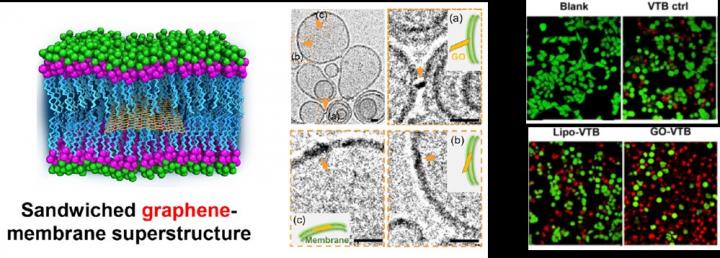
Researchers from the Institute of Process Engineering (IPE) of the Chinese Academy of Sciences and Tsinghua University (THU) proved a sandwiched superstructure for graphene oxide (GO) that transport inside cell membranes for the first time.

The discovery, published in Science Advances, opens up a membrane-specific drug delivery mode, which could significantly improve cytotoxicity effects over traditional drug carriers.

The transport of nanoparticles at bio-nano interfaces is essential for cellular responses and biomedical applications. How two-dimensional nanomaterials interact or diffuse inside the cell membrane is unknown, thus hindering their applications in the biomedical area.

“The sandwiched graphene membrane is a long-simulated superstructure but an unproved issue in vitro. We are excited to provide substantial experimental evidence and open an avenue for novel membrane-specific drug delivery,” said WEI Wei, a professor from the State Key Laboratory of Biochemical Engineering of IPE.

The formation process of sandwiched GO was visualized in a fully hydrated/native state, and the significant influence on cell roughness, cell fluidity and membrane rigidity was also revealed.

Furthermore, the sandwiched GO induced greater drug entry and quicker diffusion time inside the membrane lipid layer, thus outperforming a typical liposome carrier in anti-cancer efficacy. This feature is also extremely beneficial when delivering vaccine adjuvants (e.g., membrane receptor ligands) for enhanced immune effect, according to WEI.

All the cell interactions, diffusion dynamics and the enhanced efficiency of membrane-specific drug delivery of sandwiched GO were simulated by Prof. YAN Litang from THU.

“It is a very nice study of graphene-membrane superstructures. It discloses different transport regimes, the presence of pores and a number of other potentially interesting features related to these systems,” said peer reviewers from Science Advances. “Moreover, they demonstrate the applicability of GOs for drug delivery. Overall, the paper is very timely and tells a good story.”

The GO-based sandwiched superstructure offers immense design capabilities that may enable a considerable number of applications for these emerging nanomaterials in the cutting-edge fields of biological and medical science.

###

Media Contact
LI Xiangyu
[email protected]

Original Source

http://english.cas.cn/

Related Journal Article

http://dx.doi.org/10.1126/sciadv.aaw3192

Tags: BiologyBiomedical/Environmental/Chemical EngineeringCell Biology
Share12Tweet8Share2ShareShareShare2

Related Posts

Lowering the Risk of Repeat Preterm Births Through Probiotic Therapy

Lowering the Risk of Repeat Preterm Births Through Probiotic Therapy

March 30, 2026
Squid Evolution Ignited 100 Million Years Ago in Deep Ocean, Triggering Rapid Diversification

Squid Evolution Ignited 100 Million Years Ago in Deep Ocean, Triggering Rapid Diversification

March 30, 2026

Squirrels Scale Greater Heights to Access Superior Snacks

March 30, 2026

New Zebrafish Study Sheds Light on Why Haploid Fish Embryos Often Fail to Fully Develop

March 30, 2026
Please login to join discussion

POPULAR NEWS

  • blank

    Revolutionary AI Model Enhances Precision in Detecting Food Contamination

    96 shares
    Share 38 Tweet 24
  • Imagine a Social Media Feed That Challenges Your Views Instead of Reinforcing Them

    1005 shares
    Share 397 Tweet 248
  • Promising Outcomes from First Clinical Trials of Gene Regulation in Epilepsy

    51 shares
    Share 20 Tweet 13
  • Advancements in EV Battery Technology to Surpass Climate Change-Induced Degradation

    45 shares
    Share 18 Tweet 11

About

We bring you the latest biotechnology news from best research centers and universities around the world. Check our website.

Follow us

Recent News

Fuzzy Logic Enhances Duckworth–Lewis–Stern Cricket Targets

Treatment Goals Shape Outcomes in Critically Ill Nonagenarians

Radiofrequency Cascade Unlocks Coupled Spin Qubit Readout

Subscribe to Blog via Email

Enter your email address to subscribe to this blog and receive notifications of new posts by email.

Join 78 other subscribers
  • Contact Us

Bioengineer.org © Copyright 2023 All Rights Reserved.

Welcome Back!

Login to your account below

Forgotten Password?

Retrieve your password

Please enter your username or email address to reset your password.

Log In
No Result
View All Result
  • Homepages
    • Home Page 1
    • Home Page 2
  • News
  • National
  • Business
  • Health
  • Lifestyle
  • Science

Bioengineer.org © Copyright 2023 All Rights Reserved.