• HOME
  • NEWS
  • EXPLORE
    • CAREER
      • Companies
      • Jobs
    • EVENTS
    • iGEM
      • News
      • Team
    • PHOTOS
    • VIDEO
    • WIKI
  • BLOG
  • COMMUNITY
    • FACEBOOK
    • INSTAGRAM
    • TWITTER
Friday, May 15, 2026
BIOENGINEER.ORG
No Result
View All Result
  • Login
  • HOME
  • NEWS
  • EXPLORE
    • CAREER
      • Companies
      • Jobs
        • Lecturer
        • PhD Studentship
        • Postdoc
        • Research Assistant
    • EVENTS
    • iGEM
      • News
      • Team
    • PHOTOS
    • VIDEO
    • WIKI
  • BLOG
  • COMMUNITY
    • FACEBOOK
    • INSTAGRAM
    • TWITTER
  • HOME
  • NEWS
  • EXPLORE
    • CAREER
      • Companies
      • Jobs
        • Lecturer
        • PhD Studentship
        • Postdoc
        • Research Assistant
    • EVENTS
    • iGEM
      • News
      • Team
    • PHOTOS
    • VIDEO
    • WIKI
  • BLOG
  • COMMUNITY
    • FACEBOOK
    • INSTAGRAM
    • TWITTER
No Result
View All Result
Bioengineer.org
No Result
View All Result
Home NEWS Science News Science

Creating new molecular sieves

Bioengineer by Bioengineer
June 6, 2019
in Science
Reading Time: 2 mins read
0
IMAGE
Share on FacebookShare on TwitterShare on LinkedinShare on RedditShare on Telegram

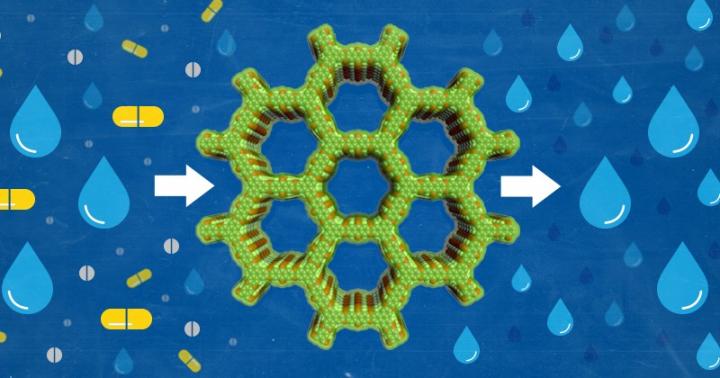
Researchers make organic frameworks that could sift antibiotic residue out of water
IMAGE

Credit: Illustration by Joy Smoker

An international team of researchers recently synthesized polyarylether-based covalent organic frameworks, the most stable crystalline porous material on record. The team, which includes the University of Delaware’s Yushan Yan and Jilin University’s Qianrong (Frank) Fang, a former postdoctoral researcher with Yan at UD, described their results in the international scientific journal Nature Chemistry.

Some materials act like sieves and let molecules pass through their pores. These materials, known as molecular sieves, are useful in many industrial processes, especially in the chemical and energy sectors. They could be used to remove contaminants from water. They have also received attention for potential applications in aerospace, rail transportation, automobile manufacturing and more, but so far, their applications have been limited by their instability under extreme conditions.

Yan, the Distinguished Engineering Professor in the Department of Chemical and Biomolecular Engineering, has investigated crystalline porous materials such as zeolite since his doctoral research in the earlier 1990s. He won the Donald Breck Award, the highest award from the International Zeolite Association in 2010 for his zeolite thin film work. When Fang joined his group in 2009, the pair began to explore an emerging class of crystalline porous materials called covalent organic frameworks, which are linked by covalent bonds, show great promise, but at times are limited by available chemistries and their instability in harsh conditions, such as strong acids and bases.

Yan and Fang were the first to make covalent organic frameworks using stable carbon-nitrogen bond (imide) and they have since, first at UD and then at Jilin University after Fang left UD to take a prestigious faculty position back in China, been working to develop covalent organic frameworks based on carbon-oxygen bonds. They anticipated these materials would be stable — if only they could make them.

To do so, they made frameworks out of polyarylether, a highly stable engineered plastic. By carefully designing the skeletons based on new stable bonds, they made a material that was more stable than any other of its kind.

“Once you have the carbon-oxygen bond, this porous material is stable in strong acid, strong bases, and strong oxidants,” said Yan. The frameworks are also stable up to 400 degrees Celsius. “Among porous crystalline materials, organic or inorganic, this is the most stable one.”

For the next step, the research team made polyarylether-based covalent organic frameworks that could sift antibiotic residue out of water in a pH ranging from 1 to 13.

In the paper, the research group concluded: “These stable COFs [covalent-organic frameworks] are a perfect platform for the preparation of functional materials that can be used under extreme chemical environments.”

###

Media Contact
Peter Kerwin
[email protected]

Original Source

https://www.udel.edu/udaily/2019/june/most-stable-crystalline-porous-material-yushan-yan/

Related Journal Article

http://dx.doi.org/10.1038/s41557-019-0238-5

Tags: BiochemistryChemistry/Physics/Materials SciencesIndustrial Engineering/ChemistryMolecular Biology
Share12Tweet8Share2ShareShareShare2

Related Posts

Five or more hours of smartphone usage per day may increase obesity

July 25, 2019
IMAGE

NASA’s terra satellite finds tropical storm 07W’s strength on the side

July 25, 2019

NASA finds one burst of energy in weakening Depression Dalila

July 25, 2019

Researcher’s innovative flood mapping helps water and emergency management officials

July 25, 2019
Please login to join discussion

POPULAR NEWS

  • Research Indicates Potential Connection Between Prenatal Medication Exposure and Elevated Autism Risk

    843 shares
    Share 337 Tweet 211
  • New Study Reveals Plants Can Detect the Sound of Rain

    729 shares
    Share 291 Tweet 182
  • Salmonella Haem Blocks Macrophages, Boosts Infection

    62 shares
    Share 25 Tweet 16
  • Breastmilk Balances E. coli and Beneficial Bacteria in Infant Gut Microbiomes

    58 shares
    Share 23 Tweet 15

About

We bring you the latest biotechnology news from best research centers and universities around the world. Check our website.

Follow us

Recent News

Personalized beverages offer vital nutrients for space missions, new study reveals

Innovative Ultrasonic Framework Enhances Real-Time Measurement of Oil Film Thickness in Rolling Bearings

HESpotEx: Deep Learning Predicts Gene Expression from Histology

Subscribe to Blog via Email

Enter your email address to subscribe to this blog and receive notifications of new posts by email.

Join 82 other subscribers
  • Contact Us

Bioengineer.org © Copyright 2023 All Rights Reserved.

Welcome Back!

Login to your account below

Forgotten Password?

Retrieve your password

Please enter your username or email address to reset your password.

Log In
No Result
View All Result
  • Homepages
    • Home Page 1
    • Home Page 2
  • News
  • National
  • Business
  • Health
  • Lifestyle
  • Science

Bioengineer.org © Copyright 2023 All Rights Reserved.