• HOME
  • NEWS
  • EXPLORE
    • CAREER
      • Companies
      • Jobs
    • EVENTS
    • iGEM
      • News
      • Team
    • PHOTOS
    • VIDEO
    • WIKI
  • BLOG
  • COMMUNITY
    • FACEBOOK
    • INSTAGRAM
    • TWITTER
Thursday, March 26, 2026
BIOENGINEER.ORG
No Result
View All Result
  • Login
  • HOME
  • NEWS
  • EXPLORE
    • CAREER
      • Companies
      • Jobs
        • Lecturer
        • PhD Studentship
        • Postdoc
        • Research Assistant
    • EVENTS
    • iGEM
      • News
      • Team
    • PHOTOS
    • VIDEO
    • WIKI
  • BLOG
  • COMMUNITY
    • FACEBOOK
    • INSTAGRAM
    • TWITTER
  • HOME
  • NEWS
  • EXPLORE
    • CAREER
      • Companies
      • Jobs
        • Lecturer
        • PhD Studentship
        • Postdoc
        • Research Assistant
    • EVENTS
    • iGEM
      • News
      • Team
    • PHOTOS
    • VIDEO
    • WIKI
  • BLOG
  • COMMUNITY
    • FACEBOOK
    • INSTAGRAM
    • TWITTER
No Result
View All Result
Bioengineer.org
No Result
View All Result
Home NEWS Science News Health

blu research suggests potential breakthrough in future e-liquid classifications

Bioengineer by Bioengineer
June 5, 2019
in Health
Reading Time: 2 mins read
0
IMAGE
Share on FacebookShare on TwitterShare on LinkedinShare on RedditShare on Telegram

Innovative in-vitro research using GARD assays can help detect known allergens
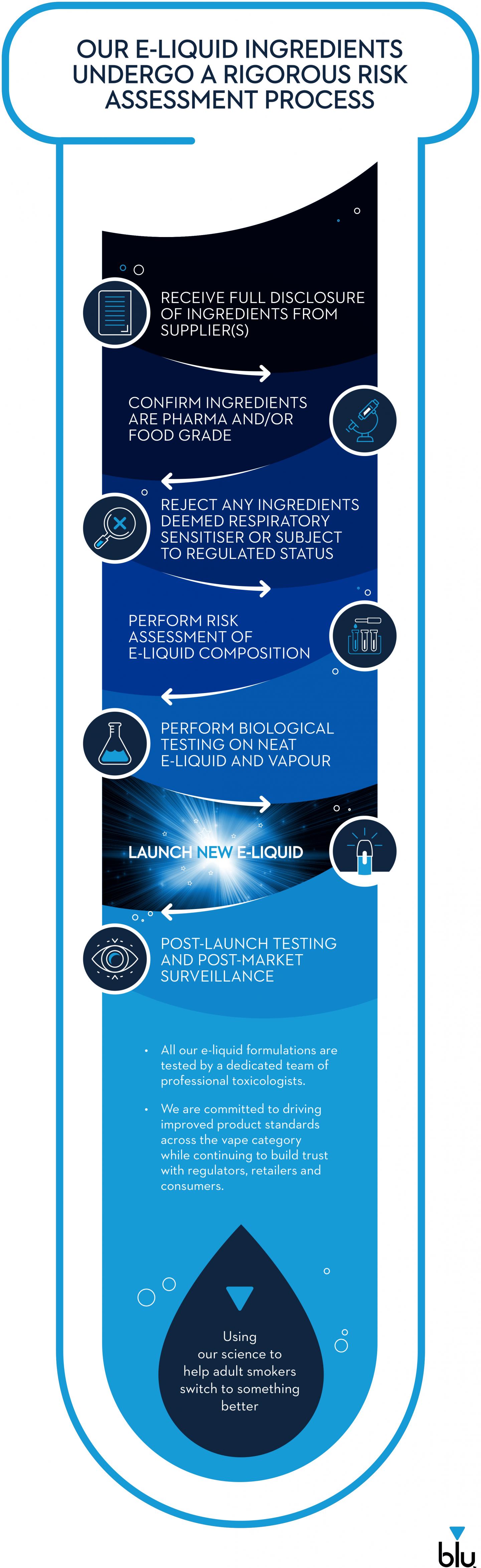
IMAGE

Credit: blu / Imperial Brands

A new study* suggests that Genomic Allergen Rapid Detection (or GARD) in-vitro assays can be used to differentiate and classify vape e-liquids, as well as detect allergens potentially present in ingredients.

Dr Grant O’Connell, Head of Scientific Affairs at Imperial Brands, explains: “GARD assay testing represents another important step in our commitment to cutting-edge e-vapour research, and forms part of our ambition to build a next-generation scientific assessment framework partly based on the US National Research Council’s blueprint for Toxicity Testing in the 21st Century (TT21C)**.

The availability of a broad range of e-liquids plays a crucial role in both attracting adult smokers to vaping and retaining them within the category. This, in turn, contributes to declining smoking rates and tobacco harm reduction. However, it’s important that e-liquid flavourings and their ingredients are guided by rigorous toxicological principles, as some constituents can be allergenic.

Demonstrating our continued commitment to leading-edge science and the manufacturing of high-quality products that safeguard consumers, blu scientists assessed the possibility of using Genomic Allergen Rapid Detection (GARD) assays to potentially raise standards in this area. These assays were originally developed to assess the sensitisation potential of compounds in the chemical manufacturing industry, but this pioneering research is the first vaping-related application.

For the study, scientists used the GARD testing approach to compare the respiratory and skin sensitising potential of five e-liquids, with initial results indicating the assays were indeed successfully able to differentiate and classify those products assessed.

Matthew Stevenson, In-Vitro Research Manager at Imperial Brands and study author, comments: “While further studies need to be conducted to assess how GARD assays could be used for the rapid screening and toxicological assessment of e-liquids in support of future product development and commercialisation, our initial success represents an exciting first step on the path to a potential entirely new way of assessing and classifying future e-liquids.”

O’Connell concludes: “TT21C advocates the use of in-vitro testing, preferably using human cells, as a replacement for traditional in-vivo animal testing and this is in keeping with blu and Imperial’s established position of not testing our products on animals***.

“By uplifting our scientific capabilities through the likes of TT21C we are continuing to protect our consumers while raising standards across the wider vaping category to provide something better for the world’s smokers.”

###

This study was made available online in January 2019 ahead of final publication in print in April 2019.

* ‘The use of Genomic Allergen Rapid Detection (GARD) assays to predict the respiratory and skin sensitising potential of e-liquids’

** https://www.ncbi.nlm.nih.gov/pubmed/20574894

*** Unless formally required to do so by governments or recognised regulatory authorities.

Media Contact
Rob Taylor
[email protected]

Related Journal Article

http://dx.doi.org/10.1016/j.yrtph.2019.01.001

Tags: Policy/EthicsPublic HealthSmoking/TobaccoToxicology
Share12Tweet8Share2ShareShareShare2

Related Posts

Aversive Learning Hijacks Brain Sugar Sensor

March 25, 2026

Can Psychosocial Factors Influence Cancer Risk?

March 23, 2026

Depression Factors in Elderly: Pre vs. Post-COVID Analysis

March 23, 2026

Hidden Health Crises Among US and UK Volunteers in Ukraine Uncovered in New Study

March 23, 2026
Please login to join discussion

POPULAR NEWS

  • blank

    Revolutionary AI Model Enhances Precision in Detecting Food Contamination

    96 shares
    Share 38 Tweet 24
  • Imagine a Social Media Feed That Challenges Your Views Instead of Reinforcing Them

    1003 shares
    Share 397 Tweet 248
  • Uncovering Functions of Cavernous Malformation Proteins in Organoids

    54 shares
    Share 22 Tweet 14
  • Promising Outcomes from First Clinical Trials of Gene Regulation in Epilepsy

    51 shares
    Share 20 Tweet 13

About

We bring you the latest biotechnology news from best research centers and universities around the world. Check our website.

Follow us

Recent News

In-Sensor Cryptography Links Physical Process to Digital Identity

Can Psychosocial Factors Influence Cancer Risk?

Depression Factors in Elderly: Pre vs. Post-COVID Analysis

Subscribe to Blog via Email

Success! An email was just sent to confirm your subscription. Please find the email now and click 'Confirm' to start subscribing.

Join 78 other subscribers
  • Contact Us

Bioengineer.org © Copyright 2023 All Rights Reserved.

Welcome Back!

Login to your account below

Forgotten Password?

Retrieve your password

Please enter your username or email address to reset your password.

Log In
No Result
View All Result
  • Homepages
    • Home Page 1
    • Home Page 2
  • News
  • National
  • Business
  • Health
  • Lifestyle
  • Science

Bioengineer.org © Copyright 2023 All Rights Reserved.