Long-term goals hold promise for treatment of blood disorders and bone marrow regeneration
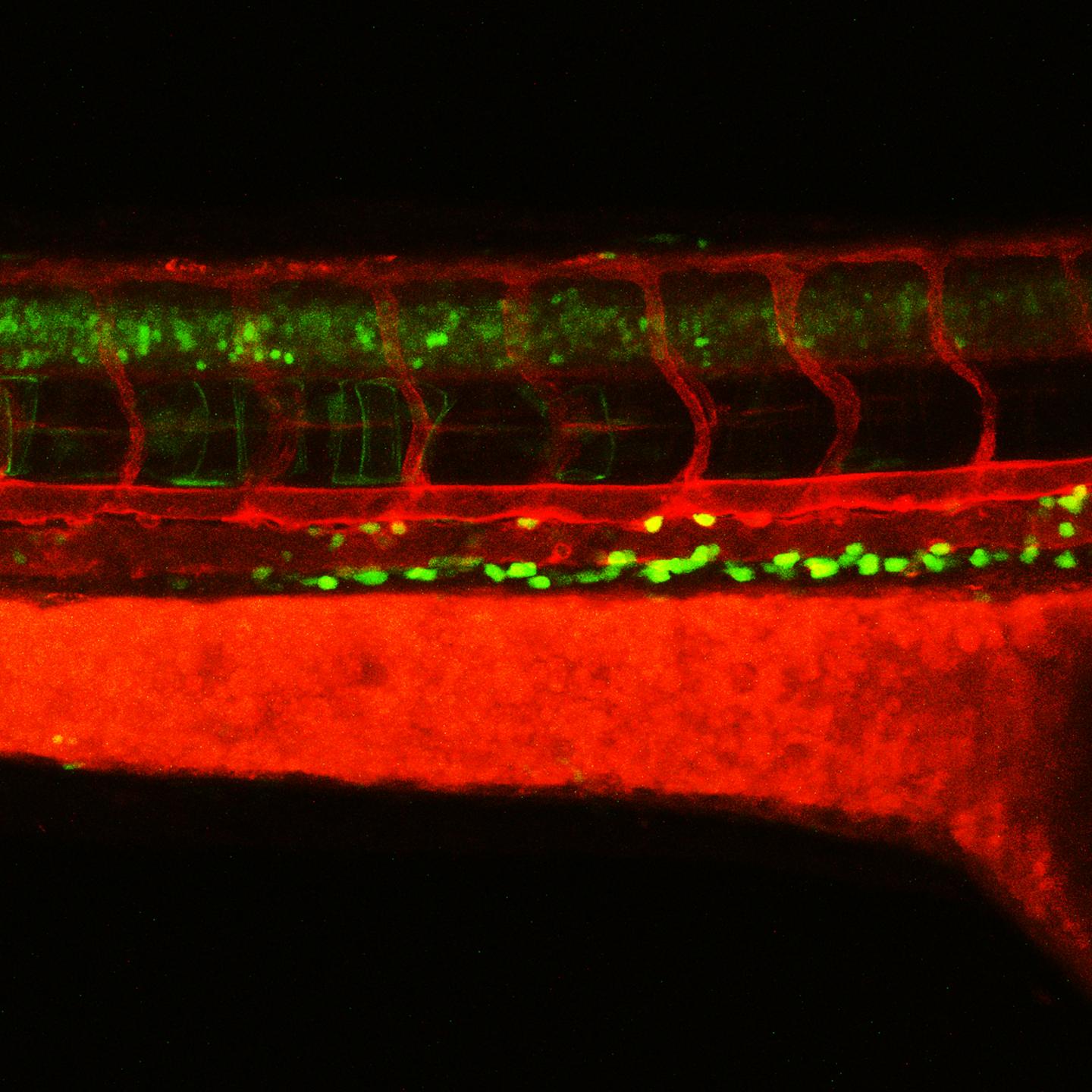
Credit: Houston Methodist
In a landmark study, scientists at Houston Methodist Research Institute discovered what makes white blood cell counts spike in individuals who have high cholesterol, possibly leading to new therapies for heart disease.
Led by Longhou Fang, Ph.D., an associate professor in the Center for Cardiovascular Regeneration, and his postdoctoral fellow Qilin Gu, Ph.D., the team looked at hypercholesterolemia, which is the type of high cholesterol that causes very high levels of LDL – the so-called “bad” cholesterol – to circulate in the blood.
They identified a new regulatory mechanism in zebrafish models responsible for this increase in white blood cells typically seen in people with these high LDL levels, which are known to increase a person’s risk for cardiovascular disease, the leading cause of morbidity and mortality in the U.S. and globally.
“Our findings may explain why this can happen,” Fang said. “This mechanism we identified activates a protein called SREBP2 that in turn leads to the development of more hematopoietic stem cells (HSPCs), which are the precursors to white blood cells and the process by which all mature blood cells are produced. We were able to show that targeting this protein using its antagonist can reduce the HSPC counts to bring down the white blood cell counts. This insight may lead to a new strategy to treat atherosclerotic cardiovascular disease.”
Additionally, Fang says finding this new pathway that controls the generation of HSPCs could be useful for treating blood disorders, such as leukemia and anemia, in the future. For instance, he says the plant-derived drug betulin, which is an SREBP2 inhibitor, could possibly be repurposed to mitigate the progression of leukemia. Even further down the line, he said this also holds promise for bone marrow regeneration using patient-derived hematopoietic stem cells, which would eliminate the need to find a donor.
Initially reported in an article titled “AIBP-mediated cholesterol efflux instructs hematopoietic stem and progenitor cell fate” in the journal Science, the study has since been cited by the New England Journal of Medicine (NEJM) and Nature Reviews Cardiology.
In the NEJM editorial, the authors write, “This study certainly teaches us that cholesterol metabolism and inflammation are interconnected in the bone marrow environment through the transcription factor SREBP2.” They go on to say, “The most notable aspect of the study…is the implication of ‘cholesterol metabolism’ genes in the biologic makeup of HSPCs. These findings provide support for the hypothesis that cholesterol metabolism is a driver of inflammation in cardiovascular disease.”
Fang and his colleagues say their next steps are to continue exploring the role of cholesterol metabolism in hematopoiesis, saying that their findings bring them one step closer to their ultimate goal of generating patient-oriented HSPCs, which will be essential for the progress of regenerative and precision medicine.
###
Other researchers collaborating with Fang and Gu on this paper include Xiaojie Yang, Jie Lv, Bo Xia, Jiaxiong Zhang, Jun-dae Kim, Shu Meng, John P. Cooke and Kaifu Chen from Houston Methodist; Yongping Bai from Xiangya Hospital at Central South University in China; Ruoyu Wang, Feng Xiong, Wenbo Li, Miguel F. Diaz and Pamela L. Wenzel from UTHealth; Thomas P. Clements, Bhavna Tandon and Daniel S. Wagner from Rice University; Yury I. Miller and David Traver from University of California San Diego; and Leonard I. Zon from Harvard Medical School.
The work was supported by grants from the National Heart, Lung and Blood Institute (HL114734, HL132155, HL135737, HL133254), the American Heart Association (16BGIA27790081, 18TPA34250009, 17POST33410671), the National Institutes of Health (HL04880, DK49216, K01DK092365, R01DK111599, CA204468, GM125632) and the Cancer Prevention and Research Institute of Texas (RP110776, RR160083, RP120348, RP170002).
For more information about Houston Methodist, visit houstonmethodist.org. Follow us on Twitter and Facebook.
For more information: AIBP-mediated cholesterol efflux instructs hematopoietic stem and progenitor cell fate. Science. (March 8, 2019) Q. Gu, X. Yang, J. Lv, J. Zhang, B. Xia, J. Kim, R. Wang, F. Xiong, S. Meng, T.P. Clements, B. Tandon, D.S. Wagner, M.F. Diaz, P.L. Wenzel, Y.I. Miller, D. Traver, J.P. Cooke, W. Li, L.I. Zon, K. Chen, Y. Bai, L. Fang. DOI: https:/
Media Contact
Lisa Merkl
[email protected]
Related Journal Article
http://dx.