• HOME
  • NEWS
  • EXPLORE
    • CAREER
      • Companies
      • Jobs
    • EVENTS
    • iGEM
      • News
      • Team
    • PHOTOS
    • VIDEO
    • WIKI
  • BLOG
  • COMMUNITY
    • FACEBOOK
    • INSTAGRAM
    • TWITTER
Thursday, March 26, 2026
BIOENGINEER.ORG
No Result
View All Result
  • Login
  • HOME
  • NEWS
  • EXPLORE
    • CAREER
      • Companies
      • Jobs
        • Lecturer
        • PhD Studentship
        • Postdoc
        • Research Assistant
    • EVENTS
    • iGEM
      • News
      • Team
    • PHOTOS
    • VIDEO
    • WIKI
  • BLOG
  • COMMUNITY
    • FACEBOOK
    • INSTAGRAM
    • TWITTER
  • HOME
  • NEWS
  • EXPLORE
    • CAREER
      • Companies
      • Jobs
        • Lecturer
        • PhD Studentship
        • Postdoc
        • Research Assistant
    • EVENTS
    • iGEM
      • News
      • Team
    • PHOTOS
    • VIDEO
    • WIKI
  • BLOG
  • COMMUNITY
    • FACEBOOK
    • INSTAGRAM
    • TWITTER
No Result
View All Result
Bioengineer.org
No Result
View All Result
Home NEWS Science News Chemistry

Everything will connect to the internet someday, and this biobattery could help

Bioengineer by Bioengineer
June 4, 2019
in Chemistry
Reading Time: 2 mins read
0
IMAGE
Share on FacebookShare on TwitterShare on LinkedinShare on RedditShare on Telegram

IMAGE

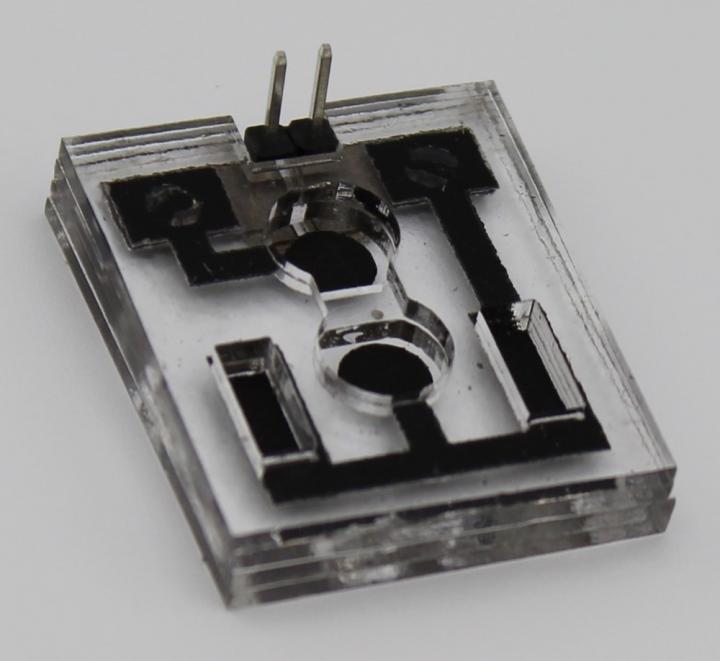
Credit: Sean Choi

BINGHAMTON, N.Y. – In the future, small paper and plastic devices will be able to connect to the internet for a short duration, providing information on everything from healthcare to consumer products, before they are thrown away. Researchers at Binghamton University, State University of New York have developed a micro biobattery that could power these disposable sensors.

The Internet of Disposable Things is a phenomenon in which wireless sensors are attached to nearly any type of device in order to provide up-to-date information via the internet. For example, a sensor could be attached to food packaging to monitor the freshness of the food inside.

“Internet of Disposable Things (IoDT) is a new paradigm for the rapid evolution of wireless sensor networks,” said Seokheun Choi, associate professor of electrical and computer engineering at Binghamton University. “This novel technique, constructed in a small, compact, disposable package at a low price point, can connect things inexpensively to function for only a programmed period and then be readily thrown away.”

Choi’s previous small-size microbial fuel cells suffered from low power density and energy-intensive fluidic feeding operation, so he thought that a small-power, disposable, solid-state battery-type microbial fuel cell platform without the fluidic system would be more applicable and potentially realizable.

“Previously, my group had two directions: 1) disposable paper-based biobatteries for single-use low-power systems (e.g. biosensors) and 2) long-term microbial fuel cells for sustainable applications,” said Choi. “The biobattery we developed this time was a kind of combined technique of those two; the power duration was significantly enhanced by using solid-state compartments but the device is a form of a battery without complicated energy-intensive fluidic feeding systems that typical microbial fuel cells require.”

“Current IoDTs are mostly powered by expensive and environmentally-hazardous batteries, thus, ultimately leading to significant cost increases and environmental issues for their large-scale deployment,” added Choi. “Our biobattery is low-cost, disposable and environmentally-friendly.”

Choi is in the process of integrating serially connected biobatteries with a DC-DC converter.

###

This research was funded by a $510,000 grant from the Office of Naval Research.

Binghamton doctoral student Maedeh Mohammadifar contributed to this research.

The paper, “A solid phase bacteria-powered biobattery for low-power, low-cost, Internet of Disposable Things,” was published in the Journal of Power Sources.

Media Contact
John Brhel
[email protected]

Related Journal Article

http://dx.doi.org/10.1016/j.jpowsour.2019.05.009

Tags: BiotechnologyChemistry/Physics/Materials SciencesComputer ScienceElectrical Engineering/ElectronicsEnergy/Fuel (non-petroleum)InternetTechnology/Engineering/Computer Science
Share12Tweet8Share2ShareShareShare2

Related Posts

Isolated H2-Reduced Clusters Boost CO2-to-Methanol Catalysis

Isolated H2-Reduced Clusters Boost CO2-to-Methanol Catalysis

March 25, 2026
blank

Physicists Identify Electronic Drivers Behind Flat Band Quantum Materials

March 21, 2026

Würzburg Chemistry Professor Claudia Höbartner Receives Prestigious Honor

March 20, 2026

Scientists Reveal How Magnets Control Metamaterial Behavior

March 20, 2026
Please login to join discussion

POPULAR NEWS

  • blank

    Revolutionary AI Model Enhances Precision in Detecting Food Contamination

    96 shares
    Share 38 Tweet 24
  • Imagine a Social Media Feed That Challenges Your Views Instead of Reinforcing Them

    1003 shares
    Share 397 Tweet 248
  • Uncovering Functions of Cavernous Malformation Proteins in Organoids

    54 shares
    Share 22 Tweet 14
  • Promising Outcomes from First Clinical Trials of Gene Regulation in Epilepsy

    51 shares
    Share 20 Tweet 13

About

We bring you the latest biotechnology news from best research centers and universities around the world. Check our website.

Follow us

Recent News

In-Sensor Cryptography Links Physical Process to Digital Identity

Can Psychosocial Factors Influence Cancer Risk?

Depression Factors in Elderly: Pre vs. Post-COVID Analysis

Subscribe to Blog via Email

Success! An email was just sent to confirm your subscription. Please find the email now and click 'Confirm' to start subscribing.

Join 78 other subscribers
  • Contact Us

Bioengineer.org © Copyright 2023 All Rights Reserved.

Welcome Back!

Login to your account below

Forgotten Password?

Retrieve your password

Please enter your username or email address to reset your password.

Log In
No Result
View All Result
  • Homepages
    • Home Page 1
    • Home Page 2
  • News
  • National
  • Business
  • Health
  • Lifestyle
  • Science

Bioengineer.org © Copyright 2023 All Rights Reserved.