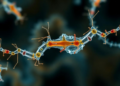
Credit: The Grainger College of Engineering
Thanks to a team of researchers from the University of Illinois at Urbana-Champaign and the University of Massachusetts Amherst, scientists are able to read patterns on long chains of molecules to understand and predict behavior of disordered strands of proteins and polymers. The results could, among other things, pave the way to develop new materials from synthetic polymers.
The lab of Charles Sing, assistant professor of chemical and biomolecular engineering at Illinois, provided the theory behind the discovery, which was then verified through experiments conducted in the lab of Sarah Perry, assistant professor of chemical engineering at UMass Amherst, and Illinois alumna. The collaborators detailed their findings in a paper titled “Designing Electrostatic Interactions via Polyelectrolyte Monomer Sequence” published in ACS (American Chemical Society) Central Science.
The colleagues set out to understand the physics behind the precise sequence of charged monomers along the chain and how it affects the polymer’s ability to create self-assembling liquid materials called complex coacervates.
“The thing that I think is exciting about this work is that we’re taking inspiration from a biological system,” Sing said. “The typical picture of a protein shows that it folds into a very precise structure. This system, however, is based around intrinsically disordered proteins.”
This paper builds on earlier findings from Perry and Sing from 2017, which ultimately aims to help advance smart material design.
“Our earlier paper showed that these sequences matter, this one shows why they matter,” Sing explained. “The first showed that different sequences give different properties in complex coacervation. What we’re able to now do is use a theory to actually predict why they behave this way.”
Unlike structured proteins, which interact with very specific binding partners, most synthetic polymers do not.
“They are fuzzier in that they will react with a wide range of molecules in their surroundings,” Sing explained.
They found that despite this fact, the precise sequence of the monomers along a protein (the amino acids) really does make a difference.
“It has been obvious to biophysicists that sequence makes a big difference if they are forming a very precise structure,” Sing said. “As it turns out, it also makes a big difference if they are forming imprecise structures.”
Even unstructured proteins have a precision associated with them. Monomers, the building blocks of complex molecules, are the links to the chain. What Sing’s group theorized is that by knowing the sequence of polymers and monomers and the charge (positive, negative or neutral) associated with them, one can predict the physical properties of the complex molecules.
“While researchers have known that if they put different charges different places in one of these intrinsically disordered proteins, the actual thermodynamic properties change,” Sing said.
“What we are able to show is that you can actually change the strength of this by changing it on the sequence very specifically. There are cases here that by changing the sequence by just a single monomer (a single link in that chain), it can drastically change how these things are able to form. We have also proven that we can predict the outcome.”
Sing adds that this information is valuable to biophysicists, bioengineers and material scientists alike. This discovery will help engineers understand a broad class of proteins and tune proteins to modify their behavior. It gives them a new way to put information into molecules for building new materials and make a better guess as to how these properties behave.
Materials scientists can, for example, use this information to have a level of control over a material to cause it to assemble into very complicated structures or make membranes that precisely filter out contaminants in water. Their hope is that scientists, inspired by biopolymers, can take this ability to predict the physical behaviors simply by reading the sequence to ultimately design new smart materials this way.
“This in some sense is bringing biology and synthetic polymers closer together,” Sing said. “For example, at the end of the day, there is not a major difference in the chemistry between proteins and nylon. Biology is using that information to instruct how life happens. If you can put in the identify of these various links specifically, that’s valuable information for a number of other applications.”
###
Media Contact
Charles Sing
[email protected]
Original Source
https:/
Related Journal Article
http://dx.