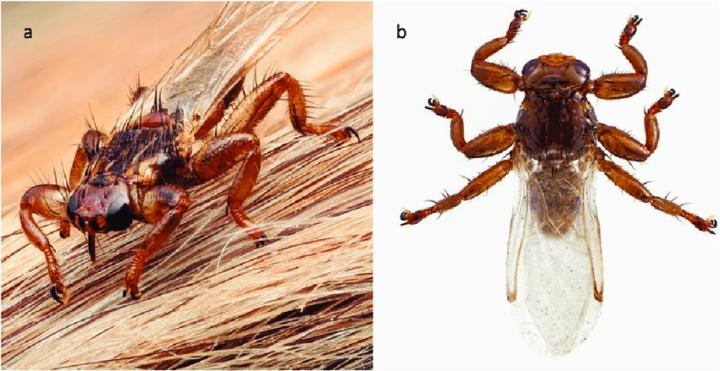
(a) Lipoptena cervi
With flattened bodies, grabbing forelegs and deciduous wings, deer keds do not look like your typical fly. These parasites of deer — which occasionally bite humans — are more widely distributed across the U.S. than previously thought, according to Penn State entomologists, who caution that deer keds may transmit disease-causing bacteria.
“It was more or less known where deer keds are found, but very broadly,” said Michael Skvarla, extension educator and director of the Insect Identification Lab in the Department of Entomology at Penn State. “We don’t know if deer keds transmit pathogens (disease-causing microorganisms), but if they do, then knowing where they are at more precisely could be important in terms of telling people to watch out for them.”
The researchers collated records of the four North American deer ked species and produced the most detailed locality map of these flies to date, documenting ten new state and 122 new county records. The researchers published their results in a recent issue of the Journal of Medical Entomology. They also provided an illustrated species-identification key.
The team harnessed citizen science — collection of data by the public — to gather deer ked records from the U.S. and Canada. In addition to scouring museum databases and community websites like BugGuide and iNaturalist, the team distributed deer ked collection kits to hunters as part of the Pennsylvania Parasite Hunters community project. The researchers also collected flies directly from carcasses at Pennsylvanian deer butcheries.
“I really like using citizen science information,” said Skvarla. “It often fills in a lot of gaps because people are taking photographs in places that entomologists may not be going. Deer keds are the perfect candidate for citizen science. They’re easy to identify because there’s only four species in the country and because they’re mostly geographically separated. And as flat, parasitic flies, they’re really distinctive. You couldn’t do this with a lot of insect groups because they’d be too difficult to identify from photographs.”
The European deer ked, Lipoptena cervi, thought to have been introduced from Europe, previously was reported to occur throughout the Northeast region. The researchers newly report this species from Connecticut, Rhode Island, Vermont, and as far south as Virginia. In Pennsylvania, it occurs throughout the state, with 26 new county records.
The researchers also describe new records of the neotropical deer ked, L. mazamae, from North Carolina, Tennessee and Missouri — increasing its range further north and east than had previously been reported.
In western North America, two deer ked species, L. depressa and Neolipoptena ferrisi, are found from British Columbia through the U.S. and into Mexico — and as far east as South Dakota. The researchers newly report these species from Nevada and Idaho.
Deer keds are usually found on deer, elk and moose, but occasionally bite humans and domestic mammals. Although several tick-borne pathogens — including bacteria that cause Lyme disease, cat scratch fever and anaplasmosis — have been detected in deer keds, it is unknown whether they can be transmitted through bites.
“In Pennsylvania you have a lot of hunters,” said Skvarla. “Deer keds can run up your arm while you’re field dressing a deer and bite you. If these insects are picking up pathogens from deer, they could transmit them to hunters. With two million hunters in the state, that’s not an insignificant portion of the population. We don’t want to scare people, but people should be aware there is the potential for deer keds to transmit pathogens that can cause disease.”
The researchers will next screen hundreds of deer keds for pathogens. They will also dissect some insects to screen the salivary glands and guts separately. According to Skvarla, this approach will give a good indication of whether deer keds could transmit pathogens through bites, or whether the bacteria are merely passed through the gut after a blood meal.
In Pennsylvania, after deer keds emerge from the soil each fall, they fly to a host and immediately shed their wings, usually remaining on the same host for life. Females produce just one egg at a time — it hatches inside her, and she feeds the growing larva with a milk-like substance. When the larva is almost fully developed, it drops to the soil and forms a pupa, eventually emerging as a winged adult. If disease-causing bacteria are transmitted from mother to offspring, newly emerged flies could pass on pathogens to hosts. Pathogens could also be spread when bacteria-harboring flies jump between animals in close contact.
###
The other researcher working on this project was Erika Machtinger, assistant professor of entomology at Penn State.
Media Contact
Andrea Elyse Messer
[email protected]