• HOME
  • NEWS
  • EXPLORE
    • CAREER
      • Companies
      • Jobs
    • EVENTS
    • iGEM
      • News
      • Team
    • PHOTOS
    • VIDEO
    • WIKI
  • BLOG
  • COMMUNITY
    • FACEBOOK
    • INSTAGRAM
    • TWITTER
Friday, December 26, 2025
BIOENGINEER.ORG
No Result
View All Result
  • Login
  • HOME
  • NEWS
  • EXPLORE
    • CAREER
      • Companies
      • Jobs
        • Lecturer
        • PhD Studentship
        • Postdoc
        • Research Assistant
    • EVENTS
    • iGEM
      • News
      • Team
    • PHOTOS
    • VIDEO
    • WIKI
  • BLOG
  • COMMUNITY
    • FACEBOOK
    • INSTAGRAM
    • TWITTER
  • HOME
  • NEWS
  • EXPLORE
    • CAREER
      • Companies
      • Jobs
        • Lecturer
        • PhD Studentship
        • Postdoc
        • Research Assistant
    • EVENTS
    • iGEM
      • News
      • Team
    • PHOTOS
    • VIDEO
    • WIKI
  • BLOG
  • COMMUNITY
    • FACEBOOK
    • INSTAGRAM
    • TWITTER
No Result
View All Result
Bioengineer.org
No Result
View All Result
Home NEWS Science News Chemistry

NICER’s night moves trace the X-ray sky

Bioengineer by Bioengineer
May 30, 2019
in Chemistry
Reading Time: 2 mins read
0
IMAGE
Share on FacebookShare on TwitterShare on LinkedinShare on RedditShare on Telegram

IMAGE

Credit: NASA/NICER

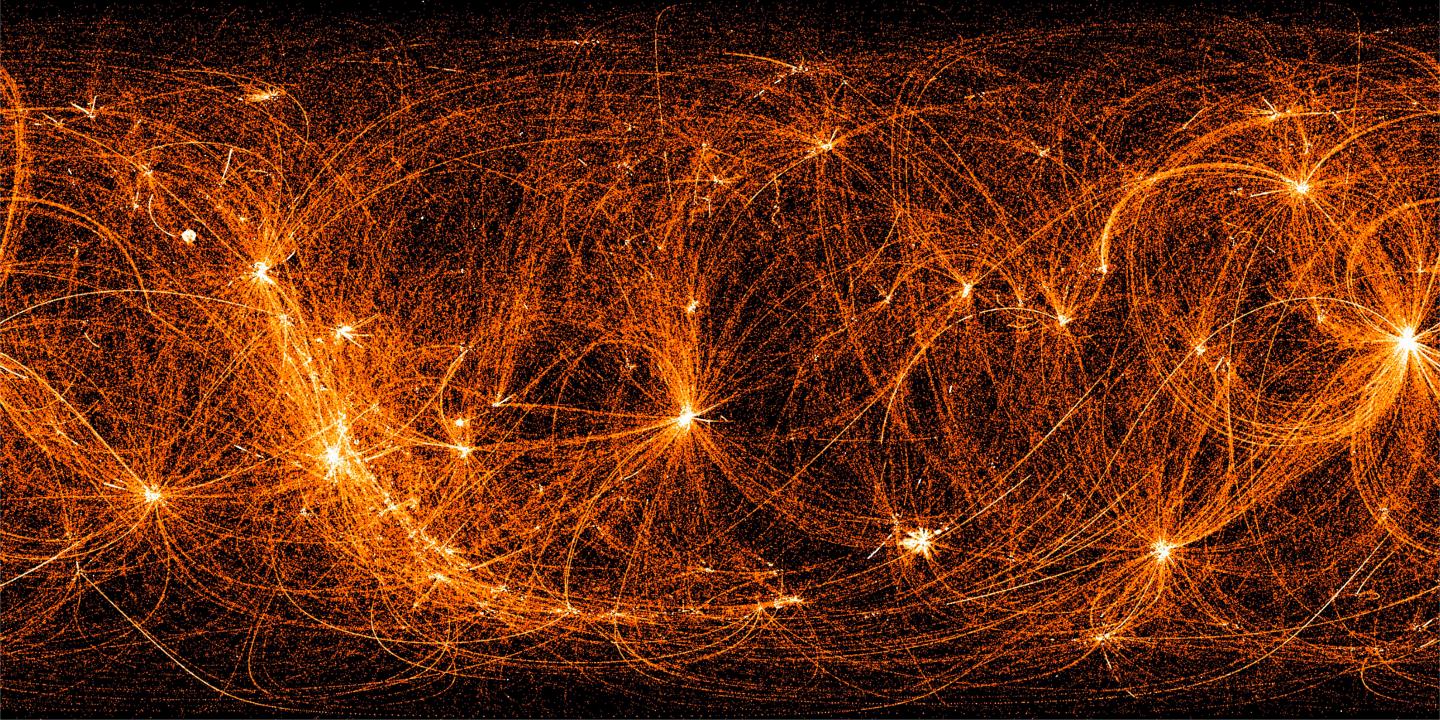
In this image, numerous sweeping arcs seem to congregate at various bright regions. You may wonder: What is being shown? Air traffic routes? Information moving around the global internet? Magnetic fields looping across active areas on the Sun?

In fact, this is a map of the entire sky in X-rays recorded by NASA’s Neutron star Interior Composition Explorer (NICER), a payload on the International Space Station. NICER’s primary science goals require that it target and track cosmic sources as the station orbits Earth every 93 minutes. But when the Sun sets and night falls on the orbital outpost, the NICER team keeps its detectors active while the payload slews from one target to another, which can occur up to eight times each orbit.

The map includes data from the first 22 months of NICER’s science operations. Each arc traces X-rays, as well as occasional strikes from energetic particles, captured during NICER’s night moves. The brightness of each point in the image is a result of these contributions as well as the time NICER has spent looking in that direction. A diffuse glow permeates the X-ray sky even far from bright sources.

The prominent arcs form because NICER often follows the same paths between targets. The arcs converge on bright spots representing NICER’s most popular destinations — the locations of important X-ray sources the mission regularly monitors.

“Even with minimal processing, this image reveals the Cygnus Loop, a supernova remnant about 90 light-years across and thought to be 5,000 to 8,000 years old,” said Keith Gendreau, the mission’s principal investigator at NASA’s Goddard Space Flight Center in Greenbelt, Maryland. “We’re gradually building up a new X-ray image of the whole sky, and it’s possible NICER’s nighttime sweeps will uncover previously unknown sources.”

NICER’s primary mission is to determine the size of dense remains of dead stars called neutron stars — some of which we see as pulsars — to a precision of 5%. These measurements will finally allow physicists to solve the mystery of what form of matter exists in their incredibly compressed cores. Pulsars, rapidly spinning neutron stars that appear to “pulse” bright light, are ideally suited to this “mass-radius” research and are some of NICER’s regular targets.

Other frequently visited pulsars are studied as part of NICER’s Station Explorer for X-ray Timing and Navigation Technology (SEXTANT) experiment, which uses the precise timing of pulsar X-ray pulses to autonomously determine NICER’s position and speed in space. It’s essentially a galactic GPS system. When mature, this technology will enable spacecraft to navigate themselves throughout the solar system — and beyond.

###

Media Contact
Claire Andreoli
[email protected]

Original Source

https://www.nasa.gov/feature/goddard/2019/nicer-s-night-moves-trace-the-x-ray-sky

Tags: AstronomyAstrophysicsSatellite Missions/ShuttlesSpace/Planetary ScienceStars/The Sun
Share15Tweet9Share2ShareShareShare2

Related Posts

Cutting Electrolyte Reduction Boosts High-Energy Battery Performance

Cutting Electrolyte Reduction Boosts High-Energy Battery Performance

December 19, 2025
Microenvironment Shapes Gold-Catalysed CO2 Electroreduction

Microenvironment Shapes Gold-Catalysed CO2 Electroreduction

December 11, 2025

Photoswitchable Olefins Enable Controlled Polymerization

December 11, 2025

Cation Hydration Entropy Controls Chloride Ion Diffusion

December 10, 2025
Please login to join discussion

POPULAR NEWS

  • Nurses’ Views on Online Learning: Effects on Performance

    Nurses’ Views on Online Learning: Effects on Performance

    70 shares
    Share 28 Tweet 18
  • NSF funds machine-learning research at UNO and UNL to study energy requirements of walking in older adults

    71 shares
    Share 28 Tweet 18
  • Unraveling Levofloxacin’s Impact on Brain Function

    54 shares
    Share 22 Tweet 14
  • Exploring Audiology Accessibility in Johannesburg, South Africa

    51 shares
    Share 20 Tweet 13

About

We bring you the latest biotechnology news from best research centers and universities around the world. Check our website.

Follow us

Recent News

AKR1C1’s Crucial Role in Pancreatic Cancer Progression

DLK1-MEG3 Methylation Linked to Small Gestational Age

Rethinking Steroid Use in Cancer Treatment

Subscribe to Blog via Email

Enter your email address to subscribe to this blog and receive notifications of new posts by email.

Join 71 other subscribers
  • Contact Us

Bioengineer.org © Copyright 2023 All Rights Reserved.

Welcome Back!

Login to your account below

Forgotten Password?

Retrieve your password

Please enter your username or email address to reset your password.

Log In
No Result
View All Result
  • Homepages
    • Home Page 1
    • Home Page 2
  • News
  • National
  • Business
  • Health
  • Lifestyle
  • Science

Bioengineer.org © Copyright 2023 All Rights Reserved.