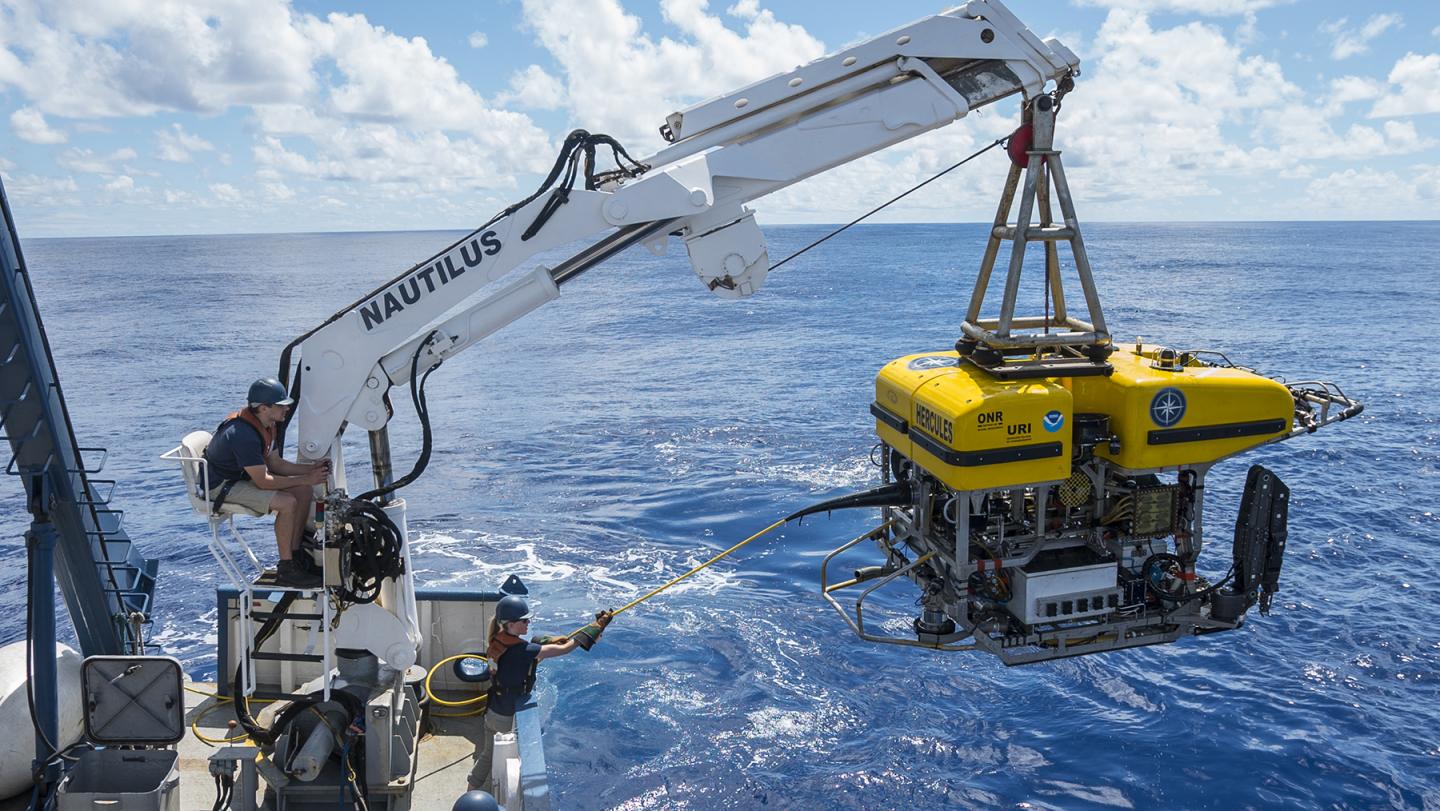
Credit: Erin Ranney/Ocean Exploration Trust
KINGSTON, R.I. — May 29, 2019 — Scientists with a NASA-led expedition are operating from the Inner Space Center at the University of Rhode Island’s Graduate School of Oceanography as colleagues explore the deep Pacific Ocean to prepare to search for life in deep space.
The SUBSEA (Systematic Underwater Biogeochemical Science and Exploration Analog) research program is a partnership among NASA’s Ames Research Center in Silicon Valley, the National Oceanic and Atmospheric Administration’s Office of Ocean Exploration and Research, Woods Hole Oceanographic Institution, the Ocean Exploration Trust and various academic centers that blend ocean and space research to better understand if the watery worlds found on moons and planets in our solar system offer conditions that could support microbial life.
Last year, the SUBSEA shipboard team used remotely operated vehicles (ROVs) deployed from the Ocean Exploration Trust’s E/V Nautilus to explore Lō’ihi Seamount, an underwater volcano off the southeastern coast of the Big Island of Hawaii. The type of hydrothermal venting at the Lō’ihi Seamount is a good representation of conditions scientists believe exist on certain moons in the outer solar system. The onshore NASA team, stationed in Mission Control at the Inner Space Center, learned how scientists and engineers communicate science objectives via telepresence.
The NASA team returns to the Inner Space Center through June 8 to test specialized mission-planning software as part of NASA’s long-term strategy for achieving extended human presence in deep-space. Scientists will study the work practices, habits, communication and information flows necessary to conduct remote science and exploration by observing operations conducted by the SUBSEA teams on the E/V Nautilus and at the Inner Space Center.
“The m+ost important role of the Inner Space Center for the SUBSEA project is to help NASA learn how to use telepresence for ocean exploration as an analog to how it may be used for space exploration,” said Dwight Coleman, director of the Inner Space Center.
SUBSEA researchers aboard E/V Nautilus will conduct field programs at the Gorda Ridge offshore of northern California and Oregon. This section of mid-ocean ridge is of interest to ocean researchers because it is home to seafloor hydrothermal activity that departs from the convention of black smoker hydrothermal systems, instead emitting clear fluids from the seafloor.
The public will be able to watch exploration of the seafloor via 24/7 live stream at http://www.
A human-robotic voyage to the moon or Mars might parallel SUBSEA’s mission architecture using robotic explorers controlled by humans nearby as directed by a remote team of scientists. Using the Inner Space Center’s cutting edge technology — including telepresence — for ocean research, exploration and education, the SUBSEA team will be able to test, evaluate and improve the necessary processes and technology tools needed for deep space exploration.
Ultimately, the results of SUBSEA’s research will inform strategies for conducting science via tele-operations at destinations in space as well as scientists’ understanding of a wider range of deep-sea environments for conducting ocean research.
“The Inner Space Center is the world leader in supporting telepresence-based ocean exploration missions, so we’re excited to serve as a base of operations for this groundbreaking project,” said Coleman.
###
The SUBSEA Gorda Ridge Expedition aboard Exploration Vessel Nautilus is funded by NOAA’s Office of Ocean Exploration and Research (OER) and the NASA PSTAR program, and is a collaboration among Ocean Exploration Trust, NASA Ames Research Center in Silicon Valley, and NOAA OER to foster collaboration between ocean and space exploration teams.
Media Contact
Peter Hanlon
[email protected]
Original Source
https:/