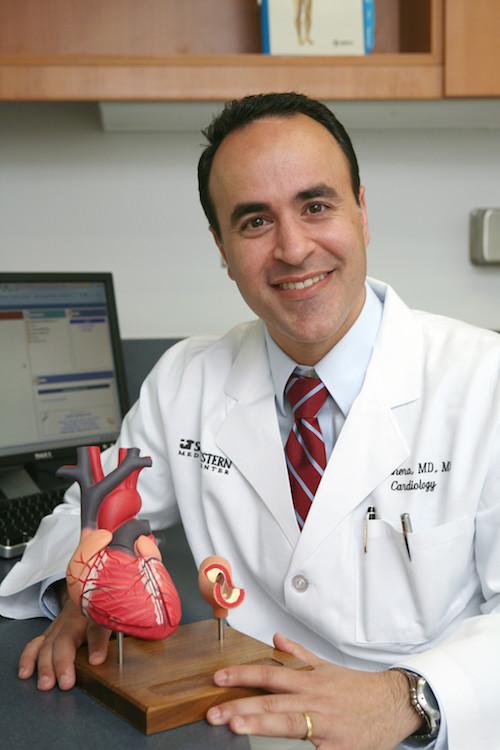
Credit: UTSW
DALLAS – May 22, 2019 – What if your blood donation held clues to a dangerous genetic cholesterol condition that could also affect the health of your loved ones?
Cardiologists know that familial hypercholesterolemia (FH), a condition that causes extremely high levels of cholesterol at an early age, is genetic. When one person is diagnosed, other family members can be identified. However, only an estimated 10 percent of those with FH are diagnosed, leaving many others at risk.
“For someone with FH, the risk of heart disease is higher because their clock started early. They’ve been bathed in high cholesterol since birth. At the same time, they may not know their kids are at risk,” said preventive cardiologist Dr. Amit Khera, Principal Investigator for the study and Professor of Internal Medicine at UT Southwestern Medical Center. “Sometimes by identifying one patient with FH, we find as many as eight or 10 more family members who are at risk.”
Related Story
Two lifesaving discoveries help four generations of women
The study published in JAMA Cardiology concludes that blood donation programs represent a unique opportunity as a public health portal to screen for diseases such as FH. According to the American Association of Blood Banks (AABB), approximately 6.8 million people in the U.S. donate blood every year, and 32.3 percent are first-time donors.
Up to 1.2 million people in the U.S. are estimated to have FH. If children are suspected to have the disease FH based upon their family history, then testing for FH begins at age 2. The standard treatment is diet and exercise, followed by the addition of statins in later childhood. Statins are a product of Nobel Prize-winning research on FH led by esteemed UT Southwestern molecular geneticists in the 1980s.
People who are at risk must first be identified in order to receive treatment. Dr. Khera decided to try examining blood donation records to find people who appear to have FH, but are less likely to see a doctor or receive statins.
“Blood donors are young, healthy, and may have less necessity to see doctors regularly,” said Dr. Khera, who holds the Dallas Heart Ball Chair in Hypertension and Heart Disease.
His team worked closely with Carter BloodCare in Dallas to review 1,178,102 individual blood donation records. They found 3,473 people who met criteria for FH based on their cholesterol levels, similar to the estimated prevalence in the general population. It was more common in blood donors under the age of 30, and for men versus women. There was no significant difference by race except for Asian donors who had a slightly higher prevalence.
The UT Southwestern cardiology team plans to develop a process for following up with people who are identified, connecting them with the appropriate medical care including family screening, and to continue studying the effectiveness of these interventions.
Anyone with a cholesterol level higher than 200 should see a physician for review of their family history, a full cholesterol panel (blood test), and a physical exam. The exam can identify the disease through visible signs such as cholesterol deposits in tendons, called xanthomas.
“The blood donor screening program could be a novel strategy to detect and notify people with potential FH, particularly younger people in whom early detection and treatment is especially impactful, as well as to guide screening of family members,” said Dr. Khera.
###
Other UT Southwestern researchers who contributed to the study include: Dr. James Z. Keeton, UTSW resident; Dr. Zahid Ahmad, Associate Professor of Internal Medicine; Colby R. Ayers, Faculty Associate in Internal Medicine; Dr. Merlyn Sayers, Professor of Pathology; and Dr. Darren K. McGuire, Professor of Internal Medicine. Dr. McGuire is a Distinguished Teaching Professor and holds the Dallas Heart Ball Chair for Research on Heart Disease in Women.
About UT Southwestern Medical Center
UT Southwestern, one of the premier academic medical centers in the nation, integrates pioneering biomedical research with exceptional clinical care and education. The institution’s faculty has received six Nobel Prizes, and includes 22 members of the National Academy of Sciences, 17 members of the National Academy of Medicine, and 15 Howard Hughes Medical Institute Investigators. The full-time faculty of more than 2,500 is responsible for groundbreaking medical advances and is committed to translating science-driven research quickly to new clinical treatments. UT Southwestern physicians provide care in about 80 specialties to more than 105,000 hospitalized patients, nearly 370,000 emergency room cases, and oversee approximately 3 million outpatient visits a year.
Media Contact
Lori Soderbergh
[email protected]
Original Source
https:/
Related Journal Article
http://dx.