Novel approach to the development of treatments for optic neuropathies
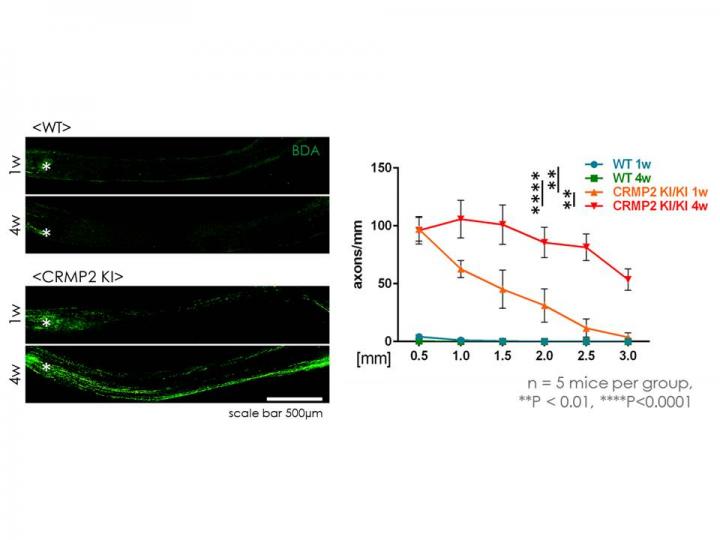
Credit: Ohshima Laboratory, Waseda University
A new study by Professor Toshio Ohshima of Waseda University has found that the inhibition of phosphorylation of collapsing response mediator protein 2 (CRMP2), a microtubule-binding protein, suppresses degeneration of nerve fibers and promotes its regeneration after optic nerve injury.
The findings of this study, recently published online in Scientific Reports, could be translated into the development of novel treatments for patients with optic neuropathies, such as traumatic injury and glaucoma.
When diagnosed with glaucoma, blind spots develop in the visual field and could lead to blindness as the optic nerve deteriorates. Such deterioration and loss of function of nerve fibers, or axonal degeneration, also occur in traumatic nerve injury and neurological diseases, such as Alzheimer’s disease and ALS. Currently, methods for completely repairing the retina, spinal cord, and other parts of the central nervous system after injury or degeneration do not exist because axonal regeneration is restricted by inhibitory factors.
In past studies, potential mechanisms which inhibit axonal regeneration have been found, and addressing these mechanisms were thought to bring scientists a step closer in developing new therapeutics for damages to the central nervous system.
The CRMP2 protein molecule functions to stabilize microtubules, which provide structural support for the central nervous system at the neuronal cellular level and promote polymerization by binding to tubulin dimers. However, these functions are prevented by various kinases through phosphorylation, a mechanism regulating neuronal proteins.
“In our previous study, what we did was to develop CRMP2 knock-in mice and genetically inhibit its CRMP2 phosphorylation,” explains Professor Ohshima. “As a result, the CRMP2 knock-in mice showed promotion of axonal regeneration after a spinal cord injury. From this, we hypothesized that the same phenomenon could also be observed after optic nerve injury.”
To investigate, the scientists compared the degeneration and regeneration of the optic nerve between wildtype and CRMP2 knock-in mice after an optic nerve injury introduced by an optic nerve crush, a procedure in which the left optic nerve was exposed and crushed for 5 seconds with a tweezer at a site approximately 1mm behind the eye’s globe. They found that destabilization and depolymerization of microtubules after an optic nerve crush injury was suppressed in CRMP2 knock-in mice, and the loss of retinal ganglion cells, the projection neuron of the eye, was also reduced.
The research team also observed that the protein level of GAP43, a molecular marker for axonal regeneration, was higher in the optic nerve from CRMP2 knock-in mice than that from wildtype mice 4 weeks after the optic nerve crush. Additionally, the number of axons increased in the optic nerve after the optic nerve crush in CRMP2 knock-in mice.
“Our experimental data indicate that inhibition of CRMP2 phosphorylation will be a novel approach to the development of treatments for human optic nerve injuries, but further study will be necessary for practical application,” says Professor Ohshima.
“For instance, some studies suggest that CRMP2 phosphorylation plays a role in forming myelin, an important substance for sufficient functional recovery of regenerated axons. Additional treatment to facilitate myelination will be required to realize functional recovery after optic nerve injury.”
###
Article information
Title: “Genetic inhibition of CRMP2 phosphorylation at serine 522 promotes axonal regeneration after optic nerve injury”
DOI: 10.1038/s41598-019-43658-w
Authors: Shunsuke Kondo, Kazuya Takahashi, Yuki Kinoshita, Jun Nagai, Shuji Wakatsuki, Toshiyuki Araki, Yoshio Goshima, Toshio Ohshima
Journal: Scientific Reports
Article in the university news
About Waseda University
Located in the heart of Tokyo, Waseda University is a leading private research university which has long been dedicated to academic excellence, innovative research and civic engagement at both the local and global levels since 1882. Today, the student body at Waseda is approximately 50,000, over 7,900 of whom are from overseas, hailing from 125 countries. To learn more about Waseda University, visit https:/
Media Contact
Jasper Lam
[email protected]
Original Source
https:/
Related Journal Article
http://dx.