Scientists at the Swedish Museum of Natural History have begun compiling an atlas of fossils in volcanic rock, to guide where and what to look for in the search for Martian life
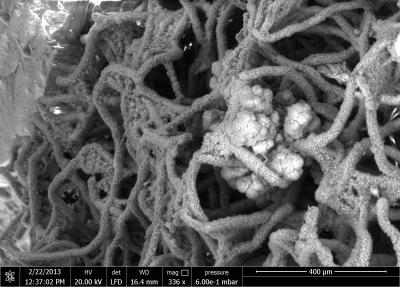
Credit: Dr. Magnus Ivarsson
In 2020, NASA and European-Russian missions will look for evidence of past life on Mars. But while volcanic, igneous rock predominates on the Red Planet, virtually the entire Earth fossil record comes from sedimentary rocks.
Addressing the problem in Frontiers in Earth Science, Swedish scientists have begun compiling evidence of fossilized microbes in underexplored igneous rock environments on Earth, to help guide where to search for a Martian fossil record – and what to look for.
“We propose a ‘volcanic microfossil atlas’ to help select target sites for missions seeking evidence of extraterrestrial life, such as the NASA Mars mission 2020 and ExoMars,” says lead author Dr. Magnus Ivarsson. “The atlas could also help us recognize what Mars microfossils might look like, by identifying biosignatures associated with different types of fossilized microbes.”
Earth’s deep biosphere
Ivarsson and colleagues study life buried in deep rock and deep time: fossilized remains of mysterious microbes, that have lived up to a kilometer below the deepest ocean floors for as long as 3.5 billion years.
“The majority of the microorganisms on Earth are believed to exist in the deep biosphere of the ocean and continental crust,” reveals Ivarsson. “Yet we are just now beginning to explore – through deep drilling projects – this hidden biosphere.”
In a watery world that never sees sunlight, bacteria, fungi and other microbes have adapted to feed on the igneous rock that surrounds them – or even on each other. They spread through micro-fractures and cavities, forming complex and extended communities.
“Upon death, the microbial communities become fossilized on the walls of their rocky home. These microfossils can provide a history of microbial life in volcanic rock.”
A volcanic microfossil atlas
Crucially, Earth’s oceanic crust is geochemically very similar to the volcanic rocks that dominate the Martian landscape.
“Our aim is to be able to use the oceanic crust microfossil record as a model system to guide Martian exploration,” Ivarsson explains. “Our review of existing knowledge is an important first step, but a more comprehensive understanding of the deep life is needed to show where and what to search for.”
To achieve this, says Ivarsson, we need to collect more data on microfossil appearance and location – but also, on their chemical composition.
“These fossils often preserve immense morphological detail. For example, we can distinguish broad classes of fungi through the appearance of spores, fruiting bodies, mycelia and other growth states – or of bacteria, through the presence of cauliflower-like formations, generations of biofilms preserved as laminated sheets, and other characteristic community structures.
“But analysis of lipids and carbon isotopes in microfossils will make it possible to discriminate more precise groups based on their metabolism.
“Altogether this information will help to identify which types of microorganism are most likely to have been preserved on Mars, and which geochemical conditions most favour fossilization.”
A fossil record on Mars
The microfossil atlas would therefore also help to determine which samples should be targeted for return to Earth, given the limited payload of the Mars missions.
“Both NASA’s Mars 2020 and the ExoMars missions are capable of detecting larger fossilized structures from volcanic rocks, such as mm-sized mineralized fungal mycelia, or larger microstromatolites in open vesicles.
“ExoMars’s 8 micrometer/pixel cameras have a greater chance of identifying small features and individual hyphae in situ on Mars. However, the NASA mission has the possibility of collecting samples for later investigation on Earth, and its 15 micrometer/px cameras may therefore be sufficient select samples with a high probability of containing biosignatures. These complimentary strategies increase the overall chance of detecting evidence of past life on Mars, if it exists,” concludes Ivarsson.
###
Please link to the original research article in your reporting:
https:/
Frontiers is an award-winning Open Science platform and leading open-access scholarly publisher. Our mission is to make high-quality, peer-reviewed research articles rapidly and freely available to everybody in the world, thereby accelerating scientific and technological innovation, societal progress and economic growth. Frontiers received the 2014 ALPSP Gold Award for Innovation in Publishing. For more information, visit http://www.
follow @Frontiersin on Twitter.
Media Contact
Matt Prior
[email protected]
Original Source
https:/
Related Journal Article
http://dx.